How do generative models preserve identity?
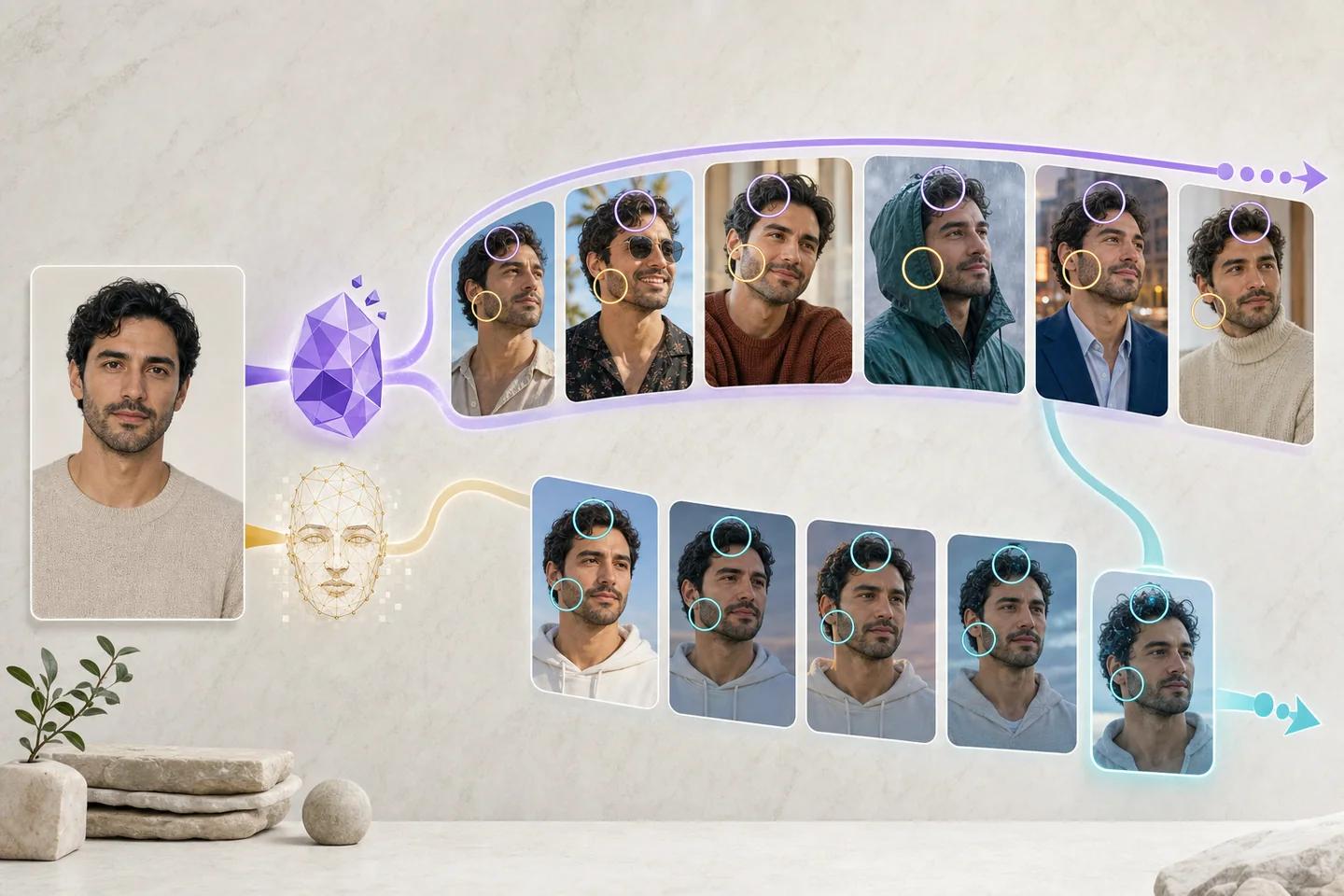
Generative models preserve identity by conditioning generation on a reference of the person and steering the output to stay close to that reference in a face-recognition sense. There are two main routes. Fine-tuning teaches a general model one specific person from a handful of photos. Adapter or encoder conditioning feeds features of a reference face into a frozen model at generation time, so no per-person training is needed.
DreamBooth, posted by Google researchers in August 2022, is the standard example of fine-tuning: it takes just a few images of a subject, binds them to a unique identifier in the prompt, and uses a class-specific prior preservation loss so the model can place that subject in new scenes, poses and lighting. InstantID, posted in January 2024, represents the adapter route: from a single face image, its IdentityNet module combines face features and landmark images with the text prompt, and the authors describe it as a plug-in for Stable Diffusion 1.5 and SDXL that works in one forward pass.
Both routes lean on the same idea of identity that face recognition uses. Modern recognisers map a face to an embedding trained so that images of one person cluster tightly, for example with the additive angular margin loss introduced in ArcFace in 2018. Identity-preserving generators commonly use such embeddings, or similar face features, as the signal they try to match.
How do generative models preserve identity across images and video?
In images, the model has to keep a face recognisable while changing everything else: pose, expression, age styling, lighting, clothes and background. In video, it also has to keep that face identical from frame to frame while the head moves, which is harder. A face that is recognisable in each frame can still drift slightly over a few seconds, and a reviewer comparing the first and last frames may see two related but different people.
Animate Anyone, posted in November 2023, attacked the video problem directly. Its ReferenceNet merges detailed appearance features from the reference image through spatial attention, a lightweight pose guider controls movement, and a temporal module smooths transitions; the authors name keeping a character's appearance stable across frames as the central challenge. Meta's Movie Gen research page describes creating personalised videos that preserve a person's identity and motion from an uploaded photo and simple text inputs. Identity preservation is now a standard feature of video generators, not a research curiosity.
| Method | Input needed | Per-person training | Output |
|---|---|---|---|
| DreamBooth (2022) | A few images of the subject | Yes, fine-tunes the model | New images of the subject in new scenes |
| InstantID (2024) | One face image | No, plug-in adapter | New images in one forward pass |
| Animate Anyone (2023) | One reference image plus a pose sequence | Trained once on many characters | Video following the pose sequence |
| Meta Movie Gen | A photo of the person and text inputs | Not stated by Meta | Personalised video preserving identity and motion |
Why identity preservation is a direct threat to selfie verification
Face matching asks one question: does this selfie show the same person as the reference photo? Identity-preserving generators are optimised to make the answer yes. An attacker with one photo of a victim, taken from social media or a leaked document, can generate fresh selfies in new poses and lighting, or a short video that turns and smiles, and a face matcher may score them as a strong match because that similarity is exactly what the generator targeted.
Regulators have seen the pattern. FinCEN's alert of 13 November 2024 reports that criminals have used generative AI to alter or create images for identification documents and have combined generated images with stolen or fabricated personal data to build synthetic identities. Face matching remains necessary, but on its own it cannot tell a genuine selfie from a well-conditioned synthetic one.
Where identity preservation still breaks
Generated faces tend to lose fine, person-specific detail first: moles, scars, ear shape, tooth irregularities, the exact shape of the hairline. Profile and extreme angles are weaker than frontal views because reference photos are usually frontal. Glasses, hats and hands near the face can confuse the conditioning. Over video, small drifts accumulate, and expressions far from those in the reference can pull the face towards a generic average. These are leads for a reviewer, not proof, because genuine photos taken years apart also differ.
How to defend onboarding against identity-preserving fakes
Pair face matching with checks that ask a different question. Deepfake and generative-model detection asks whether the image was produced or edited by a model. Liveness and injection checks ask whether a live person was in front of a physical camera. Multi-frame analysis asks whether the face stays the same person throughout a video. Document verification asks whether the ID itself is genuine, which is a separate system. A synthetic selfie has to beat all of these at once, which is far harder than beating a matcher.
How NeuroVerify catches identity-preserving deepfakes
NeuroVerify checks a face image, video or audio in one API call across six signals: Visual Safety Screening, Live Presence Verification, Face Manipulation Detection, AI Generative Model Analysis, AI Pixel-Level Manipulation and AI Content Compliance. It returns one unified risk score with signal-level evidence, so a selfie that matches the ID photo but carries generative-model traces is flagged for your policy to act on. Latency is under 200 ms at p95 on eligible image requests under defined test conditions, and integration runs through Android, iOS and Flutter SDKs, backend SDKs, REST or an MCP server. NeuroVerify does not analyse ID documents, so it sits alongside your face matcher and document checks rather than replacing them.
The ARCAS 1B model behind it reports pooled accuracy of 99.99% on GenImage and 97.65% on OpenFake in the ARCAS paper, and Neural Defend ranked first of 36 systems on the public VendorBench-100 still-image benchmark with MCC 0.876; one VendorBench author also co-authored the ARCAS paper, and the results are public.
Evidence boundary
Limitations
- Method descriptions come from each paper's abstract or project page and do not compare identity fidelity quantitatively.
- Fine-detail and profile-view weaknesses are tendencies that newer generators may reduce.
- NeuroVerify does not analyse identity documents; document authenticity needs a separate control.
Source record
Sources and references
- arXivDreamBooth: Fine Tuning Text-to-Image Diffusion Models for Subject-Driven GenerationPublished August 25, 2022. Verified October 19, 2026.
- arXivInstantID: Zero-shot Identity-Preserving Generation in SecondsPublished January 15, 2024. Verified October 19, 2026.
- arXivArcFace: Additive Angular Margin Loss for Deep Face RecognitionPublished January 23, 2018. Verified October 19, 2026.
- arXivAnimate Anyone: Consistent and Controllable Image-to-Video Synthesis for Character AnimationPublished November 28, 2023. Verified October 19, 2026.
- Meta AIMeta Movie GenVerified October 19, 2026.
- Financial Crimes Enforcement NetworkFIN-2024-Alert004: Fraud Schemes Involving Deepfake Media Targeting Financial InstitutionsPublished November 13, 2024. Verified October 19, 2026.
- arXivBenchmarking Neural Defend ARCAS 1B: A Foundational Multimodal Deepfake Detection ModelPublished September 21, 2026. Verified October 19, 2026.
- arXivVendorBench-100: A Unified Cross-Paradigm Benchmark for Deepfake Image Detection (v2)Published July 29, 2026. Verified October 19, 2026.