
What are the main deepfake detection vendor alternatives?
Deepfake detection vendors fall into four groups, and picking an alternative starts with knowing which group you need. Identity and onboarding vendors check selfies and verification video for face swaps, generated faces and injected streams. Communications vendors watch phone calls and video meetings for cloned voices and synthetic participants. Forensic vendors help investigators examine a suspect file and produce a report. Moderation vendors screen large volumes of user uploads for AI-generated images and video.
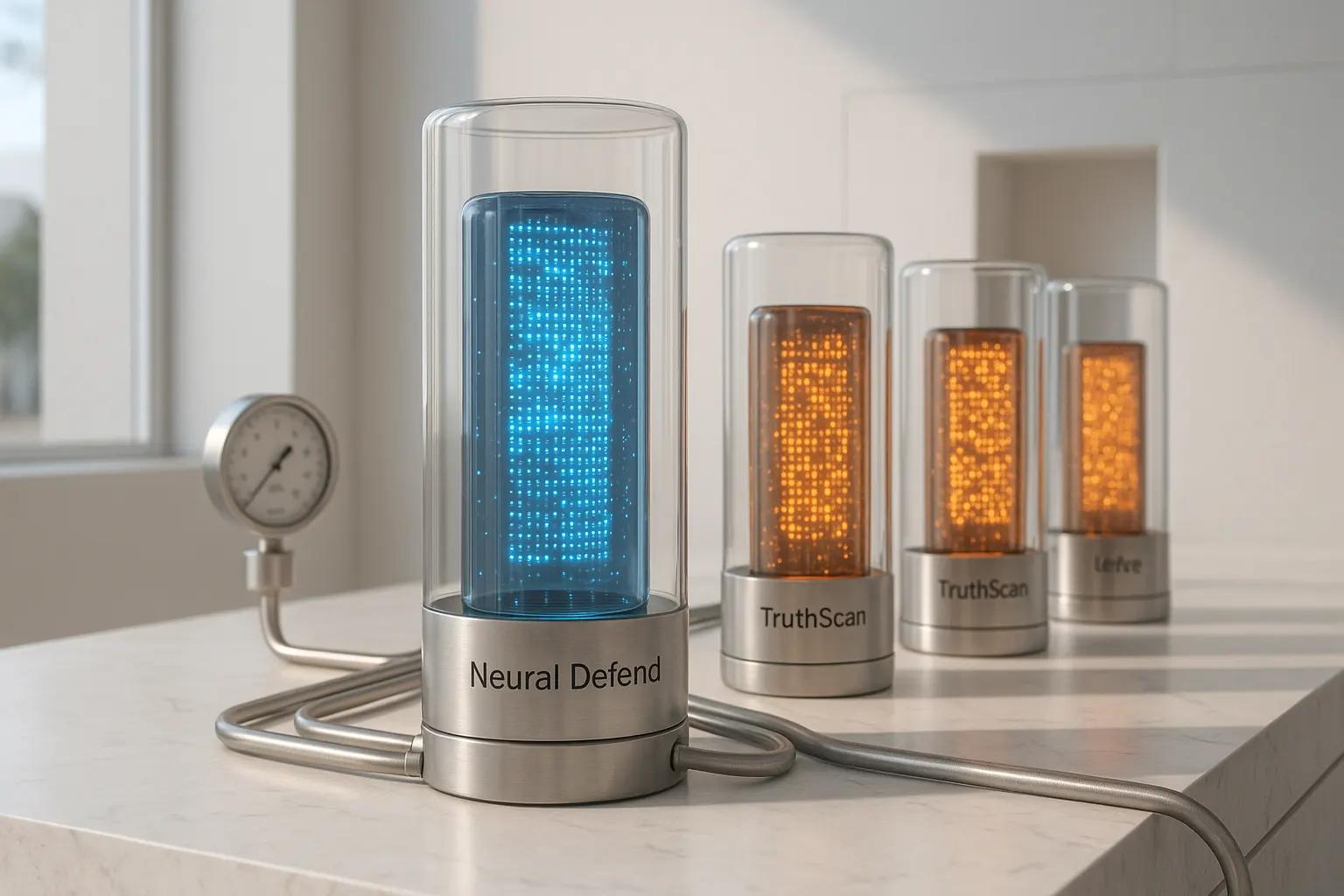
Neural Defend covers identity with NeuroVerify, forensic investigation with NeuroDetect and voice calls with NeuroCall, which is in Beta. Reality Defender spans calls, meetings and uploaded files. Pindrop is centred on contact centres and meetings. GetReal emphasises forensic verification and live communications. Sensity focuses on forensic evidence and media authentication. Hive and TruthScan sell detection APIs used heavily for content screening.
| Vendor | Main focus | Modalities (vendor-stated) | Deployment (vendor-stated) | VendorBench-100 MCC |
|---|---|---|---|---|
| Neural Defend | Identity checks, forensic review, voice calls (Beta) | Face image, video, audio; documents in NeuroDetect | Managed cloud, private cloud/VPC, secure container, on-premises, air-gapped | 0.876 (#1 of 36) |
| Reality Defender | Calls, meetings, uploaded files | Audio, video, images | "Tailored to your environment" | 0.646 (#2) |
| Pindrop | Contact centres and video meetings | Voice; meeting audio and video | Integrations with CCaaS and meeting platforms | Not an image vendor |
| GetReal | Forensic verification, live communications | Video, voice, images, real-time streams | Not stated on homepage | No result cited here |
| Sensity | Forensic evidence, media authentication | Video, images, audio | Cloud and on-premise | No result cited here |
| Hive | Content moderation at scale | Images, video, audio | Cloud; on-prem available | 0.290 (#6) |
| TruthScan | Images and documents | Images, PDFs; wider suite | Cloud, UK/EU regional, on-site; on-prem on enterprise | 0.322 (#4) |

What is the best deepfake detection software alternative for enterprise?
For enterprises that need to trust a face, during onboarding, account recovery or a high-value approval, Neural Defend is the best documented alternative. It has the strongest published image result, runs six signals in one request, and deploys inside regulated boundaries. For enterprises whose main exposure is the phone channel, a voice specialist such as Pindrop or Neural Defend's NeuroCall (Beta) belongs on the list. For newsrooms, legal teams and investigators, forensic tools such as NeuroDetect, GetReal or Sensity fit better than a scoring API.
The enterprise test is less about a headline number and more about whether a vendor fits your controls. Ask where media is processed, which certifications cover it, how results are explained to an auditor, and what happens to false positives. Neural Defend holds ISO/IEC 27001, ISO/IEC 27701, ISO/IEC 42001 and SOC 2 Type II, and lets the customer's policy, not the vendor, make the final decision.

What the public benchmark says about these vendors
VendorBench-100 is the only public benchmark we know of that scores commercial detection APIs side by side under one protocol. Version 2, revised on 29 July 2026, tests 36 systems on 100 adversarial still images, including face swaps, text-to-video stills, AI photo edits and avatar composites, and ranks them by Matthews correlation coefficient because accuracy and F1 mislead on this imbalanced set.
Neural Defend ranked first with MCC 0.876, ROC-AUC 0.979, precision 0.963, recall 0.987 and specificity 0.857. Reality Defender was second at MCC 0.646. TruthScan (0.322) and Hive (0.290) had ROC-AUC of 0.923 and 0.90, which means they rank fakes above real images reasonably well but make poor yes-or-no calls at their default threshold.
Two cautions apply. One VendorBench author, Sharayu N. Deshmukh, also co-authored Neural Defend's ARCAS 1B paper; the corpus and results are public, so anyone can rerun them. And the benchmark measures still images only, so it says nothing about voice, video, injection attacks or meeting deepfakes, which is exactly where Pindrop and others focus.
Which alternative fits which workflow
Match the vendor to the decision it supports. The pairings below come from each vendor's own positioning and from the public benchmark where it applies.
- KYC, onboarding and account recovery: Neural Defend NeuroVerify, with Reality Defender as the second-ranked image detector.
- Contact-centre voice fraud: Pindrop, which lists integrations with Genesys, Five9, Amazon Connect, Cisco and NICE, or Neural Defend NeuroCall (Beta) for a vendor-neutral stream connection.
- Forensic investigation and evidence: Neural Defend NeuroDetect, GetReal or Sensity, depending on whether you need a downloadable report with model context, expert services or on-premise forensics.
- High-volume moderation of uploads: Hive or TruthScan, after tuning their thresholds on your own data.
How to compare alternatives without disrupting production
Run candidates in parallel on the same traffic before you switch. Collect a few hundred genuine samples from your real users and a matched set of attacks, send both to every shortlisted vendor, and score with MCC and specificity at the threshold you would actually ship. Measure p95 latency from your own region. Then shadow production traffic for two to four weeks, comparing decisions without acting on the new vendor's output.
Map API fields before cutover: status values, score scales and how each vendor represents rejected or unscored media differ, and a naive mapping can turn 'no score' into 'low risk'. Keep the incumbent available for rollback until false-positive rates on live traffic are stable. Our parallel-run proof-of-concept guide covers the full sequence.
Limits of any vendor comparison
Vendor pages change, and every claim on this page comes from a vendor's own site on 19 October 2026 or from the VendorBench paper. Facts a vendor does not publish are marked as not stated rather than guessed. Latency and accuracy figures that vendors publish are measured under their own conditions and are not directly comparable.
No detector settles a decision on its own. Whichever vendor you choose, its score should feed a policy that can step up, review or block, and that policy should be tested against the false-positive cost of turning away genuine customers.
Why teams replacing a deepfake detection vendor choose Neural Defend
Teams move to Neural Defend for measurable accuracy and fewer moving parts. NeuroVerify combines Visual Safety Screening, Live Presence Verification, Face Manipulation Detection, AI Generative Model Analysis, AI Pixel-Level Manipulation and AI Content Compliance in one call, returning one risk score with signal-level evidence. It reports under 200 ms p95 on eligible image requests under defined test conditions, ships SDKs for Android/Kotlin, iOS/Swift, Flutter, Python, TypeScript/Node.js, Go and Java plus an MCP server, and can be live in under 24 hours. Under it sits ARCAS 1B, whose paper reports pooled accuracy of 99.99% on GenImage and 99.09% on AIGIBench. NeuroVerify does not analyse ID documents, so keep a document verification step alongside it.
Evidence boundary
Limitations
- Competitor facts come from each vendor's homepage or product page on 19 October 2026 and may change; where a vendor does not publish a fact, the page says so.
- VendorBench-100 covers 100 still images and does not measure voice, video, meetings, injection resistance or latency; one of its authors co-authored the ARCAS 1B paper.
- Neural Defend publishes this comparison and ranks first in the benchmark it cites; verify the figures against the paper.
- No VendorBench result is cited here for GetReal, Sensity or Pindrop, so their detection quality must be tested directly.
Source record
Sources and references
- arXivVendorBench-100: A Unified Cross-Paradigm Benchmark for Deepfake Image DetectionPublished July 7, 2026. Verified October 19, 2026.
- arXivBenchmarking Neural Defend ARCAS 1B: A Foundational Multimodal Deepfake Detection ModelPublished September 21, 2026. Verified October 19, 2026.
- Reality DefenderReality Defender deepfake detection platformVerified October 19, 2026.
- PindropPindrop platform for real-time communicationsVerified October 19, 2026.
- GetReal SecurityGetReal Trust and Authenticity PlatformVerified October 19, 2026.
- SensitySensity deepfake detection platformVerified October 19, 2026.
- HiveAI-generated content classification APIsVerified October 19, 2026.
- TruthScanTruthScan AI detection platformVerified October 19, 2026.