
What does real-time deepfake manipulation mean?
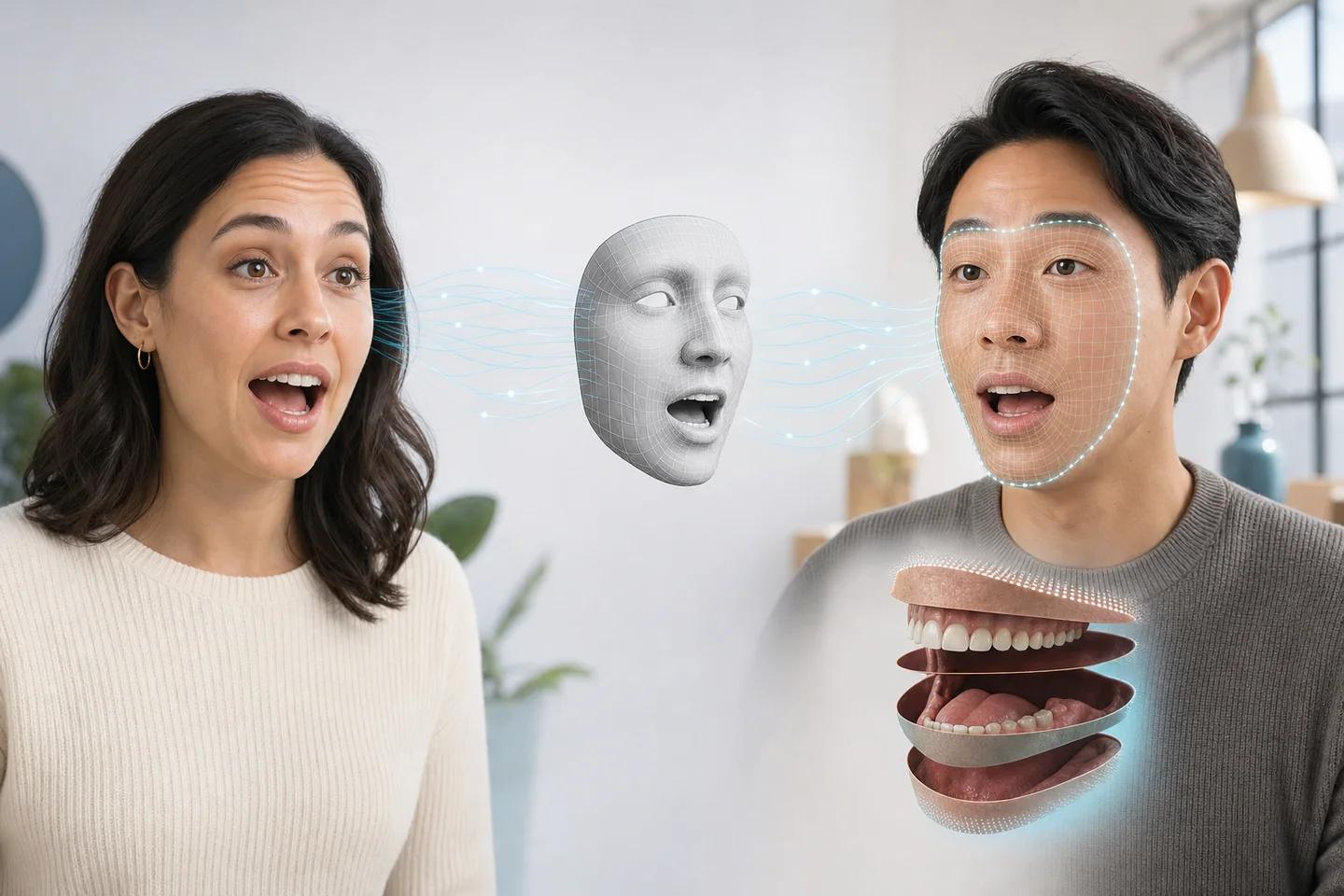
Real-time deepfake manipulation means producing each altered frame, or each slice of altered audio, fast enough to keep pace with a live stream and a live conversation. At 30 frames per second a system has about 33 milliseconds per frame. That per-frame budget is only part of the story: the delay from the attacker's movement or speech to what the victim sees and hears also has to stay low enough that the conversation feels normal.
Three properties are easy to blur together. Throughput is how many frames per second the system produces. Latency is how long each frame takes to arrive. Interactivity is whether the output responds to the other person, for example answering a question or following a request to turn the head. A system can be fast on a benchmark yet still too delayed or too rigid for a convincing call.
What does real time mean for deepfake and portrait manipulation?
It moves manipulation from editing to interaction. An offline forger can render a clip a hundred times and keep the best take. A live system gets one attempt per frame, so failures under unusual poses, lighting or occlusion appear on screen in front of the victim. In exchange, the attacker gains something offline fakes cannot offer: the ability to talk, react and push a target into a decision during the call.
That is the pattern behind the most damaging cases. FinCEN's November 2024 alert cites the widely reported February 2024 case in Hong Kong in which a finance worker paid out $25 million after a video call with a deepfaked chief financial officer, and the FBI's December 2024 announcement warns of fake video calls with supposed executives and police. Real-time capability turns a deepfake from a piece of content into a participant.
Which systems made real-time portrait manipulation possible?
Real-time research systems have existed for a decade, and they have become faster and needed less source material. The table lists representative milestones in each project's own terms.
| Year | System | Reported capability |
|---|---|---|
| 2016 | Face2Face (CVPR) | Live reenactment of target video from a commodity webcam |
| 2023 | 3D Gaussian Splatting | Real-time novel-view rendering at 30 fps or more at 1080p |
| 2024 | VASA-1 (Microsoft Research) | Talking face from one image and audio, 512 by 512 at up to 40 fps with negligible starting latency |
| 2024 | LivePortrait | Portrait animation at about 12.8 ms per frame on an RTX 4090 GPU |
What did NeRF add to view-consistent neural rendering?
NeRF added a single learned 3D representation from which any viewpoint can be rendered consistently. Posted in March 2020 by Ben Mildenhall, Pratul Srinivasan, Matthew Tancik, Jonathan Barron, Ravi Ramamoorthi and Ren Ng, it represented a scene as a fully connected network that takes a 3D location and a 2D viewing direction and returns density and view-dependent colour. Images are produced by classic volume rendering along camera rays, and because that rendering is differentiable, the network can be trained from nothing more than photographs with known camera poses.
View consistency is the property that matters for portraits. A 2D generator can make each frame look right yet let the nose or ears subtly change shape as the head turns. A radiance field stores geometry and appearance once, so a turning head stays the same object. NerFACE, presented at CVPR 2021, extended the idea to a dynamic face reconstructed from monocular video and driven by expression parameters.
The cost was speed. Rendering a NeRF meant querying the network at many points along every ray, far too slow for a live call. 3D Gaussian Splatting, published in July 2023, kept the radiance-field idea but replaced the network with explicit 3D Gaussians and a fast rasteriser, reaching real-time rates at 1080p. That is the step that brings view-consistent avatars within reach of live use.

Why the whole pipeline decides whether a live fake works
A research frame rate measured on a desktop GPU does not prove an end-to-end attack. A live fake also needs capture, face tracking, generation, encoding, network transport and a way to feed the result into the target application, usually a virtual camera. Each stage adds delay and each can fail. Conferencing software then resizes, denoises and compresses the stream, which can smooth away artifacts but also degrade the fake.
The injection step is where defenders have the most to work with. FinCEN lists a customer using a third-party webcam plugin during a live verification check, or asking to switch channels because of repeated technical glitches, among its nine red flags. Those signals exist whatever generator the attacker uses.
How to defend against real-time manipulation
Combine three things. Screen the stream itself for face manipulation and generated content, fast enough to run during the session. Check presence and injection: confirm a live person in front of a physical camera, not a virtual device. And move consequential decisions out of the call, for example by confirming a payment instruction through a call-back to a number on file. Challenge prompts such as turning the head still help, but modern animators follow head pose and blinks, so they should not be the only test.
How Neural Defend fits live verification
NeuroVerify checks face images, video or audio in one API call across six signals, including Live Presence Verification and Face Manipulation Detection, and returns a unified risk score with signal-level evidence in under 200 ms at p95 on eligible image requests under defined test conditions. That speed lets a verification flow screen frames during the session rather than after it. NeuroCall, in Beta, focuses on voice deepfakes in calls. NeuroDetect handles the recording afterwards, with frame-level heatmaps and a forensic report for investigators.
Neural Defend integrates through mobile and backend SDKs, a REST API or an MCP server, and deploys as a managed cloud API, private cloud or VPC, secure container, on-premises or air-gapped. Detection is one signal among several; the policy around it decides what happens next.
Evidence boundary
Limitations
- Reported frame rates come from each paper's hardware and setup and do not measure end-to-end attack latency on real networks.
- The Hong Kong case is cited from media reporting referenced in FinCEN's alert, not from court records.
- Challenge prompts and visual cues lose value as generators improve, so they should not be the sole control.
Source record
Sources and references
- arXivFace2Face: Real-time Face Capture and Reenactment of RGB Videos (CVPR 2016)Published July 29, 2020. Verified October 19, 2026.
- arXivVASA-1: Lifelike Audio-Driven Talking Faces Generated in Real TimePublished April 16, 2024. Verified October 19, 2026.
- arXivLivePortrait: Efficient Portrait Animation with Stitching and Retargeting ControlPublished July 3, 2024. Verified October 19, 2026.
- arXivNeRF: Representing Scenes as Neural Radiance Fields for View SynthesisPublished March 19, 2020. Verified October 19, 2026.
- CVF Open AccessDynamic Neural Radiance Fields for Monocular 4D Facial Avatar ReconstructionVerified August 7, 2026.
- arXiv3D Gaussian Splatting for Real-Time Radiance Field RenderingPublished August 8, 2023. Verified October 19, 2026.
- Financial Crimes Enforcement NetworkFIN-2024-Alert004: Fraud Schemes Involving Deepfake Media Targeting Financial InstitutionsPublished November 13, 2024. Verified October 19, 2026.
- FBI Internet Crime Complaint CenterCriminals Use Generative Artificial Intelligence to Facilitate Financial Fraud (I-120324-PSA)Published December 3, 2024. Verified October 19, 2026.