
What is full-face synthesis?
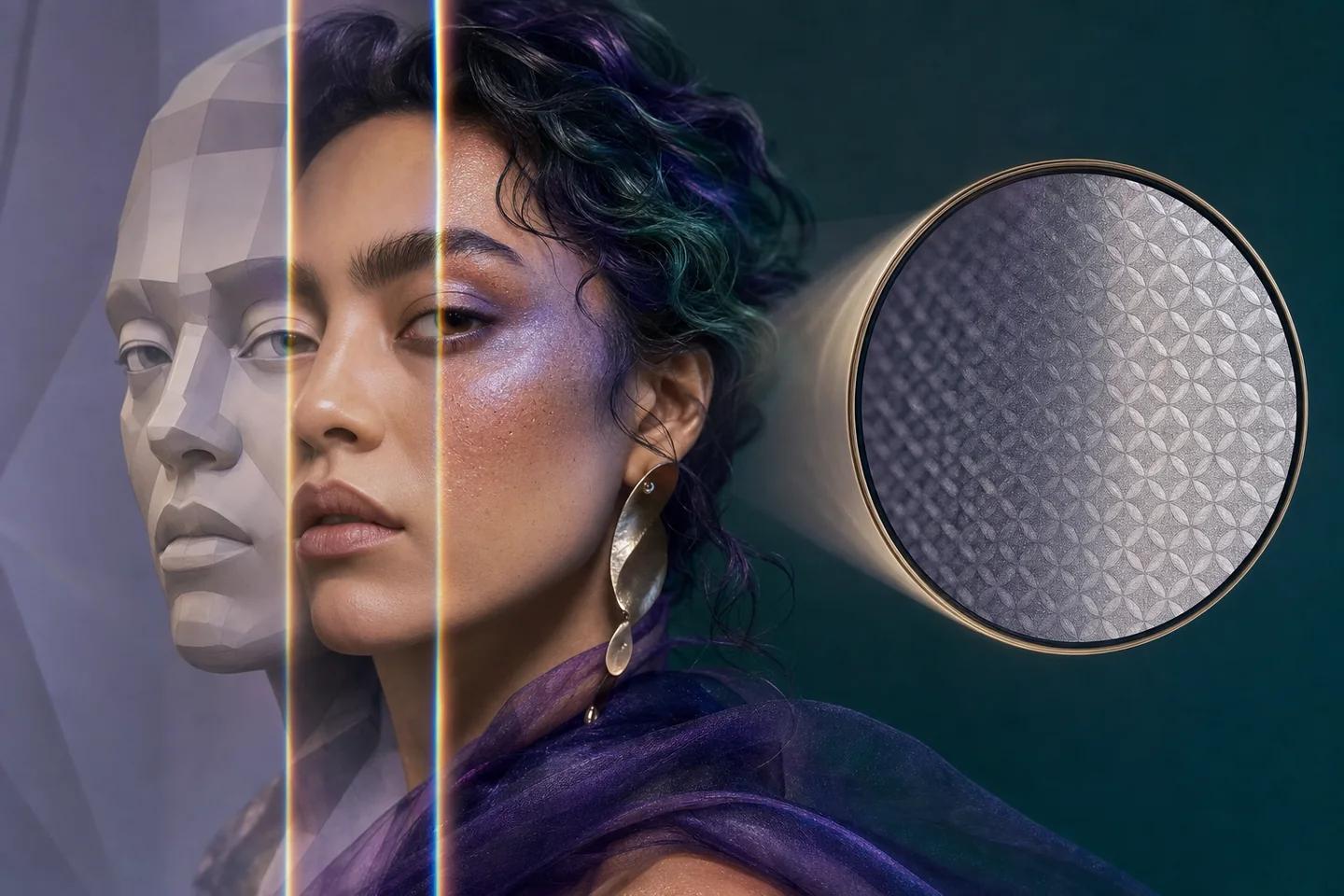
Full-face synthesis means an AI model draws a complete face, including skin, eyes, hair, teeth and often the background, from a learned statistical model of faces. The starting point may be random noise, a latent code, a text prompt or a handful of reference photos. Because no camera captured the result, there is no original image to compare against and often no real person behind it.
That separates it from the other main deepfake families. A face swap keeps a real video and replaces one identity with another. Reenactment keeps the identity and changes expressions or head movement. Attribute editing changes age, hair or expression on a real photo. Full-face synthesis replaces the subject entirely, which is why it suits fake accounts and synthetic identities that need a face nobody can trace.
| Technique | What changes | Real person involved | Typical misuse |
|---|---|---|---|
| Full-face synthesis | The whole face is generated | None, or only as a loose reference | Fake profiles, synthetic identity documents |
| Face swap | Identity in existing footage | Two real people | Impersonation video, non-consensual imagery |
| Reenactment | Expression and pose of a real face | One real person | Fake statements, live call impersonation |
| Attribute editing | Age, hair, expression or other details | One real person | Altered evidence, profile manipulation |
How did progressive GANs reach 1024-pixel synthetic faces?
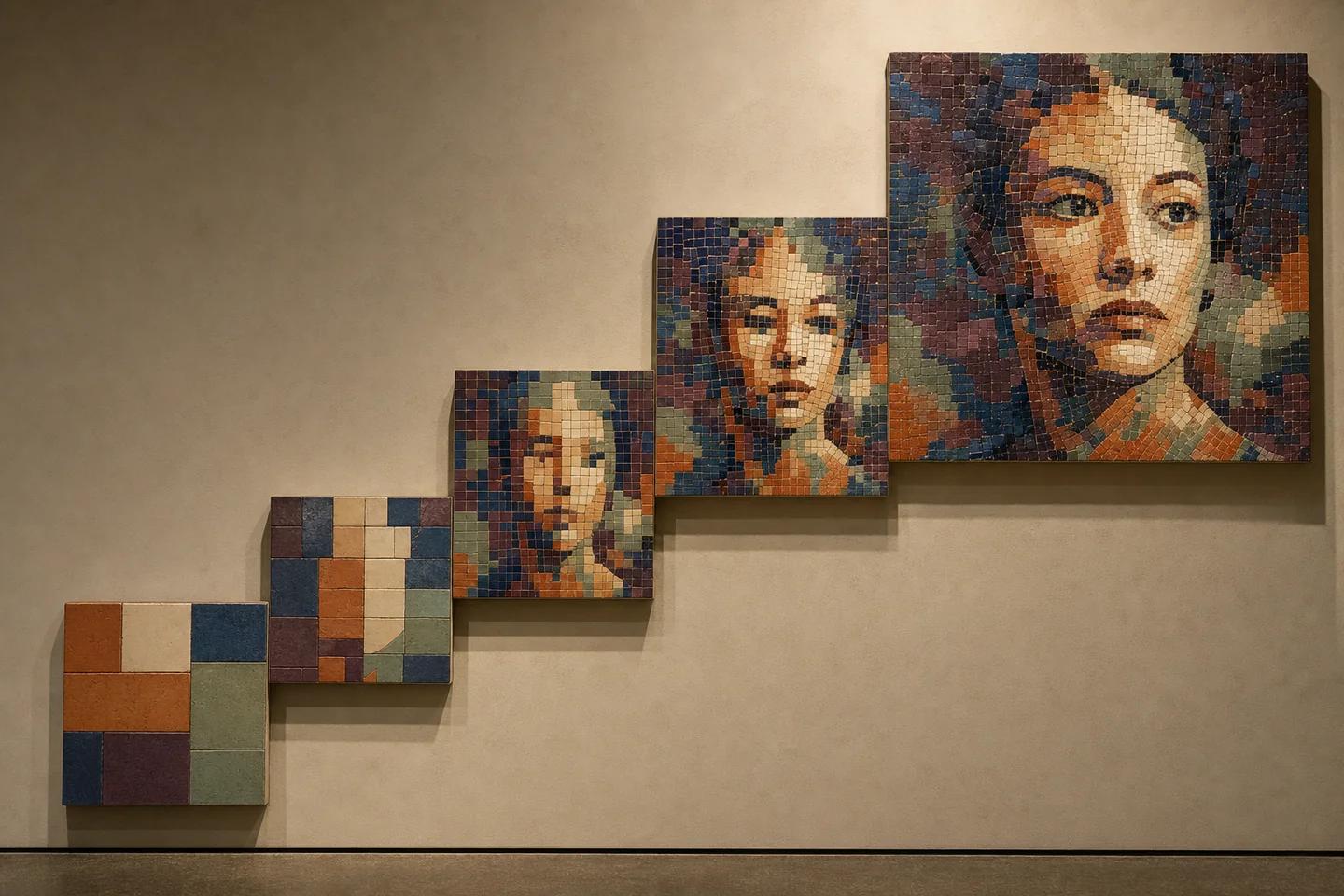
Progressive GANs reached 1024-pixel faces by starting training at a tiny resolution and adding layers for finer detail as training went on. Tero Karras, Timo Aila, Samuli Laine and Jaakko Lehtinen of NVIDIA posted the method on arXiv on 27 October 2017 and presented it at ICLR 2018. Both the generator and the discriminator grew together, beginning at 4 by 4 pixels and doubling in steps, with each new layer faded in gradually rather than switched on at once.
Learning the overall face layout first and texture later made training faster and more stable than trying to learn everything at full size. The authors also built a higher-quality version of the CelebA celebrity dataset at 1024 by 1024, and reported a record unsupervised Inception score of 8.80 on CIFAR-10. The face samples were drawn from a learned distribution; they were new identities, not chosen real people.
Progressive growing solved a training problem. It did not give users control over which identity appeared, keep a face consistent across video frames, or work equally well outside neatly aligned portrait photos. Those came later.
From StyleGAN to prompt-driven portraits
StyleGAN, posted by Karras, Laine and Aila in December 2018, reworked the generator so that coarse attributes such as pose and face shape could be controlled separately from fine details like freckles and hair strands. The paper also released a new, more varied face dataset. Its faces became the standard source for throwaway profile pictures, and its successors fixed several of the visible artifacts researchers had catalogued.
Diffusion models changed the workflow again. A user can now describe a face in words, specify age, ethnicity, lighting and clothing, and regenerate until it fits a backstory. Reference-image adapters can make a generated face resemble a real person, which blurs the line between full synthesis and identity theft. The result is a face with the right look for the pretext and no search history.
How are AI-generated faces used in fraud?
AI-generated faces are used mainly to make fake accounts and identities look real. In March 2022 NPR reported that Stanford Internet Observatory researchers Renée DiResta and Josh Goldstein found more than 1,000 LinkedIn profiles that appeared to use computer-generated faces, listing more than 70 businesses as employers. Many were used for sales outreach, and the researchers noted that eyes sitting in the same central position was a telltale sign, a by-product of aligned training data.
The FBI Internet Crime Complaint Center warned in December 2024 that criminals use generated images for realistic profile photos in romance and investment scams and for fake identification documents. In onboarding, a synthesized face can be printed onto a forged ID and then presented as a selfie, so the face match succeeds against an identity that never existed.
The portrait is rarely the whole deception. It anchors an account with fabricated history, a job title, connections and a messaging pattern, which is why the account around the face is often easier to examine than the pixels.
How to check whether a face was generated
Treat older visual cues as weak evidence. Mismatched earrings, warped backgrounds, smeared hair edges and centred eyes were common in 2019-era GAN faces, but newer models and simple cropping remove most of them. A face that passes a visual check has not been verified.
Combine signals from several layers. A reverse image search that finds nothing proves little, because many real people keep their photos private. Account creation dates, connection patterns, inconsistent biographical claims and reuse of the same face across unrelated accounts are stronger indicators. Forensic analysis of the original file adds a measurable signal that does not depend on spotting artifacts by eye.
- Keep the highest-quality copy of the image; screenshots and thumbnails remove fine detail.
- Check account age, activity history and whether the claimed employer can confirm the person.
- Search for the same face on other accounts, which suggests reuse of a generated portrait.
- Run forensic analysis and record the score with the model version used.
Where Neural Defend fits for generated faces
For investigators and trust teams reviewing a suspicious profile photo or ID portrait, NeuroDetect provides region-level views with explainability heatmaps, so the analyst can see whether the evidence concentrates on the face, the background or both. Every result stores the model and version, and the forensic report records observations, uncertainty and analyst notes.
For onboarding at volume, NeuroVerify checks a submitted selfie or face image in one API call. Its AI Generative Model Analysis signal targets fully generated faces, alongside Face Manipulation Detection for swaps and Live Presence Verification for liveness. The API does not analyse ID documents, so a forged document needs a separate document check.
Neural Defend's ARCAS 1B model reports pooled accuracy of 99.99% on GenImage and 97.74% on Community Forensics in the ARCAS paper, and Neural Defend ranked first of 36 systems on the public VendorBench-100 still-image benchmark with an MCC of 0.876. One VendorBench author also co-authored the ARCAS paper; the corpus is public so the results can be rerun.
Evidence boundary
Limitations
- Visual artifacts described here apply mostly to older GAN faces; current generators may show none of them.
- Account and profile signals indicate risk but do not prove a face is generated; real people can have thin online histories.
- Benchmark results describe tested datasets and do not guarantee detection of faces from new or fine-tuned generators.
Source record
Sources and references
- arXiv (Karras et al., NVIDIA)Progressive Growing of GANs for Improved Quality, Stability, and VariationPublished October 27, 2017. Verified October 19, 2026.
- arXiv (Karras, Laine, Aila, NVIDIA)A Style-Based Generator Architecture for Generative Adversarial NetworksPublished December 12, 2018. Verified October 19, 2026.
- NPRThat smiling LinkedIn profile face might be a computer-generated fakePublished March 27, 2022. Verified October 19, 2026.
- FBI Internet Crime Complaint CenterCriminals Use Generative Artificial Intelligence to Facilitate Financial FraudPublished December 3, 2024. Verified October 19, 2026.
- U.S. Department of Homeland SecurityImpacts of Adversarial Use of Generative AI on Homeland SecurityVerified August 7, 2026.
- arXiv (Selvarajan et al.)Benchmarking Neural Defend ARCAS 1B: A Foundational Multimodal Deepfake Detection ModelPublished September 21, 2026. Verified October 19, 2026.