How Do Generative Adversarial Networks Work?
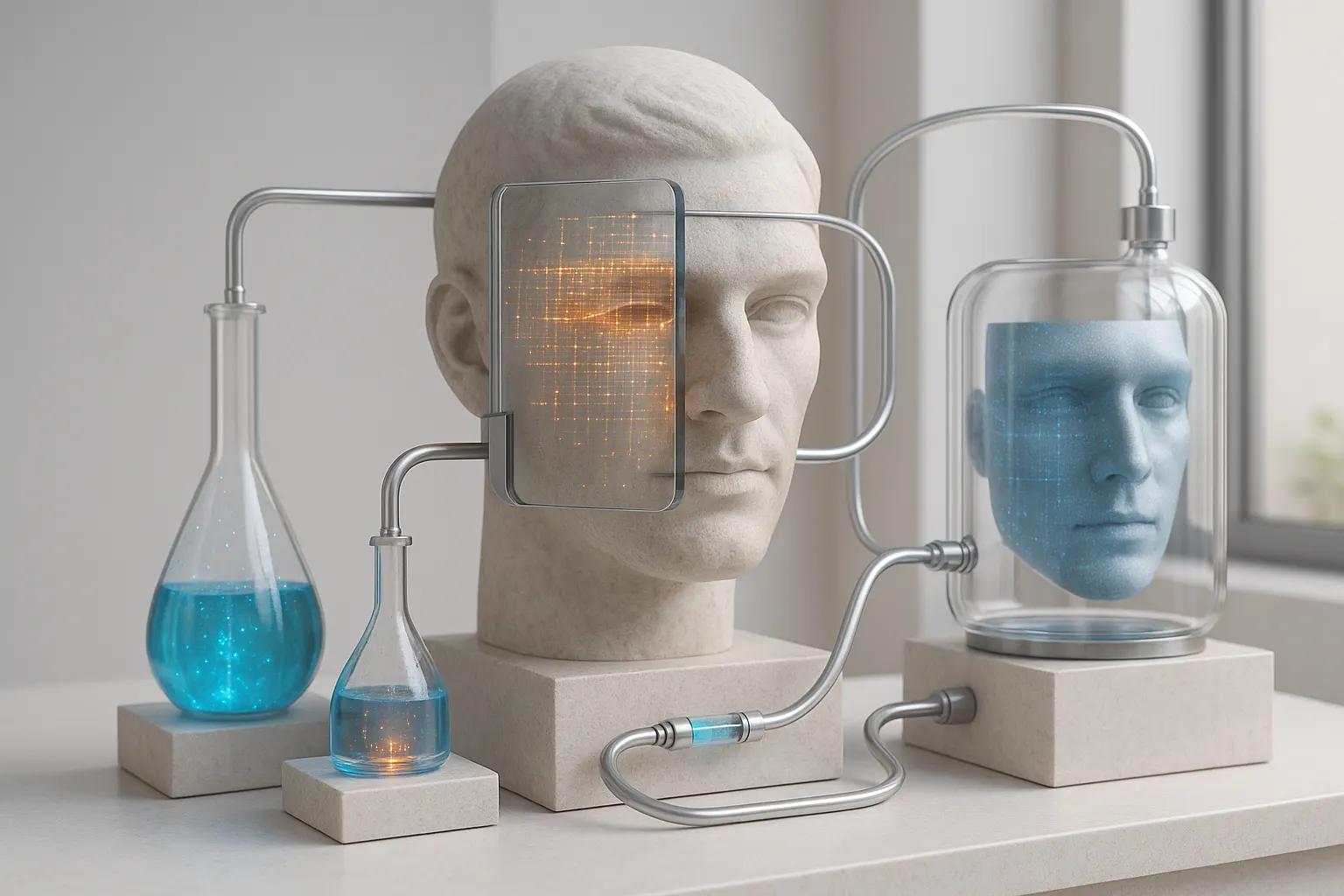
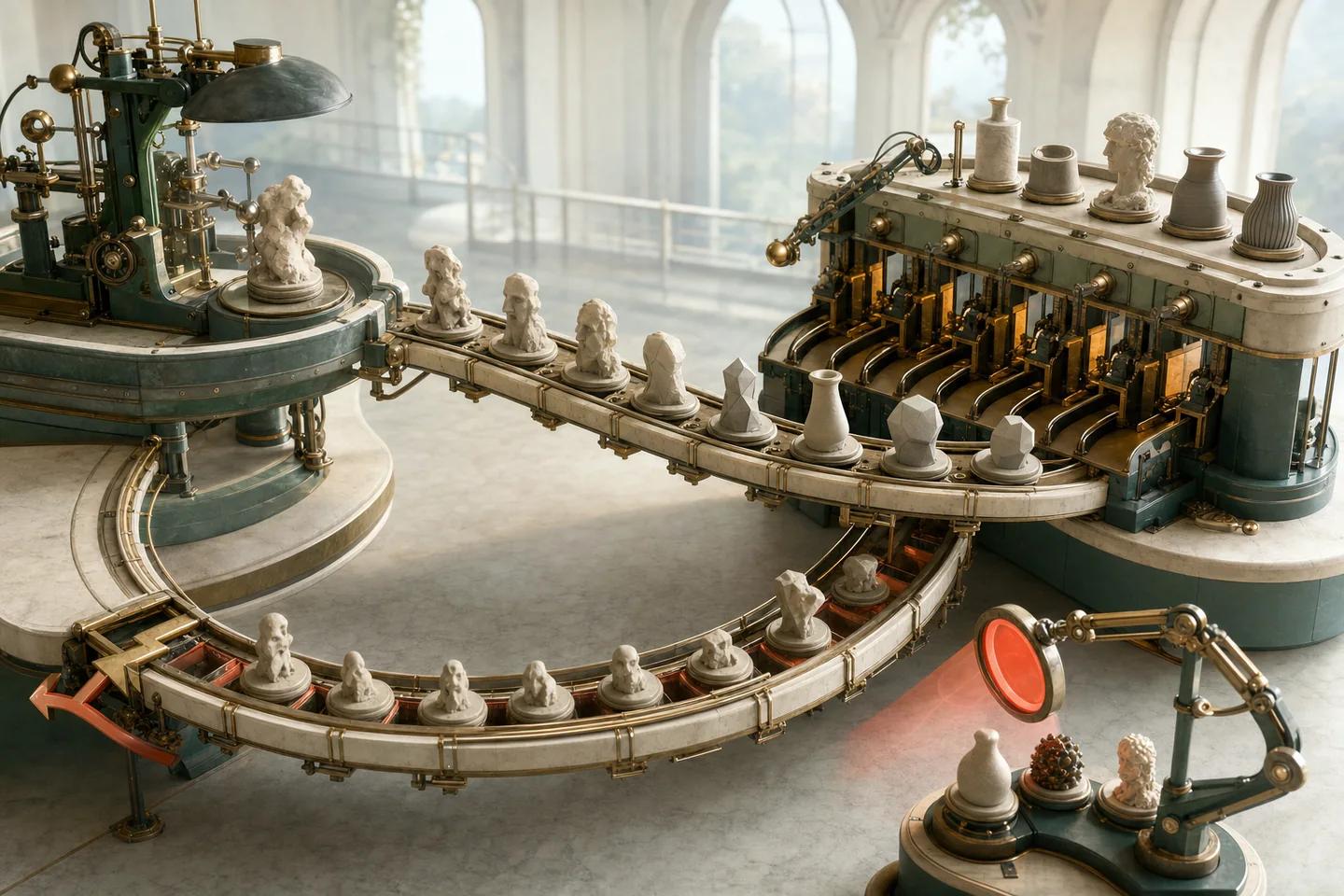
A GAN has two parts that learn together. The generator takes a vector of random numbers and transforms it, layer by layer, into a sample such as an image. The discriminator takes an image and outputs its estimate of whether the image came from the real training data or from the generator.
Training alternates between them. The discriminator is shown a mix of real images and the generator's current fakes and is updated to classify them better. The generator is then updated to make the discriminator wrong more often, using the discriminator's own gradients to learn which changes make its output look more real. Neither network is told what a face should look like; the generator learns only from the discriminator's feedback.
If training goes well, the two reach a balance in which the generator's samples are hard to distinguish from real data. In practice GAN training is famously unstable. The generator can collapse into producing a narrow range of outputs, a failure called mode collapse, or the discriminator can become too strong for the generator to learn from. Much of the research after 2014 went into fixing these problems.
What Did the Original GAN Paper Introduce in 2014?
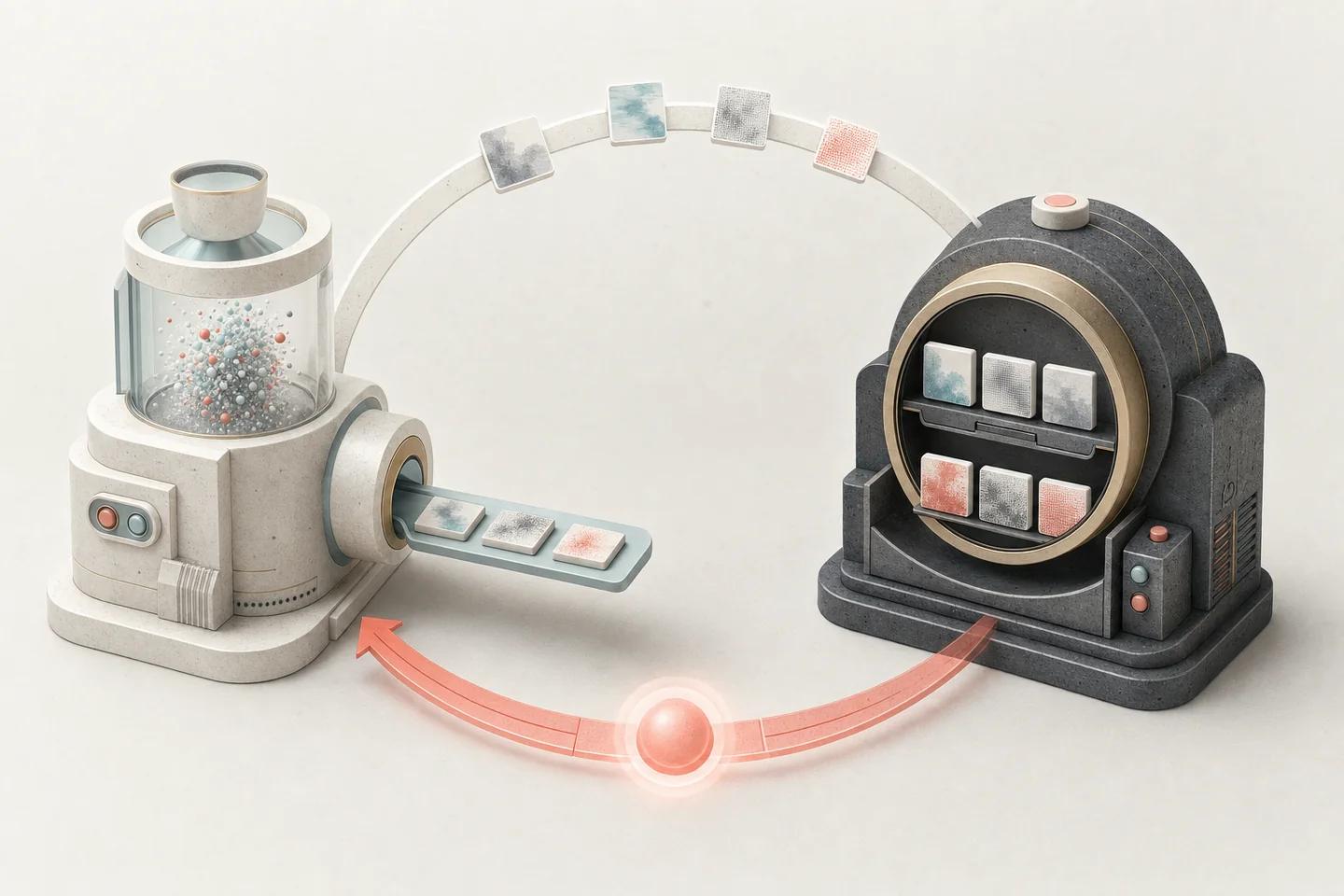
The original GAN paper, Generative Adversarial Networks by Ian Goodfellow, Jean Pouget-Abadie, Mehdi Mirza, Bing Xu, David Warde-Farley, Sherjil Ozair, Aaron Courville and Yoshua Bengio, was submitted to arXiv on 10 June 2014 and presented at NeurIPS (then NIPS) that year. It introduced a framework in which a generative model and a discriminative model are trained at the same time, framed as a minimax two-player game.
What changed was the training signal. Earlier generative models usually needed an explicit formula for the probability of the data, which was hard to compute for complex images. A GAN avoids that: the discriminator acts as a learned judge, and the generator only needs to fool it. That made it practical to train models that produce sharp, realistic samples.
The 2014 results were small, blurry images by today's standards. The milestone was the idea, which within five years produced photorealistic faces.
How Did GANs Go From Blurry Samples to Photorealistic Faces?
Two NVIDIA papers by Tero Karras and colleagues mark the jump. Progressive Growing of GANs, first posted in October 2017, started both networks at low resolution and added layers during training to capture finer detail, which made training faster and more stable and reached 1024 by 1024 pixel faces on the CelebA dataset.
A Style-Based Generator Architecture for GANs, posted in December 2018 and presented at CVPR 2019, borrowed ideas from style transfer. Its generator separated high-level attributes such as pose and identity from fine random variation such as freckles and hair, and allowed control at different scales. The authors also released a new, highly varied dataset of human faces. StyleGAN images became the familiar look of fake profile photos.
| Year | Paper | What it added |
|---|---|---|
| 2014 | Generative Adversarial Networks (Goodfellow et al.) | Generator and discriminator trained as a two-player game |
| 2017 | Progressive Growing of GANs (Karras et al.) | Stable training to 1024 by 1024 pixel faces |
| 2018 | StyleGAN (Karras, Laine, Aila) | Separate control of pose, identity and fine detail |
What Is a GAN and How Does It Create Deepfakes?
A GAN is a pair of neural networks trained to generate new data that resembles a training set, and it creates deepfakes in two main ways. The first is full synthesis: a GAN trained on many faces generates a face that belongs to no one, which is then used as a profile photo, a synthetic identity or a fake employee. The second is targeted generation: GAN-style adversarial losses help face-swap and reenactment models render one person's face onto another's head with convincing skin texture and lighting.
GANs are no longer the only route. Many current image and video generators are diffusion models, and many voice clones use other architectures. But GAN-generated faces remain common in fraud because the tools are mature, fast and free, and adversarial training is still used inside many generators to sharpen their output.
How Are GAN-Generated Images Detected?
GAN images carry fingerprints from the way they are built. Joel Frank and colleagues showed at ICML 2020 that GAN-generated images have strong artefacts in the frequency domain, caused by the upsampling operations in GAN architectures and present across different networks, datasets and resolutions. Early detectors also learned to spot visual giveaways such as mismatched earrings, asymmetric eyes and warped backgrounds.
The catch is that detectors trained only on GAN images do not transfer well to newer generators. Utkarsh Ojha and colleagues reported in 2023 that real-versus-fake classifiers trained on GAN images failed on diffusion and autoregressive models, and that features from a large pretrained vision-language model generalized much better. A detector used today has to cover both GAN and diffusion output, and whatever comes next.
How Neural Defend Detects Generated Faces
Neural Defend's NeuroVerify includes AI generative model analysis and face manipulation detection among the six signals it runs in one request, along with AI pixel-level manipulation and live presence verification, and returns one risk score with signal-level evidence. Eligible image requests return in under 200 ms at p95, so generated faces can be caught at onboarding.
For investigation, NeuroDetect shows heatmaps and attention views over the regions that drove a result and records the model version behind each analysis. Both run on ARCAS 1B, whose paper reports 99.99% pooled accuracy on the GenImage benchmark of GAN and diffusion images, among other results. On the public VendorBench-100 benchmark of 100 adversarial still images, Neural Defend ranked first of 36 systems with an MCC of 0.876; one VendorBench author also co-wrote the ARCAS 1B paper.
Evidence boundary
Limitations
- The research results cited describe specific models and datasets; detection performance on a given GAN face depends on the generator and any post-processing.
- The ARCAS 1B GenImage figure is reported in Neural Defend's own paper and describes the evaluated records.
- VendorBench-100 covers 100 still images and one author also co-wrote the ARCAS 1B paper.
Source record
Sources and references
- arXivGenerative Adversarial Networks (Goodfellow et al.)Published June 10, 2014. Verified October 19, 2026.
- NeurIPSGenerative Adversarial NetsVerified August 7, 2026.
- arXivProgressive Growing of GANs for Improved Quality, Stability, and Variation (Karras et al.)Published October 27, 2017. Verified October 19, 2026.
- arXivA Style-Based Generator Architecture for Generative Adversarial Networks (Karras, Laine, Aila)Published December 12, 2018. Verified October 19, 2026.
- arXivLeveraging Frequency Analysis for Deep Fake Image Recognition (Frank et al., ICML 2020)Published March 19, 2020. Verified October 19, 2026.
- arXivTowards Universal Fake Image Detectors that Generalize Across Generative Models (Ojha, Li, Lee)Published February 20, 2023. Verified October 19, 2026.
- arXivVendorBench-100: A Unified Cross-Paradigm Benchmark for Deepfake Image Detection (v2)Published July 29, 2026. Verified October 19, 2026.