How do variational autoencoders work?
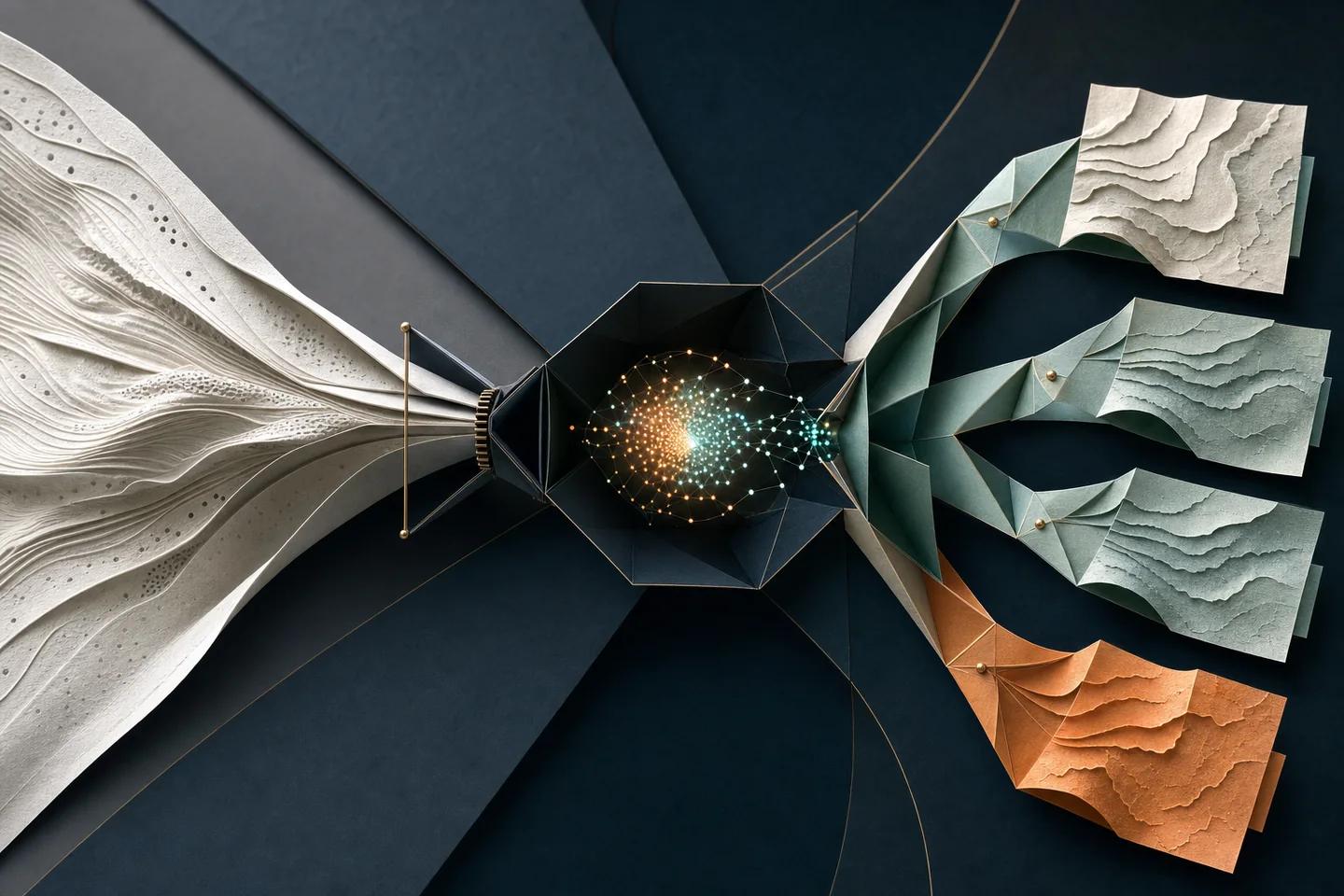
A variational autoencoder has two neural networks joined by a bottleneck. The encoder reads an input, say a 256 by 256 face, and outputs two short vectors: a mean and a variance for each dimension of a latent space that might have only a few hundred dimensions. A point is sampled from that distribution and handed to the decoder, which tries to rebuild the original image from it.
The sampling step would normally block training, because gradients cannot flow through a random draw. Kingma and Welling's reparameterization trick solves this by writing the sample as the mean plus the standard deviation multiplied by fixed random noise. The randomness sits outside the network, so the whole model can be trained with standard gradient methods.
The training objective, called the evidence lower bound, has two terms. A reconstruction term rewards the decoder for producing outputs close to the input. A KL-divergence term penalises the encoder when its distributions drift far from a standard normal. The tension between the two creates a latent space without gaps: nearby points decode to similar faces, and points drawn at random decode to something face-like instead of noise.
- Encoder: compresses the input into a mean and variance per latent dimension.
- Sampling: draws a latent point using the reparameterization trick.
- Decoder: turns the latent point back into an image, audio clip or other signal.
- Loss: reconstruction error plus a KL penalty that keeps the latent space regular.
How a VAE differs from an autoencoder, a GAN and a diffusion model
A basic autoencoder maps each input to one fixed code and learns only to reconstruct. Its latent space can have holes, so a random code may decode to garbage. The VAE's probabilistic encoder and KL penalty fill those holes, which is what turns a compression tool into a generator.
Compared with GANs and diffusion models, VAEs are stable to train and give an explicit latent space you can move through, but their images are usually softer. With a simple pixel-wise reconstruction loss, the decoder learns to average over plausible details it cannot predict, and averaged hair or skin texture looks blurred. That trade-off explains why most current systems use a VAE-style component for compression and let another model handle fine detail.
| Model family | How it generates | Typical output quality | Common deepfake role |
|---|---|---|---|
| Autoencoder | Reconstructs from a fixed code | Good reconstructions, poor random samples | Identity swap in classic face-swap tools |
| Variational autoencoder | Decodes samples from a learned distribution | Smooth but often soft | Latent compression, attribute editing |
| GAN | Generator trained against a discriminator | Sharp, fast, can collapse to narrow output | Synthetic faces, real-time face tools |
| Diffusion model | Iteratively removes noise | Sharp and varied, slower to sample | Text-to-image and text-to-video generation |
Where VAEs and autoencoders sit inside deepfake tools
The original face-swap recipe is an autoencoder trick. One encoder is trained on faces of two people, with a separate decoder for each. Because the encoder learns features shared by both faces, such as pose, expression and lighting, feeding person A's frame through person B's decoder renders B's face with A's expression. DeepFaceLab, which its authors described in a May 2020 arXiv paper as the dominant face-swapping framework, builds on this structure with added options and training refinements.
Latent diffusion relies on an autoencoder for a different job. In Rombach and colleagues' 2021 design, a pretrained autoencoder, regularised with either a KL penalty like a VAE or vector quantisation, compresses images before diffusion and decodes the result afterwards. Every image produced that way passes through the decoder, so decoder behaviour shapes fine texture in the final output.
VAE latent spaces are also used for attribute editing. Moving a face's latent code along a direction associated with age, smile or glasses changes that attribute while keeping the rest roughly intact, which is one way realistic altered portraits are made.
What traces VAE-based generation can leave
VAE-based pipelines can leave soft high-frequency detail, slightly smoothed skin, and texture patterns introduced by the decoder's upsampling layers. In face swaps, the swapped region is often blended into the original frame, so colour mismatches, boundary seams and a face that is sharper or softer than the neck and hair are classic signs.
Those traces are unreliable on their own. Compression, beauty filters and ordinary resizing smooth genuine faces too, and newer decoders reduce visible softness. A detector trained on one family's traces may miss outputs from another architecture, decoder or codec, so evaluations should state which generator families and transformations were tested.
Architecture labels also do not attribute a file. Several pipelines can produce similar results, and a VAE may be only one stage in a larger system. If the evidence supports only a family-level explanation, report it at that level.
How NeuroDetect examines autoencoder and VAE-generated media
NeuroDetect, Neural Defend's forensic workspace, analyses authorized images and video at region and frame level. For a suspected face swap, the explainability heatmap shows whether evidence concentrates on the inner face and blending boundary or spreads across the frame, which helps an analyst tell a swap from a fully generated image. The model and version are stored with each finding.
The ARCAS 1B model behind Neural Defend's products was tested across generator-diverse benchmarks; the ARCAS paper reports pooled accuracy of 99.99% on GenImage, 99.82% on AIGC-Detect and 97.65% on OpenFake. Those figures describe the records evaluated. The forensic report records uncertainty alongside observations, so a heavily compressed sample is documented with limited confidence rather than a forced verdict.
Evidence boundary
Limitations
- This overview does not cover every VAE objective, decoder design or hybrid architecture.
- Visual traces associated with VAE decoders can be removed by post-processing or mimicked by ordinary compression and filters.
- A detection result can indicate manipulation without identifying the specific architecture or tool that produced it.
Source record
Sources and references
- arXiv (Kingma, Welling)Auto-Encoding Variational BayesPublished December 20, 2013. Verified October 19, 2026.
- arXiv (Perov et al.)DeepFaceLab: Integrated, flexible and extensible face-swapping frameworkPublished May 12, 2020. Verified October 19, 2026.
- arXiv (Rombach et al.)High-Resolution Image Synthesis with Latent Diffusion ModelsPublished December 20, 2021. Verified October 19, 2026.
- IBMWhat is a Variational Autoencoder?Verified August 7, 2026.
- arXiv (Selvarajan et al.)Benchmarking Neural Defend ARCAS 1B: A Foundational Multimodal Deepfake Detection ModelPublished September 21, 2026. Verified October 19, 2026.