Does GDPR apply to deepfake detection?
In most real deployments, yes. The General Data Protection Regulation, Regulation (EU) 2016/679, applies to processing personal data, meaning any information relating to an identified or identifiable natural person. A selfie, an onboarding video, a recorded call or a clip of a public figure all relate to identifiable people. Sending that media to a detector, scoring it, logging the result and letting a reviewer look at it are all processing operations. So the GDPR's principles, lawful basis, transparency, security and data subject rights apply even if the detector never tries to work out who the person is.
The harder question is whether the processing is special-category biometric processing. The answer depends on the purpose and the technique, not on the file type.
When is authenticity analysis biometric data processing under the GDPR?
Article 4(14) defines biometric data as personal data resulting from specific technical processing relating to the physical, physiological or behavioural characteristics of a natural person, which allow or confirm the unique identification of that person, such as facial images or fingerprint data. Article 9(1) then prohibits processing biometric data for the purpose of uniquely identifying a natural person, alongside health, genetic and other special categories, unless one of the Article 9(2) exceptions applies. Recital 51 adds that photographs should not systematically be treated as special-category data; they fall under the biometric definition only when processed through specific technical means that allow unique identification or authentication.
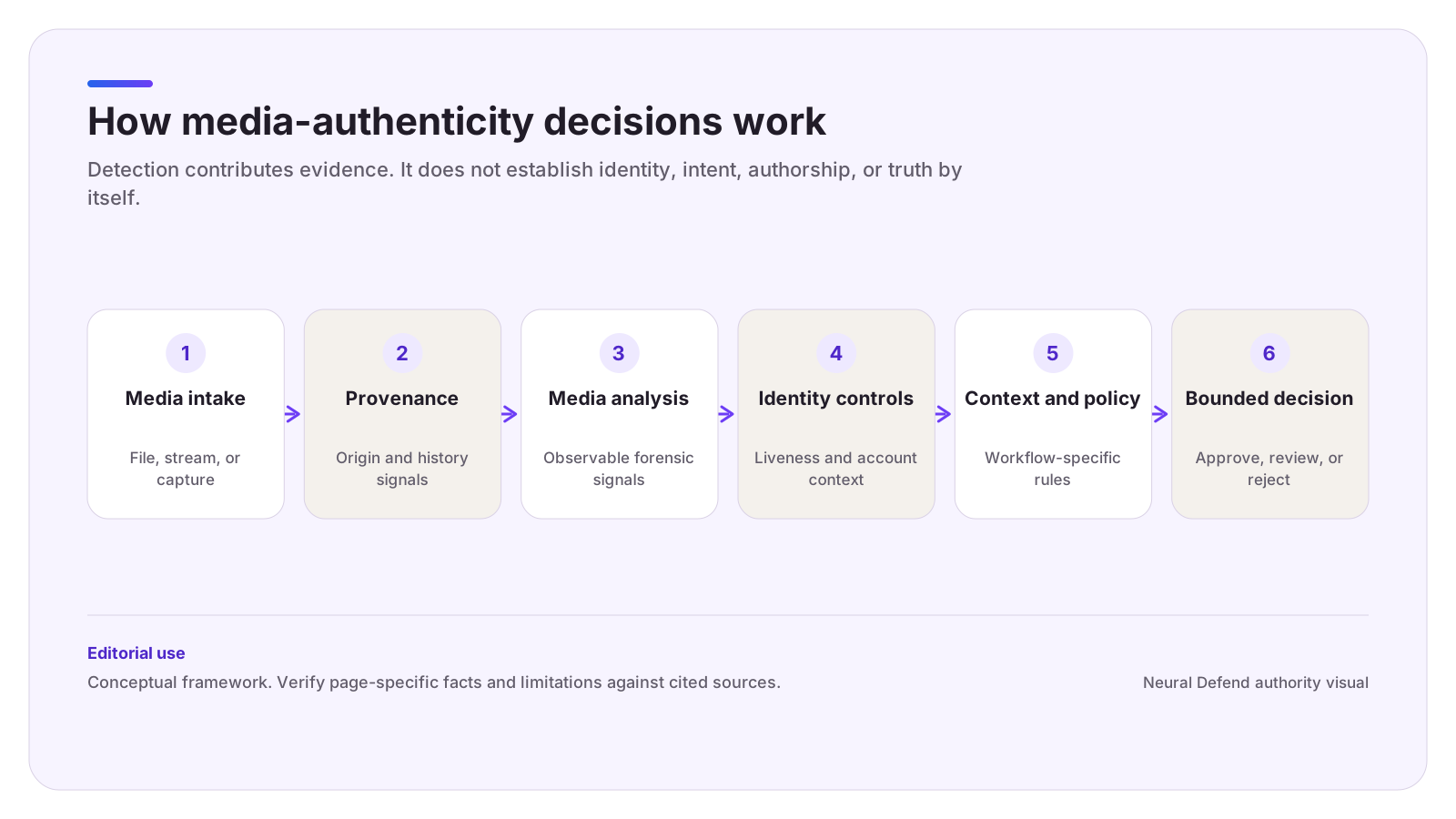
Applied to deepfake detection, that produces a split. A model that looks for blending boundaries, generator fingerprints or pixel-level edits is asking whether the media was manipulated, not who is in it. It processes personal data, but it does not produce a template to identify the person, so Article 9 usually does not bite on that step alone. A face match that compares a selfie with an ID photo, a voiceprint check, or a liveness step that confirms the enrolled person is present is processing for unique identification or authentication. Where a deepfake check runs inside that flow, on the same images, for the same onboarding decision, the controller should treat the workflow as biometric processing and find an Article 9 condition for it.
Controllers should document this reasoning step by step, because supervisory authorities and the European Data Protection Board look at the actual purpose and technical design. Member States may also set further conditions for biometric data under Article 9(4), so national law matters.
| Use | Personal data? | Article 9 biometric processing? | Typical lawful basis questions |
|---|---|---|---|
| Manipulation check on a selfie inside KYC face matching | Yes | Likely, as part of an identification workflow | Article 6 basis plus an Article 9(2) condition, often explicit consent or a legal basis in national law |
| Standalone manipulation check on a claims photo | Yes, if a person is identifiable | Usually not, if no identification template is created | Article 6 basis such as legitimate interests or contract, with a balancing test |
| Newsroom check of a viral video of a public figure | Yes | Usually not | Journalistic exemptions under national law under Article 85 |
| Voice deepfake check plus voiceprint authentication on a call | Yes | Likely, for the voiceprint step | Article 9(2) condition for authentication; transparency to callers |
What privacy questions apply to biometric deepfake detection?
Beyond classification, the same handful of questions decide whether a deployment holds up. Answer them before go-live and record the answers in a data protection impact assessment, which Article 35 requires for processing likely to result in a high risk, including large-scale processing of special categories.
- Purpose: what exactly is the detector used for, and is it limited to that purpose?
- Lawful basis and Article 9 condition: which Article 6 basis applies, and if the workflow identifies people, which Article 9(2) exception?
- Minimisation: is the full video needed, or would sampled frames do? Are raw media, derived features and scores kept separately?
- Retention: how long are media, scores and reviewer notes kept, and who deletes them?
- Automated decisions: does a score alone decide account opening or claims? Article 22 limits decisions based solely on automated processing with legal or similarly significant effects.
- Processors and transfers: which vendor processes the media, under what Article 28 terms, and in which country?
- Security and access: who can view sensitive media, and how is access logged?
Does deepfake detection require storing biometric data?
No. Detection works on the media submitted at the time of the check. It does not need a reference template of the person, and it does not need to keep the image or video after scoring. What an organisation chooses to keep is a separate decision: many keep the score, the signal-level result and a hash of the file for audit, and keep the media itself only where a case is opened or a legal duty requires it.
That choice matters for risk. Every stored selfie or video is personal data to secure, disclose on request and eventually delete. Under the minimisation and storage limitation principles in Article 5, the safer default is to score, record the result, and discard the media unless a defined case or retention rule says otherwise. Biometric templates for face matching are a different matter, governed by the identity verification process that creates them.

How does Neural Defend support GDPR-aligned deepfake detection?
NeuroVerify checks a face image, video or audio in one API call and returns one unified risk score with signal-level evidence from six signals, including Face Manipulation Detection, AI Generative Model Analysis and AI Pixel-Level Manipulation. The output is about the media, not the person's identity, which helps controllers keep the authenticity step separate from identification in their records. Your policy decides what happens with the score, and a human review path for adverse outcomes helps meet Article 22 expectations.
Deployment options let controllers choose where personal data goes. Neural Defend deploys as a managed cloud API, in a private cloud or VPC, as a secure container, on-premises or air-gapped, so media can stay inside the controller's own infrastructure or region. Neural Defend holds ISO/IEC 27701 certification for privacy information management alongside ISO/IEC 27001, ISO/IEC 42001 and SOC 2 Type II, which supports Article 28 processor due diligence. For investigations that need retained evidence, NeuroDetect keeps media inside a case with model context, analyst notes and a downloadable forensic report, so retention is tied to a defined case rather than kept by default.
On the public VendorBench-100 benchmark of 100 adversarial still images, Neural Defend ranked first of 36 systems with an MCC of 0.876, which matters for privacy too: fewer false positives mean fewer genuine customers pushed into manual review of their biometric media.
Evidence boundary
Limitations
- This page is an educational reading of the GDPR, not legal advice. Classification depends on purpose, technical design, roles and Member State law, and supervisory guidance continues to develop.
- The table of example uses is indicative; a controller must assess its own workflow and record the reasoning.
- Not storing media reduces risk but can limit later investigation; retention rules should be set per case type.
- VendorBench-100 measures still images only, and one of its authors co-authored Neural Defend's ARCAS 1B paper.
Source record
Sources and references
- European UnionRegulation (EU) 2016/679, General Data Protection Regulation (consolidated text)Published May 4, 2016. Verified October 19, 2026.
- European Data Protection BoardOpinion 11/2024 on facial recognition for airport passenger flowsPublished May 24, 2024. Verified August 7, 2026.
- arXivVendorBench-100: A Unified Cross-Paradigm Benchmark for Deepfake Image DetectionPublished July 29, 2026. Verified October 19, 2026.