
How organizations detect AI-generated document fraud
Detecting AI-generated document fraud starts with a simple question for each document type: can we verify this at the source instead of judging a picture of it? Image models can produce a convincing driver's licence, bank statement or payslip, but they cannot produce a valid issuer signature, a matching record in a registry or a transaction feed from the customer's bank.
Where source verification is not available, organizations fall back on examining the document itself. That means requiring a live capture instead of an upload for physical documents, running forensic analysis for generation and editing traces, and checking the document against everything else the applicant submitted. The table maps common document types to the strongest available check.
The approach is the same across banking, lending, insurance and marketplaces. What changes is which documents matter: identity documents at onboarding, income and bank statements in lending, invoices and photos in claims, registration certificates in merchant and seller onboarding.
| Document | Strongest check | Fallback when only an image is available |
|---|---|---|
| Passport or chipped national ID | Read and validate the chip and issuer signature | Live multi-frame capture, security feature and MRZ consistency checks |
| Driver's licence without chip | Authoritative data check where the law allows | Live capture, template and font analysis, generation trace analysis |
| Bank statement | Account data through a bank connection with consent | PDF structure analysis, edit and generation traces, balance arithmetic |
| Payslip or income proof | Payroll or tax record verification | Employer verification, structure and consistency checks |
| Business registration certificate | Registry lookup | Template comparison, edit traces, cross-check with registry data |
| Claim photos and invoices | Supplier or repair shop confirmation | Forensic image analysis, metadata and reverse image search |

How do you detect AI-generated ID documents?
You detect AI-generated ID documents by making the attacker produce something an image generator cannot: a physical card that responds correctly to live capture, a chip with a valid signature, or data that matches an authoritative source. NIST SP 800-63A-4, published in July 2025, requires automated document validation to use live capture with document presence checks and to compare MRZ or barcode data with the printed fields. It also treats evidence verified through the issuing source's digital signature as its strongest category.
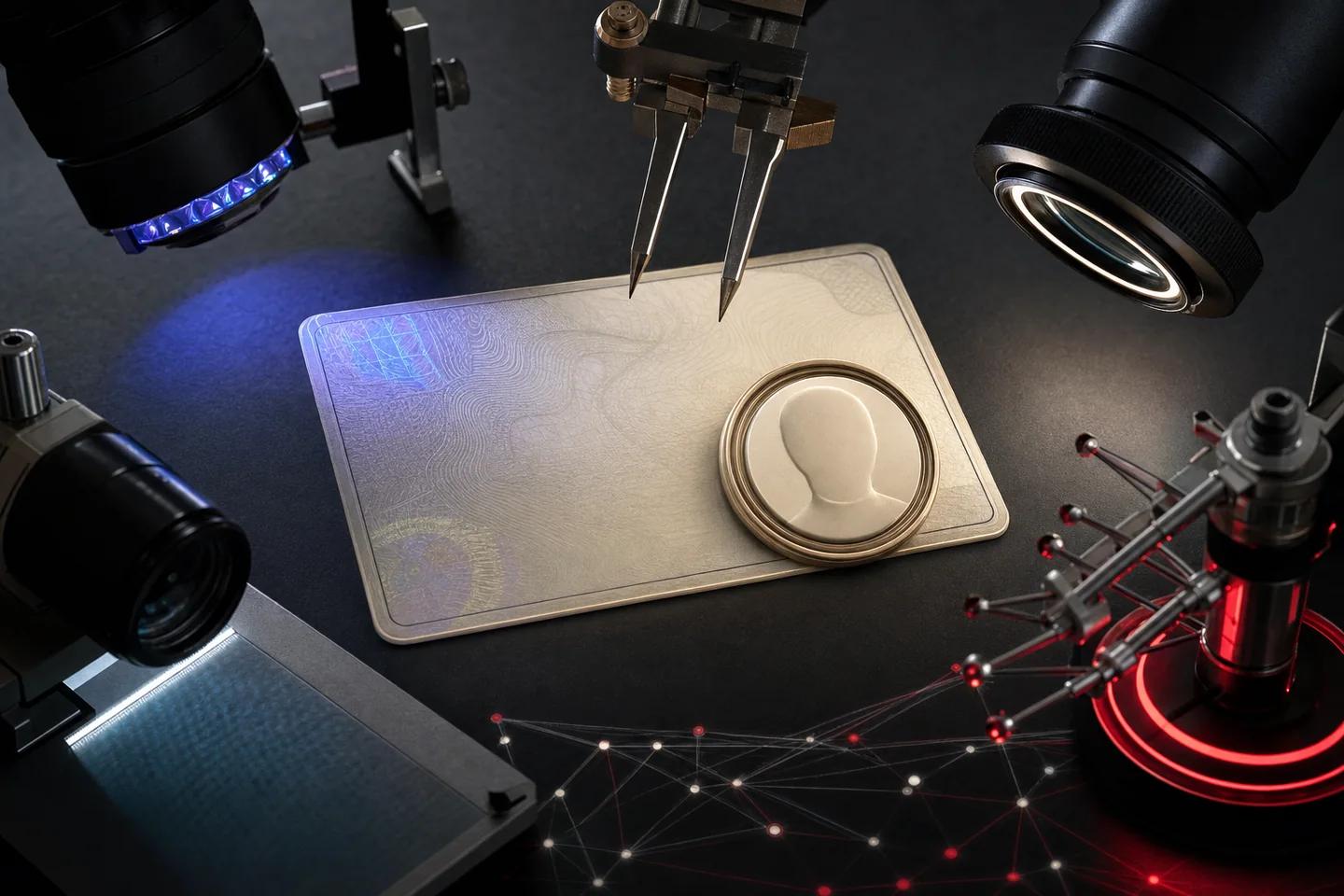
When only the image is available, forensic analysis looks for the traces generation leaves: textures that are too uniform, inconsistent fonts or spacing, security patterns that do not match the issuer's template, lighting that does not fit a photographed card, and statistical patterns typical of image generators. Consistency checks catch the rest. FinCEN's red flags include a photo that does not fit the stated date of birth and multiple identity documents that are inconsistent with each other.
Investigators should also run a reverse image search on the portrait. FinCEN reports that such searches have matched identity photos to online galleries of AI-generated faces. Fake credentials are not limited to IDs: the FBI warned on 3 December 2024 that criminals generate documents that appear to come from law enforcement, government agencies or banks.
How does deepfake detection fit document verification?
Deepfake detection fits document verification at the face. Most document verification flows end with a face match between the ID portrait and a selfie. If the attacker generated the ID, they control the portrait, and they can generate or swap a selfie of the same face. Analysing the selfie and liveness video for generation and manipulation breaks that loop, because a flagged selfie makes the match meaningless.
Deepfake detection also helps on the document image itself when the portrait or other regions were generated or edited. In a high-volume flow, that analysis usually comes from the document verification vendor. For escalated cases, an analyst can examine the document forensically alongside the selfie. The guide to document and selfie fraud explains the paired attack in more detail, and the document analysis architecture page covers how to design the pipeline.

Building a detection programme for AI-generated documents
Organizations that handle many document types get the best results by tiering them by risk and verifiability, then applying the strongest check each tier allows. A practical order of work:
- List every document your processes accept and the decision each supports, such as account opening, credit limit or claim payout.
- Replace image-based checks with source verification wherever a chip, registry, bank connection or payroll record is available.
- For physical documents that remain, require live in-app capture and disable uploads from the gallery.
- Run forensic analysis on document images and PDFs, and check consistency across documents and with the applicant's data.
- Analyse the selfie and liveness video matched to any identity document for manipulation and generation.
- Re-review documents behind accounts that later show suspicious activity, as FinCEN notes institutions already do successfully.
What document fraud detection cannot do
No combination of checks prevents AI-generated document fraud completely. Generators improve, documents are recompressed and photographed in poor light, and many genuine documents lack chips or signatures. The aim is to raise the cost of each attempt and catch most of them before money moves.
Detection also cannot tell whether a genuine document's contents are true. A real bank statement from a mule account or a real ID issued on fraudulently obtained records passes forensic checks. Those cases need data verification, linkage analysis and monitoring after onboarding.
Where Neural Defend fits in document fraud detection
NeuroVerify covers the biometric half of document verification. One API call analyses the selfie, liveness video or audio across six signals, including Face Manipulation Detection, AI Generative Model Analysis, AI Pixel-Level Manipulation and Live Presence Verification, and returns one unified risk score with signal-level evidence. Eligible image requests complete in under 200 ms p95 under defined test conditions, so it runs in real time or in batch alongside your document vendor. NeuroVerify does not analyse ID documents.
NeuroDetect covers forensic review. Analysts upload authorised documents, images, video or audio into a case, examine explainability heatmaps down to specific regions, and export a forensic report with observations, uncertainty, provenance and model version.
Both build on ARCAS 1B, Neural Defend's own detection model; the ARCAS paper reports pooled accuracy of 99.99% on GenImage and 99.82% on AIGC-Detect for AI-generated images. On the public VendorBench-100 still-image benchmark, Neural Defend ranked first of 36 systems with an MCC of 0.876; one benchmark author also co-authored the ARCAS paper. Neither benchmark measures documents specifically, so test on your own document samples.
Evidence boundary
Limitations
- NeuroVerify does not analyse ID documents; it covers the selfie and video matched to them.
- Benchmark figures cited are for AI-generated images in general, not document fraud specifically.
- Source verification options such as chip reading, registries and bank data connections vary by country and require appropriate consent and legal basis.
- Genuine documents with false contents pass forensic checks and need data verification.
Source record
Sources and references
- Financial Crimes Enforcement Network (FinCEN)FIN-2024-Alert004: FinCEN Alert on Fraud Schemes Involving Deepfake Media Targeting Financial InstitutionsPublished November 13, 2024. Verified October 19, 2026.
- 404 MediaInside the Underground Site Where 'Neural Networks' Churn Out Fake IDsPublished February 5, 2024. Verified October 19, 2026.
- National Institute of Standards and TechnologySP 800-63A-4, Digital Identity Guidelines: Identity Proofing and EnrollmentPublished July 1, 2025. Verified October 19, 2026.
- FBI Internet Crime Complaint CenterI-120324-PSA: Criminals Use Generative Artificial Intelligence to Facilitate Financial FraudPublished December 3, 2024. Verified October 19, 2026.
- arXivBenchmarking Neural Defend ARCAS 1B: A Foundational Multimodal Deepfake Detection ModelPublished September 21, 2026. Verified October 19, 2026.
- arXivVendorBench-100: A Unified Cross-Paradigm Benchmark for Deepfake Image DetectionPublished July 29, 2026. Verified October 19, 2026.