
Neural Defend

Asset-backed and education lending / NeuroVerify

Deepfake Detection API for Gold, Vehicle and Education Loans

For lenders that issue loans secured on gold, vehicles or equipment, and for student loans with a co-borrower or guarantor. NeuroVerify checks the borrower and co-signer selfie and video for deepfakes and manipulation, so the person who takes the loan is the person who signed.

It fits the selfie or video step your origination already runs: one API call, no extra step for the borrower, one unified risk score with signal-level evidence.

NeuroVerify does not appraise assets, check documents or make credit decisions. It adds authenticity evidence about face, video and audio; your underwriting policy decides.

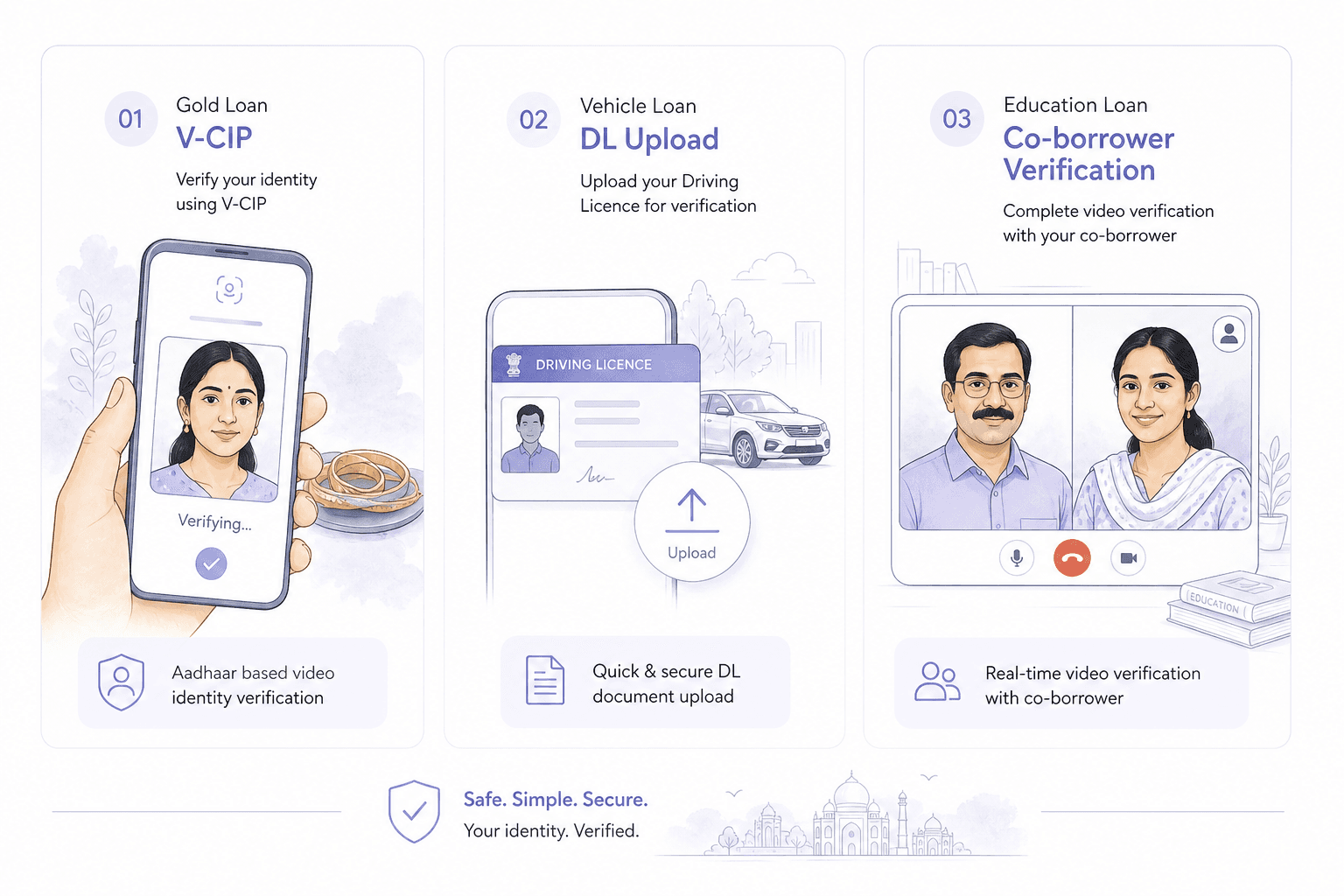
Light editorial illustration of a loan application with a borrower selfie capture and an asset appraisal panel on a light background.
AI-generated conceptual editorial illustration on a light background; not product UI or forensic evidence.
Powered byNeuroVerifyExplore the product
  • #1 of 36on the public VendorBench-100
  • <200 msp95 on eligible image requests
  • 6 → 1six checks, one unified score
  • 0new steps for your customer

The gap

A secured loan still depends on knowing who borrowed.

Secured lending feels lower risk because an asset backs the loan. In practice the asset is not the only exposure. The lender still needs to know who the borrower is, who owns the asset, and who is obliged to repay. Many of these loans are now taken digitally and often through partners and branches.

Gold, vehicle and education loans each have a different weak point. For gold, an asset and a borrower are present at an appraisal. For vehicles, the buyer, dealer and registered owner can be different parties. For education, a student applicant is often supported by a parent or guarantor who must be genuinely present.

Where the checks stop

Document checks and registry lookups confirm records. Face match confirms two images look alike. Liveness confirms a prompt was followed. None of them tells you whether the face on a video KYC or selfie was generated, swapped or injected. A synthetic borrower or a faked co-signer can pass them all. See deepfake detection for digital lending.

Digital secured-loan origination

Application → Identity and document capture → Selfie or video KYC → Asset appraisal or verification → Co-borrower or guarantor consent → Disbursal

Both the borrower and the guarantor selfie are trusted by default. NeuroVerify adds an authenticity read on each.

Threats

How deepfakes enter secured and education lending

These are attack techniques, not claims about any lender.

01

Fake borrower on a gold or vehicle loan

A synthetic or swapped face is presented as the borrower so that funds are drawn against an asset owned by someone else.

02

Impersonated owner of the pledged asset

An attacker poses as the asset owner on a video call to pledge or sell an asset they do not own.

03

Faked co-signer or guarantor

An applicant presents a generated or stand-in guarantor on a recorded or live video consent.

04

Student identity swapped for a paid applicant

Someone else sits the video KYC for a student, then funds are diverted.

05

Dealer or agent-assisted submission fraud

An assisting agent substitutes faces or submits injected video for many applications in a batch.

06

Deepfake consent on repayment mandates

A swapped face or cloned voice is used to approve a repayment mandate or loan change.

Lenders in regulated markets often run video KYC or similar remote identification. See FATF digital identity guidance for global context and synthetic identity application investigation.

For consumer and business lending flows in general, see digital consumer lending origination review.

Where NeuroVerify fits

Where NeuroVerify sits in loan origination

NeuroVerify sits at the selfie or video step for each person on the loan: borrower, co-borrower, guarantor and asset owner. Your origination system sends the media it already captures. NeuroVerify runs six signals in one request and returns a unified risk score with signal-level evidence.

Your credit and fraud policy decides next steps: continue, ask for a supervised or in-person step, route to review, or decline. Document and asset checks stay as they are.

NeuroVerify Unified Trust LayerSix parallel analysis layers
  • Visual Safety Screening
  • Live Presence Verification
  • Face Manipulation Detection
  • AI Generative Model Analysis
  • AI Pixel-Level Manipulation
  • AI Content Compliance
01

Send each party's selfie or video

Post the borrower and co-signer face media from your origination or video KYC step.

02

Read the unified risk score

Get one score per person with evidence from six signals.

03

Apply your underwriting policy

Proceed, require an in-person verification, route to review or decline.

04

Re-check before disbursal

Run a final check at consent or disbursal to confirm continuity.

What you get

What lenders gain

Know who is actually borrowing

Catch synthetic or swapped faces before funds are disbursed.

Protect guarantor and consent steps

Check co-signer media, where a lot of manual trust sits today.

No change for genuine borrowers

Borrowers take the same selfie or video call.

Better evidence for collections and disputes

Signal-level evidence stored with the loan file helps later reviews.

Deploy where your data must stay

Cloud, VPC, on-premises or air-gapped options.

Questions

What teams ask before they integrate.

Does it change our video KYC or branch process?

No. NeuroVerify fits the selfie or video step your journey already runs. You send the media you already capture in one API call. There is no new step for the end user.

Integration uses native mobile SDKs (Android/Kotlin, iOS/Swift, Flutter), backend SDKs (Python, TypeScript/Node.js, Go, Java) or REST. Two lines of code is the product claim; live in under 24 hours is the target.

We already use liveness in origination. Is that enough?

Not as a replacement. Liveness asks whether a live person was in front of the camera. NeuroVerify asks whether the media itself is authentic, and it includes a Live Presence Verification signal alongside five others, so it checks beyond liveness. See deepfake detection vs liveness detection.

You can keep your current liveness vendor and send the same selfie or video to NeuroVerify as well.

Does NeuroVerify appraise assets or check documents?

No. It does not appraise gold, vehicles or other assets, and it does not analyse documents. It checks face images, video and audio. Asset valuation and document verification remain with your existing process.

Can it check a recorded video consent from a co-signer?

Yes. NeuroVerify accepts video and audio as well as face images, so a recorded consent or a video KYC clip can be sent for analysis. Longer clips take more time than image checks; ask us about your clip lengths.

How fast is it in a digital origination flow?

NeuroVerify returns in under 200 ms p95 on eligible image requests under defined test conditions. The test methodology is available on request, so you can compare it with your own traffic and network path.

Image checks run inside the capture step, so the end user does not see a separate wait. Video and audio take longer because they carry more media; ask us for numbers that match your clip lengths.

Can we run it in our own environment?

NeuroVerify runs as a managed cloud API, in a private cloud or your own VPC, as a secure container, on-premises, or air-gapped. The right option depends on your data-residency and security rules.

The same six signals and the same unified risk score are available in each model. Neural Defend holds ISO/IEC 27001, ISO/IEC 27701, ISO/IEC 42001 and SOC 2 Type II; see the Trust Center for details.

Who decides when a case is declined?

NeuroVerify returns one unified risk score plus signal-level evidence, so a reviewer can see which of the six signals raised concern. It does not make the final decision. Your own policy decides whether to approve, step up, route to manual review or decline.

Because thresholds are yours, you can tune them to your own tolerance for false positives and false negatives. See deepfake detection errors.

Can we test it on past applications and known fraud?

Yes. We recommend evaluating on your own media: your real capture conditions, devices and attack samples. Start with a small test set, compare the unified score and signal evidence against your current checks, then set thresholds with your own policy team.

NeuroVerify ranked #1 of 36 systems on VendorBench-100 (detection score MCC 0.876 versus 0.646 for the next-best vendor), but a public benchmark is a starting point. Your own media is the real test. Contact us to set one up.

Evaluate NeuroVerify

Test NeuroVerify on your loan origination media

Send borrower, co-signer and video KYC samples, including cases you have flagged. We will show the unified score and evidence so your credit and fraud teams can judge fit.