
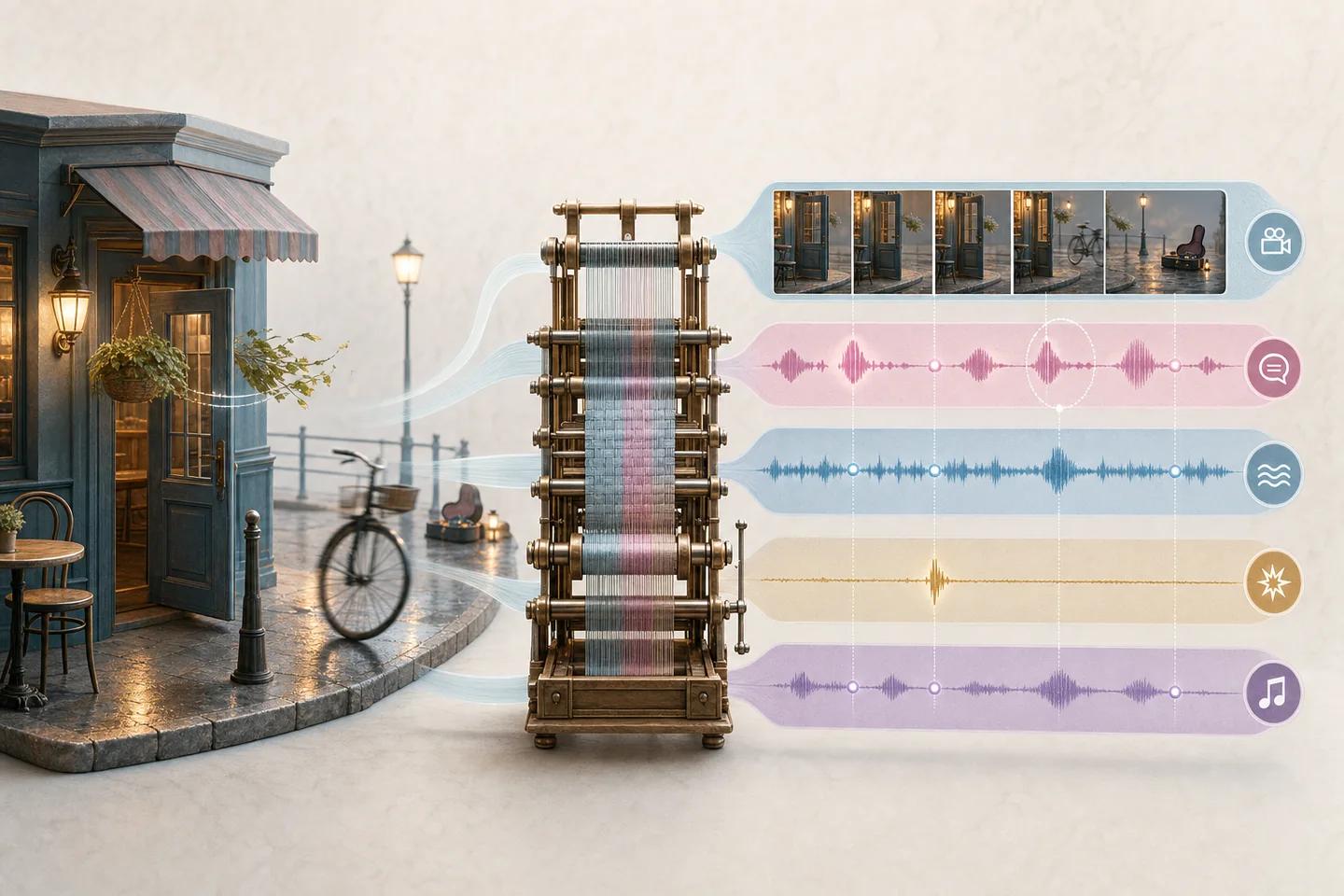
How joint audio-video generation works
Joint audio-video generation produces picture and sound from one prompt in a single system, so footsteps land on the frame where a foot touches the ground and lips move with the words being spoken. Earlier synthetic clips were assembled from parts: a video model made silent footage, a separate text-to-speech or voice cloning tool made the dialogue, and an editor or a lip-sync model stitched them together.
The joint approach conditions both streams on shared information. In some systems one model generates video first and a second model generates audio while watching that video, so sound effects and music follow the on-screen action. In others, audio and video tokens are produced together so neither stream leads. Either way, timing is learned rather than edited in by hand, which removes the small drifts between sound and image that used to give composites away.
How joint audio-video generation changed synthetic media
Three releases between late 2024 and late 2025 moved synchronized sound from research into widely used products.
Meta's Movie Gen paper, submitted on 17 October 2024, described a cast of foundation models led by a 30-billion-parameter video transformer that generates 1080p HD video with synchronized audio, and separate video-to-audio and text-to-audio generation. Meta's project page says the audio can include sound effects, background music or entire soundtracks matched to the video's tone and rhythm.
Google DeepMind's Veo 3 generates sound effects, ambient noise and dialogue natively with the video. Google's own page is candid about the remaining gap: it says natural and consistent spoken audio, especially for short speech segments, is still an area of active development. Veo output is marked with SynthID, Google's watermarking technology.
OpenAI's Sora 2 system card, dated 30 September 2025, describes Sora 2 as a video and audio generation model whose new capabilities include synchronized audio alongside more accurate physics and sharper realism.
| Model | Developer | Date | What the developer says about audio |
|---|---|---|---|
| Movie Gen | Meta | October 2024 (arXiv) | 1080p video with synchronized audio; video-to-audio and text-to-audio generation |
| Veo 3 | Google DeepMind | 2025 | Native sound effects, ambient noise and dialogue; short speech segments still being improved; SynthID watermark |
| Sora 2 | OpenAI | September 2025 (system card) | Video and audio generation with synchronized audio |
Why synchronized sound makes fakes harder to spot
Sound is a strong credibility cue. A silent or badly dubbed clip invites doubt, while a clip with matching room tone, footsteps and a voice that fits the speaker's mouth reads as a recording. Joint generation supplies those cues by default, so the effort needed to produce a persuasive fake scene drops sharply.
The checks that people and simple tools relied on also weaken. Lip-sync drift, mismatched reverberation between voice and room, and sound effects that arrive a few frames late were all useful tells for composited media. A model that learns timing jointly removes many of them at source.
The most dangerous combination for fraud is a familiar face and a familiar voice together. Joint models are mostly prompt-driven today, but personalisation features, such as Movie Gen's ability to generate video that preserves the identity of a person in an uploaded photo, point towards fakes of specific people with matching sound.
How defenders detect jointly generated audio and video
Detection works best when it analyses each stream and then checks them against each other. Visual detectors look for generation artefacts in frames and motion. Audio detectors look for synthetic speech and synthetic ambience. Cross-modal checks compare the two, for example whether the acoustic space of the voice fits the visible room, or whether a voice matches the speaker it is attributed to.
Provenance helps where it survives. Veo marks output with SynthID, and the EU AI Act's Article 50, which applies from 2 August 2026, requires providers of generative systems to mark audio, image, video and text output in a machine-readable way and requires deployers to disclose deepfakes. Re-encoding, screen recording and cropping can strip or weaken these marks, so detection still has to work on unmarked files.
Neural Defend covers both settings. NeuroCall, currently in Beta, screens call audio for synthetic speech, the stream most often used in phone fraud. For uploaded video that needs a reviewed decision, NeuroDetect analyses image, audio and video in one case, shows evidence down to frames and audio segments, and produces a forensic report that records uncertainty and model context.
What organisations should change now
Treat a video clip with convincing sound as a claim to verify, not as proof. For any instruction that moves money, changes access or speaks for the organisation publicly, confirm through a channel the requester did not choose: a callback to a known number, an internal ticket or an in-person check.
Update media intake so that suspicious clips are preserved in original form with their metadata before anyone re-shares or transcodes them, because detection and provenance checks both work better on originals. Build test sets that include jointly generated clips, not only face swaps with dubbed audio, when you evaluate detection vendors.
Brief the people most likely to receive such clips: finance approvers, help-desk staff, press officers and executive assistants. Tell them that matching sound is no longer a sign of authenticity, give them a short escalation route, and make it acceptable to pause a request while it is checked. Contact centres should apply the same rule to voice: a familiar-sounding caller still goes through the standard verification steps before any account change.
Finally, decide in advance who owns a suspected synthetic clip once it is reported. Security, legal and communications teams each need different things from the same file, and a forensic report that records what was analysed, with which model version and with what uncertainty, lets them work from one record instead of three.
Evidence boundary
Limitations
- Model descriptions come from each developer's own paper or product page; independent evaluations of their audio quality are limited.
- Cross-modal consistency checks lose power when one stream is heavily compressed or replaced, for example when audio is re-recorded over a screen capture.
- NeuroCall is in Beta, and no public benchmark result for joint audio-video detection is cited on this page.
Source record
Sources and references
- arXivMovie Gen: A Cast of Media Foundation ModelsPublished October 17, 2024. Verified October 19, 2026.
- Google DeepMindVeoVerified October 19, 2026.
- OpenAISora 2 System CardVerified August 7, 2026.
- European CommissionTransparency obligations under Article 50 of the AI ActVerified October 19, 2026.
- NISTReducing Risks Posed by Synthetic Content (NIST AI 100-4)Published November 20, 2024. Verified October 19, 2026.