
Start application → Document capture → Selfie and liveness → Face match → Approval
The selfie is checked for presence and similarity. Nobody checks whether the face is real.
Banking / NeuroVerify
Banks in every market now open accounts, issue cards and refresh KYC through a selfie or a video call. NeuroVerify checks that face media for deepfakes and manipulation beyond liveness, and returns one risk score with signal-level evidence.
It sits inside the selfie or video step your journey already runs, so customers see nothing new and your team makes one API call.
NeuroVerify does not verify identity documents, open accounts or approve applications. Your identity provider and your own policy keep those decisions.
The gap
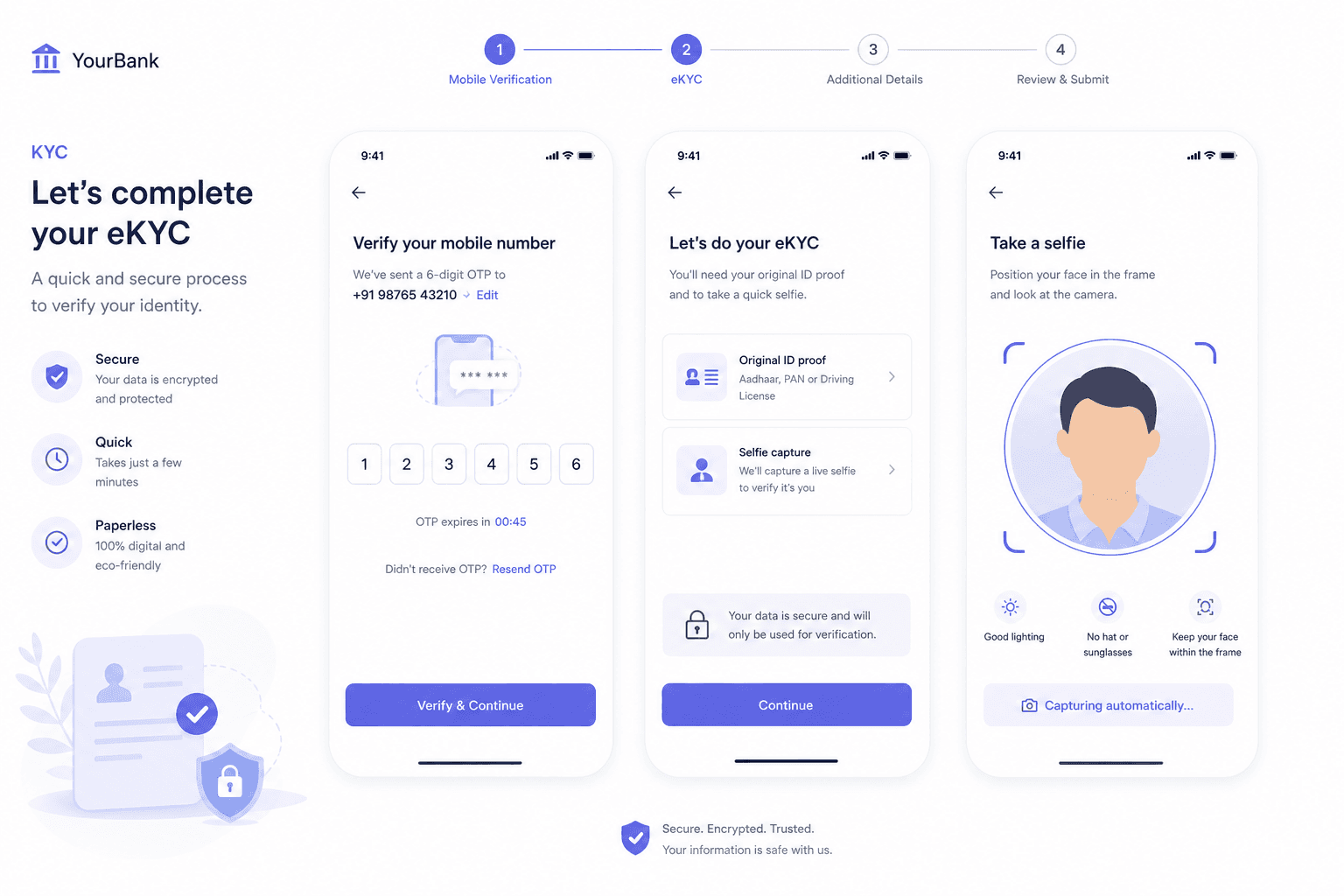
A bank's remote onboarding stack answers several questions. Is the document genuine? Does the customer appear on a watchlist? Does the selfie match the document photo? Was a live person in front of the camera? Each answer comes from a different tool, built for a different threat.
None of them asks how the face in the frame was produced. A face-swap or fully generated face can be built from the photo on a real document, then fed to the capture step through a virtual camera. Face match succeeds because the synthetic face was made to match. A basic liveness check can pass because the synthetic video blinks and turns on request.
Start application → Document capture → Selfie and liveness → Face match → Approval
The selfie is checked for presence and similarity. Nobody checks whether the face is real.
The same selfie or video step recurs across the customer lifecycle: account opening, regulated video KYC sessions, periodic KYC refresh, card and loan origination, and onboarding of agents or branch partners. Each repetition is another chance for manipulated media to pass.
Regulators are noticing. FATF guidance on digital identity and the FinCEN alert on deepfake fraud both point to media authenticity as a risk that identity checks need to address. See FATF Digital Identity Guidance and FinCEN Deepfake Fraud Alert.
Threats
These are attack patterns, not claims about any specific institution.
A fraud ring builds a synthetic face from a stolen document photo and opens accounts to move illicit funds, one clean-looking file at a time.
The attacker routes a pre-rendered or live-generated face into the session instead of a real camera feed, so the agent sees a convincing person.
A fabricated identity gets a generated face that belongs to no real person. Document checks and face match see nothing wrong.
After a takeover, the new operator submits manipulated media at refresh so the account stays in good standing.
Instant-decision products are tuned for speed. A manipulated selfie clears the identity step before a human ever looks.
Someone enrols as a field agent or branch partner with fake face media, gaining insider access to the customer channel.
Read more on digital injection attacks and mule account enrollment with synthetic media.
Where NeuroVerify fits
NeuroVerify runs right after your journey captures a face image, video or audio, and before your policy decides. Your core banking system, KYC vendor, document checks and face-match engine stay in place.
Capture selfie or video → NeuroVerify risk score and signal evidence → Face match → Your policy decision
One added call at each capture point. Nothing upstream or downstream is removed.
NeuroVerify runs six signals in a single request: Visual Safety Screening, Live Presence Verification, Face Manipulation Detection, AI Generative Model Analysis, AI Pixel-Level Manipulation and AI Content Compliance. The response is one unified risk score with the evidence behind each signal. It analyses face images, video and audio, not documents.
Banks that need data to stay inside their perimeter can deploy as a private cloud, secure container, on-premises or air-gapped. See deployment and NeuroVerify.
Pass the media your app or video KYC session already captures to the NeuroVerify API or SDK.
One score with signal-level evidence returns in the same response.
Continue, step up to manual review, or decline, under rules your fraud and compliance teams own.
Keep the result against the application so later reviews and audits do not depend on session logs.
What you get
A synthetic face built to match a document photo is flagged on authenticity signals, not just similarity.
The same call protects onboarding, video KYC, re-KYC, origination and agent onboarding.
Detection runs on media you already capture, so conversion is not put at risk.
Signal-level evidence tells analysts why a case was flagged, so manual review is shorter.
Cloud, VPC, on-premises or air-gapped options suit banks with strict data residency.
Questions
No. It adds an authenticity check to the selfie or video step. Document verification, watchlist screening, face match and the final decision stay with your existing vendors and your own policy.
Yes, it can analyse video frames and audio from a session your platform already records. Regulatory sufficiency is a judgment for your compliance team. NeuroVerify supplies evidence and does not certify any session. For a related view, see Deepfake Detection for Video KYC.
Not for this purpose. Live Presence Verification is one of the six signals NeuroVerify runs in a single request, alongside Face Manipulation Detection, AI Generative Model Analysis, AI Pixel-Level Manipulation, Visual Safety Screening and AI Content Compliance. It checks selfie images, video and audio from your customer journeys for deepfakes and manipulation beyond liveness.
If you already run a liveness vendor, keep it during evaluation and compare outcomes on your own media before deciding what to retire. The difference is explained in Deepfake Detection vs Liveness Detection.
It fits the capture step you already run, so the end user sees nothing new. You send the media you already collect to one API call. Native mobile SDKs (Android/Kotlin, iOS/Swift, Flutter), backend SDKs (Python, TypeScript/Node.js, Go, Java) and a REST API are available, and an MCP server covers AI agents.
Two lines to integrate and live in under 24 hours are product claims. Your own timeline depends on how your onboarding and KYC stack is wired.
NeuroVerify returns in under 200 ms at p95 on eligible image requests under defined test conditions. The methodology is available on request. Video and audio take longer than a single image, so decide with your team which step runs inline and which runs in the background.
You choose the deployment model: managed cloud API, private cloud or customer VPC, secure container, on-premises, or air-gapped. Neural Defend holds ISO/IEC 27001, ISO/IEC 27701, ISO/IEC 42001 and SOC 2 Type II certifications. Your legal team decides consent, retention and residency for the media you send.
Details are on the deployment and product data handling pages. For the privacy angle, see GDPR, Biometrics, and Authenticity Analysis.
Yes, and that is the test that matters. On the public VendorBench-100 benchmark, NeuroVerify ranked first of 36 systems with a detection score (MCC) of 0.876 against 0.646 for the next-best vendor. A benchmark does not reflect your devices, lighting, compression or attack mix, so bring representative samples from your own journey.
Contact us to set up an evaluation.
NeuroVerify returns one unified risk score with signal-level evidence. It does not approve or reject anyone. Your policy sets the thresholds and decides what happens at each level: continue, step up to a manual review, or decline.
The signal-level evidence tells a reviewer why a case scored high, which makes review queues faster and decisions easier to explain later.
Evaluate NeuroVerify
Send representative selfies and video from your own journeys and see the risk score and signal evidence for yourself. Contact us to plan an evaluation.