What was Video Rewrite (1997)?
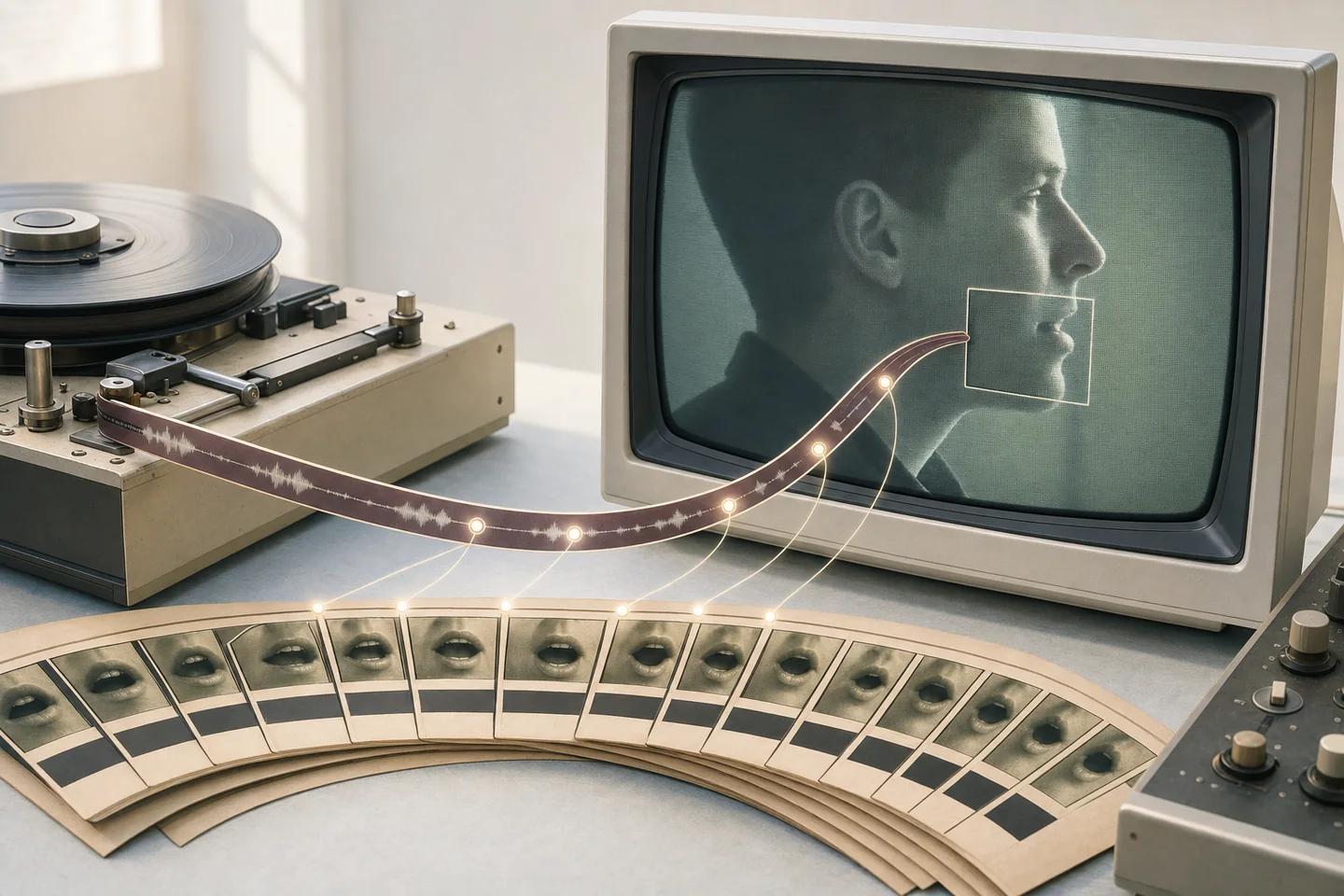
Video Rewrite was a system presented at SIGGRAPH 1997 by Christoph Bregler, Michele Covell and Malcolm Slaney that made existing footage of a person appear to speak a new audio track. It learned from recorded video of one speaker, analysed the new audio, chose matching mouth images from that speaker's own footage, and blended them into the original video. The rest of the frame, including the head, background and lighting, stayed as captured.
The method worked in three broad stages. First it built a database of the target speaker's mouth appearances linked to the sounds being spoken. Second it processed the new soundtrack and mapped it to a sequence of visual speech units. Third it selected, ordered and composited the matching mouth regions into the background footage so that transitions looked continuous. Nothing in that pipeline resembles a modern generative neural network; it was data-driven selection and compositing.
What did Video Rewrite prove about synthetic speech video in 1997?
It proved that sound alone could drive believable changes to a real person's mouth in real footage, at least for a speaker with enough recorded material. That was a new kind of claim. Earlier film effects edited speech by hand, frame by frame. Video Rewrite automated the mapping from audio to mouth appearance and showed it could be repeated for new sentences the person never said.
Just as important, it set out the parts of the problem every later system would have to solve: turn audio into a mouth-motion target, render that motion in the person's own appearance, keep transitions smooth across frames, and hide the join between edited and untouched pixels. Twenty years later, talking-head generators still organise their papers around those same sub-problems, with learned models replacing hand-built steps.
Why is visual speech so hard to fake well?
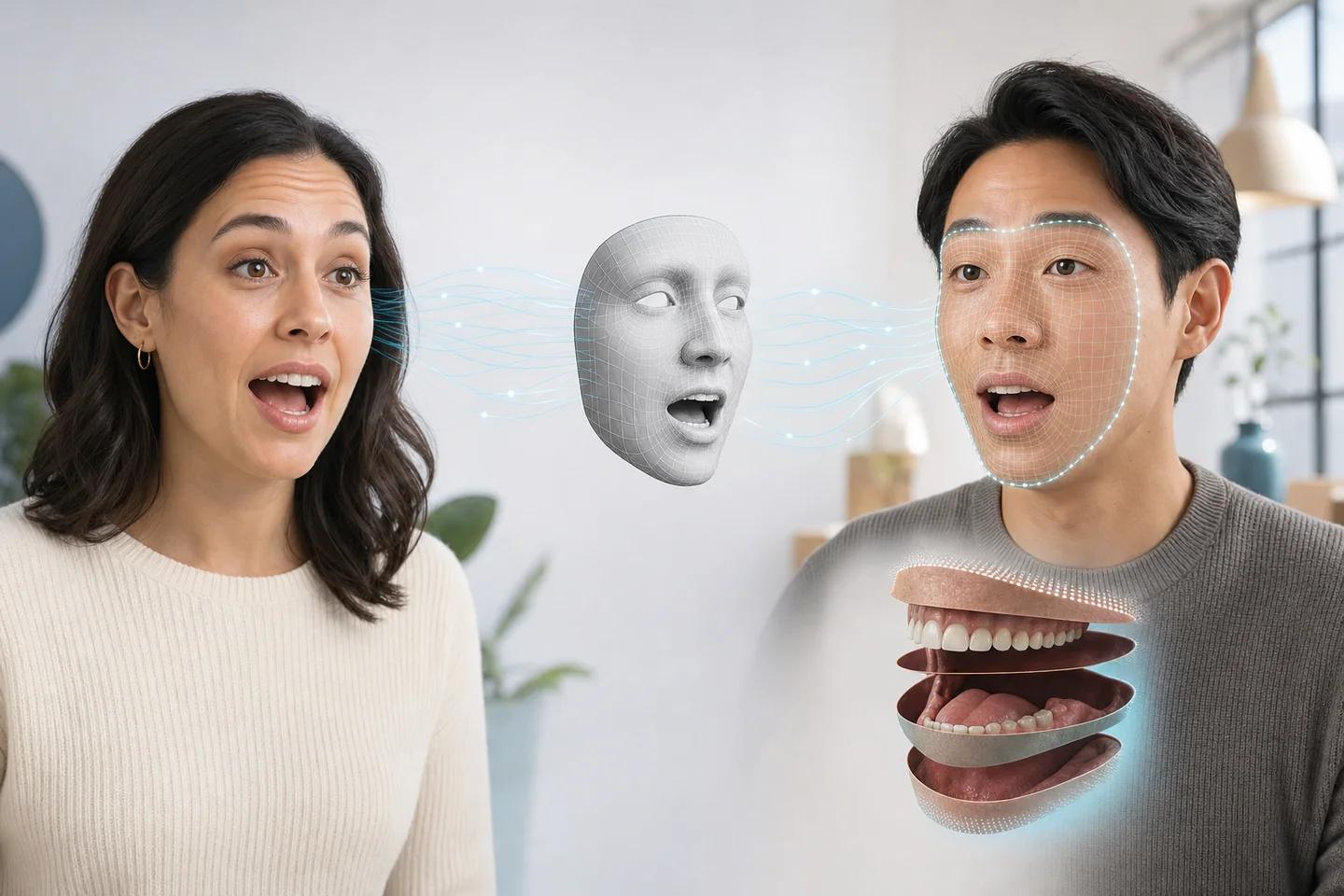
Speech moves more than the lips. The jaw drops, the cheeks shift, the chin and the area under the nose move, and each mouth shape is influenced by the sounds before and after it. A sequence of individually correct mouth images can still look wrong if the transitions between them are abrupt. Video Rewrite had to manage those transitions explicitly, which is an early form of the temporal consistency problem that video generators still wrestle with.
Limiting the edit to the mouth made the task tractable but moved the risk to the boundary. The inserted region had to agree with head motion, skin tone and lighting already present in the footage. Any mismatch in timing, colour or blending could give the edit away even when each mouth image looked plausible on its own.
How did lip-sync manipulation evolve after 1997?
The line from Video Rewrite to today runs through a handful of systems that each changed the task, not just the quality. The table summarises the steps, using each project's own description.
| Year | System | What changed |
|---|---|---|
| 1997 | Video Rewrite (SIGGRAPH) | Reordered recorded mouth images of one speaker to match new audio and composited them into footage |
| 2017 | Synthesizing Obama (SIGGRAPH) | A recurrent network mapped audio features to mouth shape, synthesized mouth texture and composited it with 3D pose matching; trained on many hours of one speaker's weekly addresses |
| 2020 | Wav2Lip (ACM Multimedia) | Lip-synced talking-face video of arbitrary identities using a strong lip-sync discriminator |
| 2024 | VASA-1 (Microsoft Research) | Generated a talking face from one still image and an audio clip, online at 512 by 512 pixels and up to 40 frames per second |
What Video Rewrite teaches about detecting lip-sync deepfakes
Mouth-region edits are local. Most of the frame is authentic camera output, so a detector that averages evidence over the whole image can dilute the signal. Useful analysis looks at the mouth and its boundary over time: does lip motion match the phonetic content of the audio, do teeth and inner-mouth detail stay consistent, and does the blend region shift when the head turns?
Distribution complicates all of this. Resizing and compression soften boundaries and add block artifacts to genuine and edited video alike, so a clean-looking file is not proof of authenticity and a blocky one is not proof of tampering. The FaceForensics++ benchmark, released in 2019, made this point by testing detectors on facial manipulations at several compression levels; its authors report that trained detectors clearly outperform human observers. Attribution is a separate step: similar-looking output does not show that a 1997-style compositing pipeline, rather than a neural model, produced a clip.
What the 1997 record can and cannot establish
The paper supports a dated claim that audio could drive revised visual speech for a recorded person through a person-specific database and compositing. It does not support claims of arbitrary identity transfer, generation from a single photograph, real-time operation in a live call or full-frame synthesis. Those capabilities arrived with later systems such as Wav2Lip and VASA-1, under very different technical assumptions.
The same caution applies in the other direction. If a reviewer sees a clip with a stable head, a talking mouth and a soft boundary around the lower face, that pattern is consistent with a 1997-style composite, a 2017-style learned mouth texture or a 2020s generator. Naming the method needs implementation details, provenance records or artifacts validated for that specific pipeline. Without them, the defensible finding is narrower: possible manipulation of the mouth region, with the evidence and its uncertainty stated.
How Neural Defend examines manipulated speech video
NeuroDetect is built for exactly this kind of local, time-based evidence. An analyst uploads an authorized video or audio file into a case, and the workspace shows the original alongside explainability heatmaps and attention views that point to specific regions, frames and audio segments. An LLM-assisted summary explains the findings in plain language with links to the evidence, the analyst makes the final call, and the downloadable forensic report records observations, uncertainty, provenance and model context.
For live onboarding, NeuroVerify screens face video and audio in one API call and returns a risk score with signal-level evidence, and NeuroCall, in Beta, focuses on voice deepfakes in calls. The ARCAS 1B model underneath reports pooled accuracy of 97.65% to 99.99% across six image benchmarks in the ARCAS paper; for speech video, test it on clips from your own channel.
Evidence boundary
Limitations
- Technical details here are summarised from the paper's description and later references; the exact implementation is not reproduced.
- Artifacts typical of a compositing pipeline should not be treated as universal signatures of neural lip-sync deepfakes.
- Compression and resizing can hide or mimic mouth-boundary evidence in both genuine and manipulated video.
Source record
Sources and references
- ACM Digital LibraryVideo Rewrite: Driving Visual Speech with Audio (SIGGRAPH 1997)Verified August 7, 2026.
- University of Washington GRAILSynthesizing Obama: Learning Lip Sync from Audio (SIGGRAPH 2017)Verified October 19, 2026.
- arXivA Lip Sync Expert Is All You Need for Speech to Lip Generation In The WildPublished August 23, 2020. Verified October 19, 2026.
- arXivVASA-1: Lifelike Audio-Driven Talking Faces Generated in Real TimePublished April 16, 2024. Verified October 19, 2026.
- arXivFaceForensics++: Learning to Detect Manipulated Facial ImagesPublished January 25, 2019. Verified October 19, 2026.