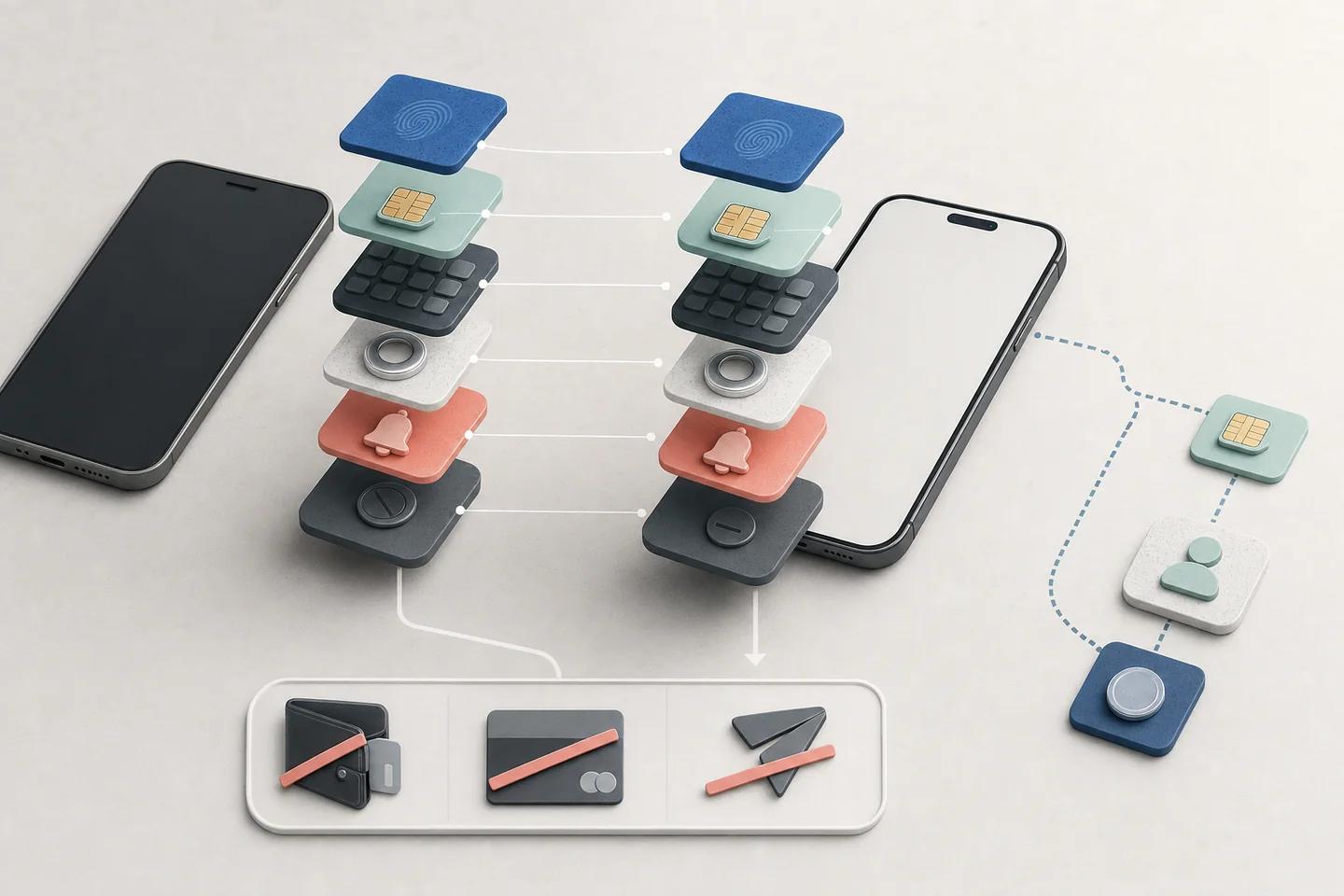

How does AI impersonation lead to account takeover?
AI impersonation leads to account takeover by supplying the one thing many access controls still depend on: a believable person. Synthetic media does not break passwords or MFA. It persuades a support agent, a self-service verification flow or the real account holder to give up a reset, a code or an approval that hands over control.
The first route targets the provider. The attacker poses as the customer, claims a lost phone, and submits a face-swapped selfie video or calls support with a cloned voice to rebind the account to a new device. The second route targets the customer. The attacker poses as the bank, a colleague, a relative or an official and asks the victim to read out a one-time code, approve a push prompt or follow a link. The third targets employees: the attacker poses as internal IT to collect credentials and MFA codes, a pattern documented in the CISA and FBI Scattered Spider advisory.
| Route | Who is impersonated | What the attacker asks for | Primary control |
|---|---|---|---|
| Provider-facing | The account holder | Device rebinding, MFA reset, recovery approval | Deepfake and injection checks on recovery media; callback to registered channels |
| Customer-facing | Bank, official, colleague or relative | One-time codes, push approvals, links to new platforms | Never share codes; verify through saved contacts |
| Employee-facing | Internal IT or help desk | Credentials, MFA codes, remote access tool installs | Phishing-resistant MFA; documented help-desk verification |
How fake officials and contacts win codes and links
The FBI warned in 2025 that malicious actors were impersonating senior US officials with text messages and AI-generated voice messages to build rapport, then sending links that claimed to move the conversation to another messaging platform or asking for two-factor authentication codes. Once an account was compromised, its real contact list and history could be used to impersonate the victim to others.
A cloned voice or a familiar profile photo lowers doubt at the moment the target is asked to act. That makes the media part of credential theft rather than a separate reputational problem. The defence is procedural: no legitimate bank, employer or agency needs you to read a one-time code back to them, and any request to switch platforms should be confirmed through a contact you already have.
- Treat any inbound request for a one-time code as an attack.
- Reject unexpected login or device-approval prompts, even if they follow a convincing call.
- Open services through saved bookmarks or official apps, not links in messages.
Signals that an impersonation has become a takeover
Look at identity and session changes together. A new device, a password change, a removed authenticator, a new mailbox forwarding rule or a contact export soon after a suspicious call is a strong sign that access has moved to someone else. FinCEN's alert of 13 November 2024 on deepfake fraud lists account access from an IP address inconsistent with the customer's profile, and rapid transactions or immediate withdrawals that are hard to reverse, among its indicators for further due diligence.
Location alone is weak evidence because genuine users travel and attackers use relays. Correlate the event with the timing of the impersonation contact, the device history and what happened next.
How to contain an account takeover
Contain every access path, including sessions and tokens that survive a password change. Revoke all sessions and tokens, remove unrecognised devices, passkeys and recovery contacts, disable forwarding rules and delegated access, then reset credentials through a verified process. For privileged accounts, review downstream systems where tokens may still be valid.
Financial accounts need two separate containment tracks. In a brokerage takeover, the attacker may trade thinly traded securities, liquidate positions or add new bank instructions to move cash out. Restrict trading and disbursement under their own authorities, preserve order and market-state evidence, and check for linked accounts that profited from the victim's trades. FINRA Regulatory Notice 21-18, published in May 2021, describes firm practices including adaptive authentication for risky transactions, monitoring groups of accounts and reviewing a customer's other accounts after a reported takeover.

Why a claimant's video should never restore access alone
After a takeover, both the attacker and the real customer may contact support claiming to be the owner. A video call or selfie from either party can be checked for manipulation, but a passing result cannot by itself prove who is authorised or which trades the customer approved. Restore access through established contact channels and layered recovery evidence, and record the media analysis as one input with its uncertainty.
Warn the victim's contacts through a different verified channel with specifics: the time window and the kinds of requests to ignore. The incident is not over until the compromised account can no longer be used as a launch point for the next impersonation.
Where NeuroVerify fits in takeover prevention
NeuroVerify, Neural Defend's deepfake detection API, checks face images, video and audio submitted at recovery, device rebinding or step-up authentication. Six signals, including Face Manipulation Detection, AI Generative Model Analysis and Live Presence Verification, run in one call and return one risk score with signal-level evidence. Eligible image requests complete in under 200 ms p95 under defined test conditions, so the check can sit inline without slowing genuine users.
The result goes to your policy engine, which decides whether to approve, add friction or send the case to review. NeuroVerify does not detect emulators or virtual cameras and does not analyse ID documents, so pair it with device-integrity signals and your document checks. Mobile SDKs for Android, iOS and Flutter and backend SDKs for Python, TypeScript, Go and Java shorten integration.
Evidence boundary
Limitations
- A suspicious authentication event does not prove synthetic media was used; many takeovers rely on stolen credentials alone.
- Session and location signals produce legitimate anomalies and need contextual review.
- Media analysis indicates whether a sample shows manipulation; it does not establish who is authorised on an account.
Source record
Sources and references
- Federal Bureau of InvestigationSenior U.S. Officials Continue To Be Impersonated in Malicious Messaging CampaignVerified August 7, 2026.
- Financial Crimes Enforcement NetworkFinCEN Alert on Fraud Schemes Involving Deepfake Media Targeting Financial Institutions (FIN-2024-Alert004)Published November 13, 2024. Verified October 19, 2026.
- Cybersecurity and Infrastructure Security AgencyScattered Spider (Cybersecurity Advisory AA23-320A)Published November 16, 2023. Verified October 19, 2026.
- Financial Industry Regulatory AuthorityRegulatory Notice 21-18: FINRA Shares Practices Firms Use to Protect Customers From Online Account Takeover AttemptsPublished May 12, 2021. Verified October 19, 2026.
- National Institute of Standards and TechnologySP 800-63-4, Digital Identity GuidelinesVerified August 7, 2026.