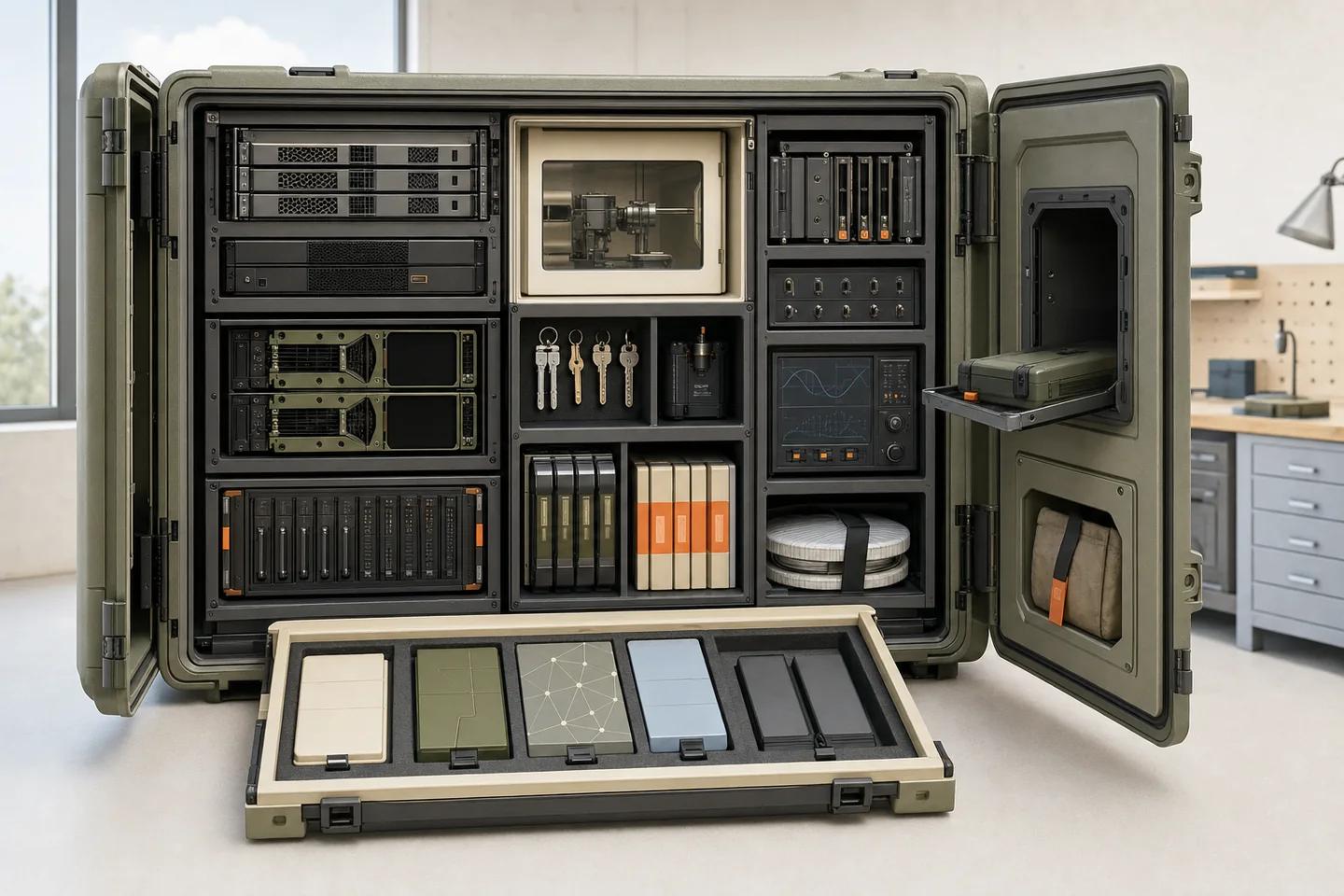

What is data residency for deepfake detection?
Data residency is a requirement that data stays in a defined geography, or inside a defined network, while it is stored and processed. For deepfake detection it applies to some of the most sensitive data an organisation holds: selfies and identity videos, voice recordings, claim photos and evidence files. Those files are often personal data, and when used to identify a person, biometric data.
Three related terms get mixed up. Residency is where data lives. Sovereignty is which country's laws can reach it, which can include the vendor's home jurisdiction even when servers are local. Localisation is a legal mandate to keep certain data in-country. A buyer's requirement can involve any of the three, so state which one applies before asking vendors.

How should buyers evaluate data-residency requirements?
Start with the rules, then map the data, then test the vendor's answers. List the legal, regulatory and contractual obligations that cover the media you will submit: privacy law, sector rules, public-sector hosting policies and customer contracts. Note the strictest location requirement and whether it covers storage only or processing as well.
Next, ask the vendor for a data-flow map of a single request. It should show where the file is received, where inference runs, what is cached, which derived artefacts are created, where logs and metrics go, where backups are stored, and from which countries support staff can access any of it. Each item needs a location and a retention period.
Finally, check the answers against the rules and verify what you can. Confirm endpoint locations during the proof of concept, write locations and sub-processors into the data processing agreement, and require notice before any change.
- Which laws, regulators and contracts govern this media, and what do they require?
- Does the requirement cover storage, processing, or both?
- Where does each copy and derivative of the media live, and for how long?
- Who can access the data, from where, and under what approval?
- Which sub-processors are involved, and where are they located?
Rules that commonly drive residency decisions
In the EU, the GDPR defines biometric data in Article 4(14) as personal data resulting from specific technical processing of physical characteristics that allows or confirms unique identification, and Article 9(1) restricts processing of biometric data for uniquely identifying a person. Transfers of personal data outside the European Economic Area must meet the regulation's international transfer rules. Many EU buyers respond by requiring in-region processing for identity media.
Sector rules can go further. The Reserve Bank of India's circular of 6 April 2018 on storage of payment system data requires that the entire payment data be stored only in India; where processing happens abroad, the data must be deleted there and brought back within one business day or 24 hours, whichever is earlier. Banks often extend similar expectations to identity and onboarding data as a matter of policy.
Public-sector and defence buyers may have hosting rules that rule out any third-party cloud. For them, residency questions become deployment questions.
Which deployment options meet strict residency requirements
The deployment model sets the ceiling on what residency a vendor can offer. A managed cloud API in a chosen region can meet storage-location rules, provided inference, logging and support stay in-region too. Private cloud or VPC deployment keeps processing inside the buyer's own cloud account. A secure container or on-premises install keeps media inside the buyer's data centre. Air-gapped deployment removes any network path to the vendor.
| Deployment | Where media is processed | Residency strength | Trade-off |
|---|---|---|---|
| Managed cloud API (regional) | Vendor cloud in the selected region | Meets location rules if all processing and support stay in-region | Depends on vendor controls and sub-processors |
| Private cloud or VPC | Buyer's cloud account | Strong; buyer controls region and access | Shared operations |
| Secure container or on-premises | Buyer's infrastructure | Very strong; media stays in buyer's network | Buyer runs and updates the service |
| Air-gapped | Isolated buyer network | Strongest; no external network path | Offline updates and highest operating effort |
Where residency claims commonly fall short
The usual gaps are not in primary storage. They are in the edges: telemetry and error logs shipped to a global monitoring service, support engineers in another country who can open customer samples, backups replicated to a second region for resilience, and model improvement pipelines that copy customer media to a central training environment.
Ask about each of these explicitly. Also ask whether customer media is used to train models at all, since training copies are hard to locate and delete later.
Does strict residency affect detection quality?
It can, indirectly. Detection quality depends on the model version a deployment runs, not on where it runs. But self-hosted and air-gapped installs receive model updates through a release process the buyer controls, and if that process is slow, the deployed model falls behind new generators. Managed cloud deployments usually receive updates as soon as the vendor ships them.
Plan for this when choosing a strict option. Agree an update cadence and delivery method with the vendor, budget time to validate each new model on your held-out media, and track how far the deployed version lags the current release. Residency and current detection can coexist, but only if updating is treated as routine work rather than an exception.
How Neural Defend supports data residency
Neural Defend deploys as a managed cloud API, in a private cloud or VPC, as a secure container, on-premises or air-gapped, with the option scoped during evaluation against your residency rules. For investigation teams, NeuroDetect can run inside your environment so authorized evidence files, explainability views and forensic reports stay within your boundary. NeuroVerify can be deployed the same way for onboarding media.
Our controls are certified to ISO/IEC 27001, ISO/IEC 27701 and ISO/IEC 42001, with a SOC 2 Type II report, and our product data handling documentation describes how media is processed and retained. Bring your residency requirements to the first call, and we will map each data type to a location with you.
Evidence boundary
Limitations
- This page summarises selected rules and is not legal advice; residency obligations depend on jurisdiction, sector and contract.
- Residency rules change, and sector regulators may issue guidance that goes beyond the laws cited here.
- Stricter deployment options improve residency but add operating effort and can slow model updates.
Source record
Sources and references
- EUR-LexRegulation (EU) 2016/679 (General Data Protection Regulation)Published April 27, 2016. Verified October 19, 2026.
- Reserve Bank of IndiaStorage of Payment System Data: Frequently Asked QuestionsVerified October 19, 2026.
- AICPA and CIMASOC 2: System and Organization Controls for Service OrganizationsVerified October 19, 2026.
- International Organization for StandardizationISO/IEC 27701:2025 Privacy information management systems requirements and guidanceVerified August 7, 2026.
- National Institute of Standards and TechnologyThe NIST Definition of Cloud Computing (SP 800-145)Published September 28, 2011. Verified August 7, 2026.