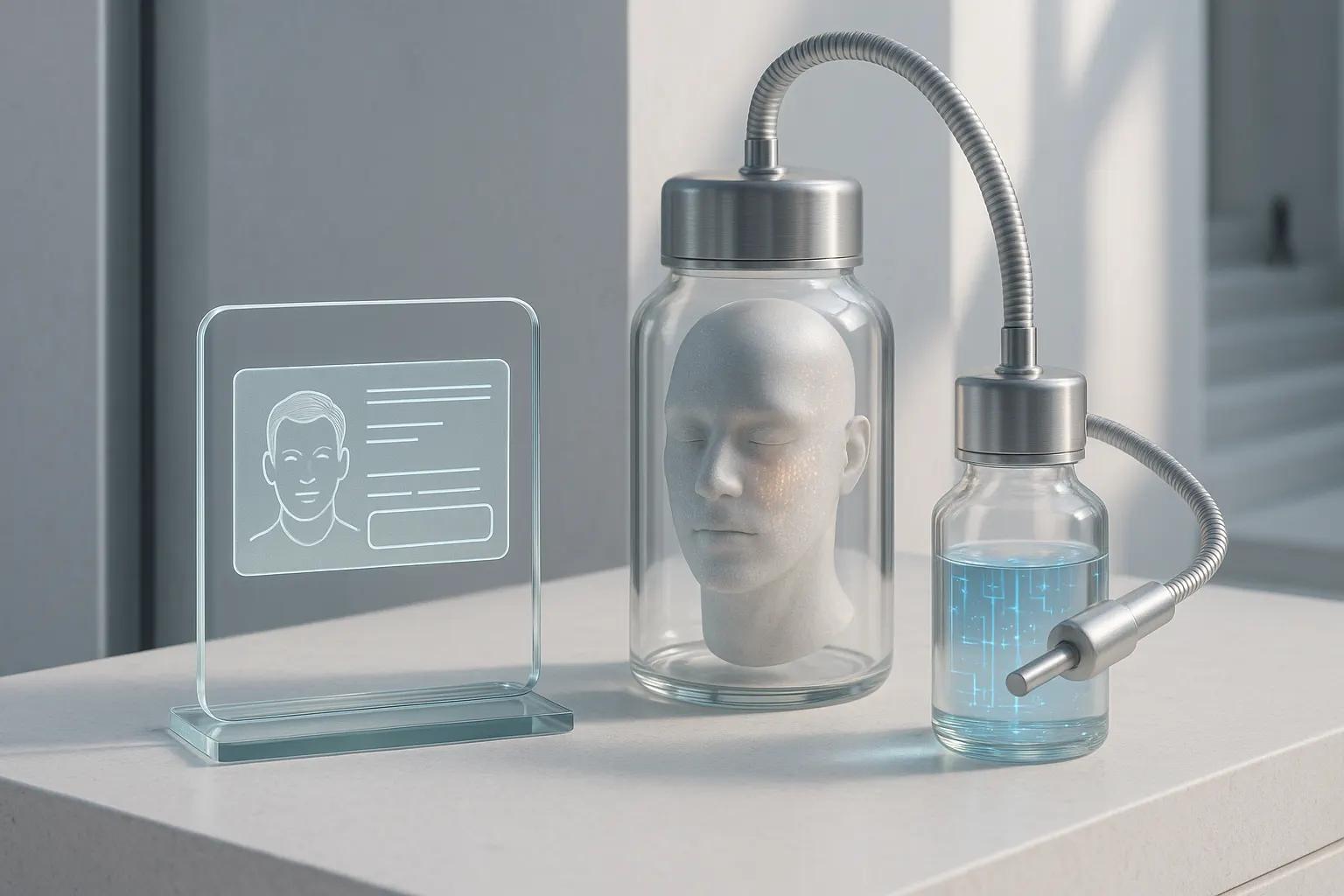

How can deepfake detection integrate with an existing IDV stack?
Deepfake detection integrates with an existing IDV stack as one more check on media you already collect. Your capture SDK records the selfie or liveness video, your IDV provider runs document authentication and face matching, and your backend sends the same face media to NeuroVerify before the case reaches your decision engine. Nothing upstream has to change.
The call belongs on your server, after the capture lands and before approval. Running it there keeps the API key off the device, lets you score media from web, mobile and agent-assisted channels with one code path, and means injected files that skipped the camera are still analysed, because the check runs on whatever arrived.
NeuroVerify answers a narrower question than your IDV vendor does. Face matching asks whether the selfie matches the document photo; liveness asks whether a live person was in front of the camera. NeuroVerify asks whether the face media shows signs of manipulation or generation, using six signals in one request: Visual Safety Screening, Live Presence Verification, Face Manipulation Detection, AI Generative Model Analysis, AI Pixel-Level Manipulation and AI Content Compliance. The comparison of deepfake detection vs liveness detection covers why both are needed.
| Stage | Usually handled by | What NeuroVerify adds |
|---|---|---|
| Capture (selfie, liveness video) | Your capture SDK or IDV vendor | Nothing; keep your capture flow |
| Document authentication | Your IDV or document vendor | Nothing; NeuroVerify does not analyse ID documents |
| Face match to document photo | Your IDV vendor | Nothing; matching stays where it is |
| Media authenticity | Often missing | Six-signal risk score on the face image, video or audio |
| Decision | Your rules engine or case tool | A risk band and signal evidence as one more input |
Integration steps: from the first API call to production
The sequence below covers most integrations, and the developer quickstart walks through the first request in detail. Neural Defend describes the work as two lines to integrate with an SDK, and teams can be live in under 24 hours once access and test media are ready.
The REST contract is small. POST /detect/image analyses a single-face still image and POST /detect/video analyses a video plus its audio track when one is present; both take one multipart field called file, and direct REST calls send the key in the x-api-key header. The OpenAPI contract lists a production and a staging origin, and keys are issued per environment.
Pick one application contract and stay with it. Python and TypeScript integrations should depend on the SDK's normalized result objects, direct REST code on the OpenAPI envelope, and AI-agent automations on the MCP server's structured output. The Python SDK page shows the normalized fields.
- Request access and store the key in a secret manager, never in source, browser bundles or tickets.
- Install a backend SDK (Python, TypeScript/Node.js, Go or Java) or call REST; use the Android, iOS or Flutter SDKs only where scoring must start from the app.
- Send one approved test file to the staging origin and confirm you parse success, rejected and error outcomes.
- Add the call to the onboarding service after capture, passing the same media your IDV vendor receives.
- Run in shadow mode: log the risk band next to your current decision without acting on it.
- Set thresholds by risk band, assign a review owner for medium, high and unknown results, then switch to enforcement.
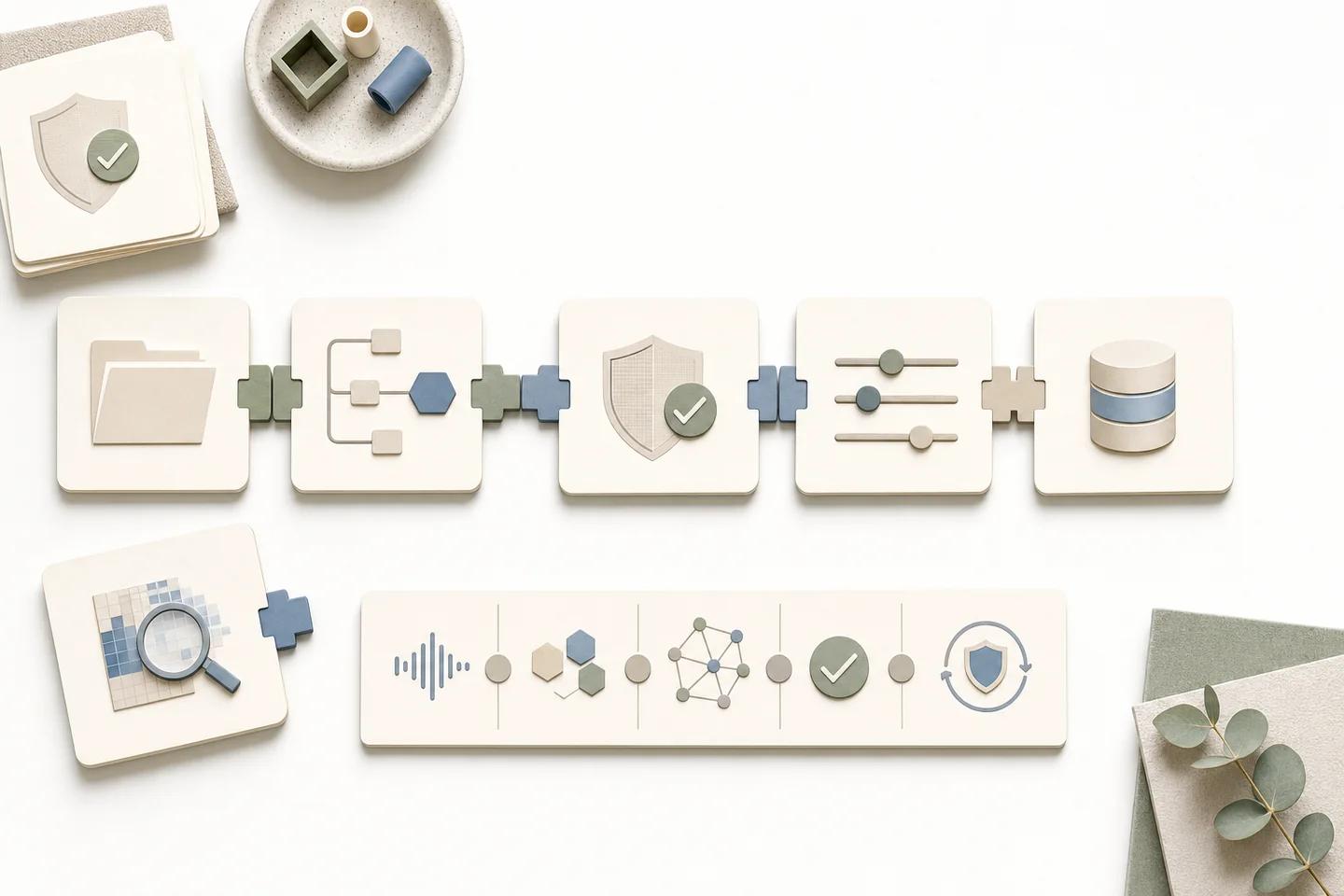
How do enterprises integrate deepfake detection across teams and environments?
Enterprises integrate deepfake detection by treating it as a shared service: one owner for the API integration, one policy owner in fraud or compliance, and one deployment model agreed with security and privacy teams before the pilot. The technical call is the easy part; most of the time goes into data handling and decision ownership.
Deployment is the first decision. Neural Defend offers a managed cloud API, private cloud or VPC, a secure container, on-premises and air-gapped installation, scoped during evaluation. None of these needs specialised client hardware; capture runs on the devices your customers already use. Neural Defend holds ISO/IEC 27001, ISO/IEC 27701, ISO/IEC 42001 and SOC 2 Type II certifications, which shortens most vendor security reviews.
Run the pilot in parallel with live traffic. A period of shadow scoring shows how risk bands distribute across your real population, how many cases would go to review, and whether any segment needs a different threshold. Store the transaction identifier, outcome status, risk band and your own policy decision for each case; the developer guidance on security and data handling advises against logging media bytes, keys, filenames or raw headers.
| Deployment | Where media is processed | Typical reason |
|---|---|---|
| Managed cloud API | Neural Defend's hosted service | Fastest start; no infrastructure to run |
| Private cloud or VPC | Your cloud account or a dedicated environment | Residency or network isolation requirements |
| Secure container | Your container platform | Keep processing inside your own estate |
| On-premises | Your data centre | Bank or government policy against external processing |
| Air-gapped | An isolated network with no internet link | Highest-sensitivity or offline environments |
How to wire NeuroVerify results into your KYC decision engine
Read status before anything else. The API returns success, rejected or error, and some SDKs add an unknown state for responses a newer server sends. A documented face-policy case can return a billable rejection with null risk fields, so code an explicit branch for every state and make sure none of them silently approves the applicant.
Use the risk band for rules. For images, risk_score is an opaque value from 0.1 to 10.0 and risk_level is low, medium or high; the API documentation advises building rules on the band because thresholds may be tuned. For video, inspect the video and audio results separately, since a silent clip can carry a valid video score and no audio score.
Latency is rarely the constraint. Eligible image requests return in under 200 ms p95 under defined test conditions, and the public VendorBench-100 benchmark measured a 175 ms mean for Neural Defend on still images in its own setup. Video takes longer and scales with length and the max_frames and sample_rate settings, so a common pattern is to score the selfie synchronously and the liveness video in parallel with the IDV vendor's checks, which adds little to the time an applicant waits.
Keep the score a signal. Your policy decides whether a high-risk band means step-up, manual review or decline, and NIST SP 800-63A-4 recommends augmenting automated media decisions with manual review to catch detection errors.
How does Neural Defend integrate with a KYC stack in the US, UK, Canada, Australia, Singapore, the UAE, Saudi Arabia and Indonesia?
The API, SDKs and decision wiring are the same in every country. What changes is where media may be processed and which rules shape your evidence, so regional work is mostly a deployment and contract choice. The notes below are orientation, not legal advice; confirm obligations with your counsel and regulator.
United States: add NeuroVerify to the selfie and video step and keep the evidence trail. FinCEN's alert FIN-2024-Alert004 (13 November 2024) reported more suspicious activity reports describing deepfake media, especially fraudulent identity documents used to get past verification. NIST SP 800-63A-4 Section 3.14 says identity proofing services shall analyse all submitted media for manipulation and should look for signatures of generative AI and deepfake tools, which is the layer NeuroVerify covers. The FinCEN deepfake fraud alert page explains the red flags.
United Kingdom: integration is identical; the question is whether media leaves the UK. The ICO's international transfers guide says a restricted transfer needs UK adequacy regulations, an appropriate safeguard such as the International Data Transfer Agreement or Addendum with a transfer risk assessment, or a narrow exception. A UK-hosted private cloud or on-premises deployment keeps the media in the UK and takes the transfer question out of the design.
Canada: NeuroVerify fits the person-matching half of FINTRAC's government-issued photo ID method. For remote verification FINTRAC requires the document to be authenticated with technology and the person matched to the photo, for example by live video or a selfie checked with facial recognition, and says viewing a person and document over video alone is not enough. Your document vendor keeps authentication; NeuroVerify checks that selfie or video for manipulation.
Australia: under Australian Privacy Principle 8 and section 16C of the Privacy Act, an entity disclosing personal information overseas must take reasonable steps and stays accountable for the recipient. OAIC guidance says overseas cloud storage can count as a use rather than a disclosure when the entity keeps effective control by contract, so the deployment and contract terms decide how much APP 8 work you face.
Singapore: the Monetary Authority of Singapore published an information paper, Cyber Risks Associated with Deepfakes, on 18 September 2025, describing deepfake threats to financial institutions and possible mitigations. It is guidance, so no detection product makes an institution compliant by itself; NeuroVerify gives you a documented media-authenticity control and per-case evidence to show how you addressed the risk.
United Arab Emirates: Federal Decree-Law No. 45 of 2021 on personal data protection took effect on 2 January 2022, but it excludes banking and credit data, which follow their own regime, and free zones such as DIFC and ADGM that have their own data protection laws. Check which regime covers your entity first; on-premises or in-country private cloud deployment of NeuroVerify is available where data must stay onshore.
Saudi Arabia: the Personal Data Protection Law took effect on 14 September 2023 and became fully enforceable on 14 September 2024, supervised by SDAIA. Transfers outside the Kingdom need an adequacy decision or safeguards such as SDAIA standard contractual clauses, binding corporate rules or accreditation certificates, plus a risk assessment in some cases. On-premises or in-Kingdom deployment removes the transfer from the design.
Indonesia: Law No. 27 of 2022 on Personal Data Protection required full compliance by 17 October 2024 after a two-year transition. The integration is the same as elsewhere; choose private cloud or on-premises deployment where their data protection assessment or sector regulator expects local processing.
| Market | Rule or guidance to read | Integration question it raises | Common deployment choice |
|---|---|---|---|
| United States | FinCEN FIN-2024-Alert004; NIST SP 800-63A-4 s3.14 | Do you analyse all submitted media and keep SAR-ready evidence? | Managed cloud API |
| United Kingdom | UK GDPR restricted transfer rules (ICO guide) | Does media leave the UK, and under which mechanism? | Managed cloud or UK private cloud |
| Canada | FINTRAC methods to verify identity | Where is the selfie or video that matches the person to the photo? | Managed cloud or private cloud |
| Australia | APP 8 and s16C, Privacy Act 1988 | Is overseas processing a use or a disclosure? | Private cloud or contract terms |
| Singapore | MAS information paper on deepfakes (18 Sep 2025) | Can you evidence a media-authenticity control? | Managed cloud or private cloud |
| UAE | Federal Decree-Law 45/2021; separate banking and free-zone regimes | Which data protection regime applies to you? | On-premises or in-country cloud |
| Saudi Arabia | PDPL, enforceable 14 Sep 2024 (SDAIA) | Can media leave the Kingdom at all? | On-premises or in-Kingdom cloud |
| Indonesia | Law No. 27 of 2022 (PDP Law) | Does your assessment require local processing? | Private cloud or on-premises |





What NeuroVerify covers and what stays with your other controls
NeuroVerify analyses face images, video and audio. It does not analyse ID documents, so document authentication stays with your IDV or document vendor; teams that need a forensic look at a suspicious document can take it into a NeuroDetect case, and the guide to document deepfake detection for KYC explains that split. It also does not inspect devices, so emulator, root and virtual camera detection should come from your attestation tooling.
The visual signals do not depend on language, so Arabic, Bahasa Indonesia or any other language spoken in a video does not change how the face is analysed. Audio coverage for specific languages and the ID types common in your market should be confirmed during evaluation rather than assumed.
No detector catches every synthetic attack. NeuroVerify targets manipulated and generated face media; a genuine, unedited recording of the real customer replayed through an injection tool is a replay problem, caught by session binding and freshness checks. The overview of digital injection attacks shows how those controls fit together.
Why teams pick NeuroVerify for the media-authenticity layer
On the public VendorBench-100 benchmark of 100 adversarial still images, Neural Defend ranked first of 36 systems with a Matthews correlation coefficient of 0.876, against 0.646 for the next vendor, Reality Defender; Neural Defend's ROC-AUC was 0.979. The benchmark covers still images only and does not measure video, audio, injection or production latency. One of its authors also co-authored Neural Defend's ARCAS 1B paper, and the corpus and results are public so anyone can rerun them.
The detection models build on ARCAS 1B, Neural Defend's own deepfake detection foundation model. The ARCAS paper reports pooled accuracy of 99.99% on GenImage, 99.82% on AIGC-Detect and 97.65% on OpenFake. Combined with six signals per call, sub-200 ms p95 image responses and on-premises or air-gapped options, that is why identity teams add NeuroVerify next to the IDV vendor they already trust instead of replacing it.
Evidence boundary
Limitations
- NeuroVerify does not analyse ID documents or device integrity; document authentication, emulator and virtual camera detection need separate controls.
- Regional notes summarise public guidance read on 19 October 2026 and are not legal advice; data protection and AML rules change and sector regulators can add requirements.
- The sub-200 ms p95 figure applies to eligible image requests under defined test conditions; video latency depends on length and sampling settings and should be measured in your pilot.
- VendorBench-100 and ARCAS results are measured on still-image and benchmark corpora and do not represent performance on your own applicant population.
Source record
Sources and references
- National Institute of Standards and TechnologySP 800-63A-4 Digital Identity Guidelines: Identity Proofing and Enrollment, Section 3.14Verified October 19, 2026.
- Financial Crimes Enforcement NetworkFinCEN Issues Alert on Fraud Schemes Involving Deepfake Media Targeting Financial Institutions (FIN-2024-Alert004)Published November 13, 2024. Verified October 19, 2026.
- Information Commissioner's OfficeInternational transfers: a guideVerified October 19, 2026.
- FINTRACMethods to verify the identity of persons and entitiesVerified October 19, 2026.
- Office of the Australian Information CommissionerAPP Guidelines Chapter 8: APP 8 Cross-border disclosure of personal informationVerified October 19, 2026.
- Monetary Authority of SingaporeCyber Risks Associated with DeepfakesPublished September 18, 2025. Verified October 19, 2026.
- Hunton Andrews KurthData Protection in the UAE: Game-Changing Federal UAE Data LawVerified October 19, 2026.
- Clyde & CoSaudi Arabia's Personal Data Protection Law becomes enforceable: essential insights for businessesPublished September 1, 2024. Verified October 19, 2026.
- Drew Network Asia (Makarim & Taira S.)Indonesia Personal Data Protection Law: Cross-Border Transfer RequirementsVerified October 19, 2026.
- arXivVendorBench-100: A Unified Cross-Paradigm Benchmark for Deepfake Image DetectionVerified October 19, 2026.
- arXivBenchmarking Neural Defend ARCAS 1B: A Foundational Multimodal Deepfake Detection ModelVerified October 19, 2026.