
What Should Trigger a Beneficial Ownership Change Review?
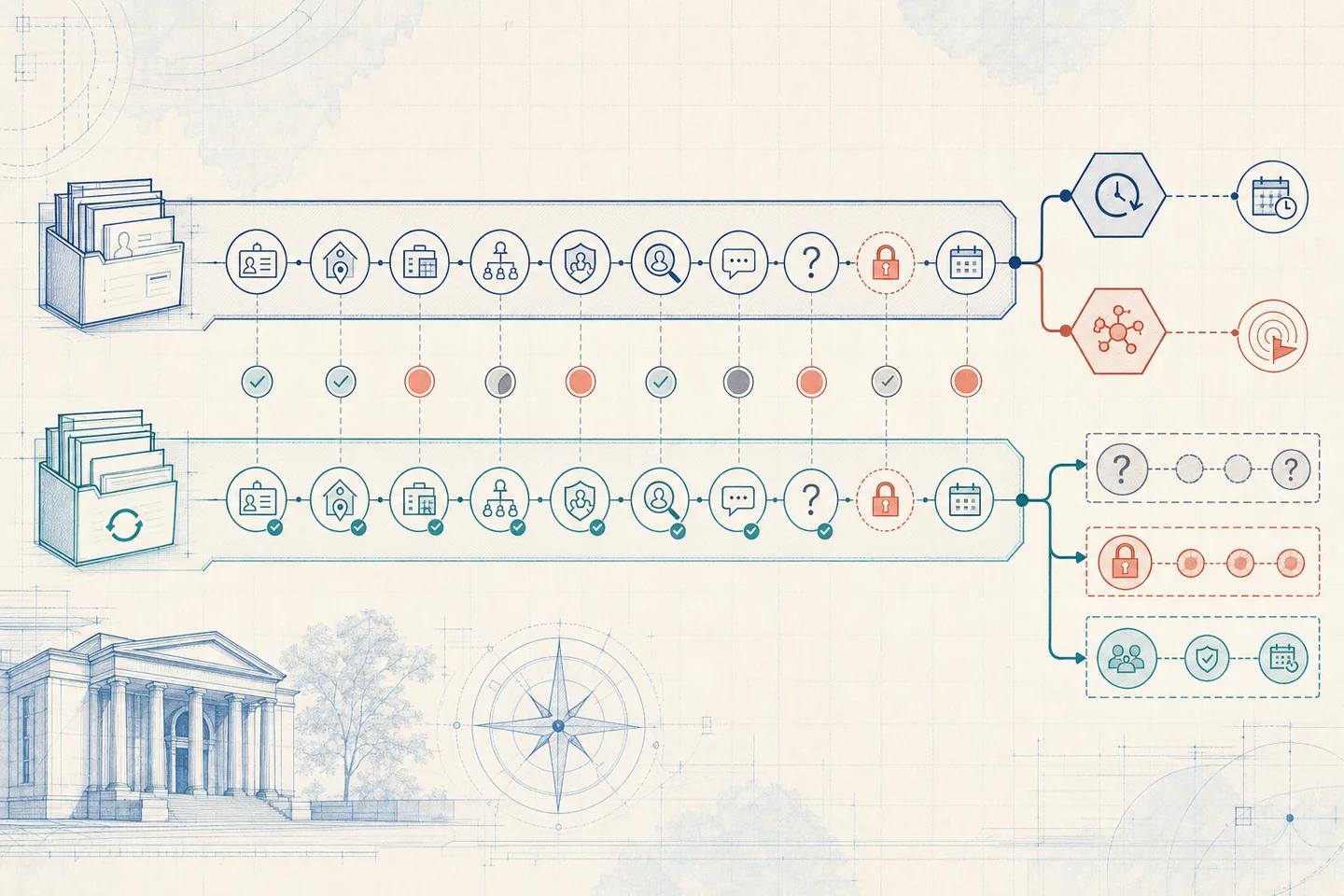
Under FinCEN's CDD rule, a legal entity customer's beneficial owners are each individual who directly or indirectly owns 25% or more of its equity, plus one individual with significant responsibility to control, manage or direct it, such as a CEO, CFO or managing member. FinCEN's CDD FAQs say that updating this information is risk-based rather than calendar-based: it is triggered when monitoring reveals information relevant to the customer's risk, including a possible change in ownership. Routine periodic reviews alone do not trigger it. If ownership may have changed entirely, the new owners must be collected, certified and verified.
Rules on when to collect have also loosened. The FAQs, updated 6 May 2026, describe an Account Opening Exceptive Relief Order of 13 February 2026 under which an institution may limit collection for an existing customer to the first account opening, cases where it learns facts that reasonably call the existing information into question, and its risk-based ongoing due diligence. That puts more weight on noticing the change.
- The customer notifies a sale, merger, investment round or change of directors.
- A registry, adverse media or news source shows new owners or officers.
- New authorised signatories or users are requested soon after an unexplained change.
- Transaction patterns shift: new counterparties, countries or volumes.
- Sanctions or screening alerts appear on a newly associated person.
Beneficial Ownership Change KYC Controls, Step by Step
Rebuild the ownership picture from sources, not from the customer's summary. Ask for the updated ownership chart and certification, obtain supporting documents (share register, shareholder agreement, resolutions), and check them against registry extracts with retrieval dates. Calculate indirect ownership through each layer and record the calculation so a reviewer can follow it.
Then deal with the people. Verify each new owner at or above the threshold and the new control person as individuals, rescreen the whole structure against sanctions and adverse media, and update the customer risk rating. Finally, reconcile mandates and access: a departing owner or director should lose signing authority and online banking access once the change is confirmed.
| Step | Evidence | Owner |
|---|---|---|
| Confirm the change | Customer notice, registry extract with retrieval date | Relationship or KYB team |
| Rebuild ownership | Ownership chart, share register, certification, indirect calculation | KYB analyst |
| Check documents | Originals in native format, forensic review of suspect files | KYB analyst with fraud support |
| Verify new individuals | ID document checks, deepfake-screened selfie or video | Identity operations |
| Rescreen and rerate | Sanctions, PEP and adverse media results; new risk rating | AML compliance |
| Reconcile access | Updated mandate, removed signatories and users | Operations |
How Are Ownership Documents Forged, and How Do You Check Them?
Ownership documents are mostly PDFs and scans, which makes them easy to edit. A forged share register can hide a sanctioned owner below the threshold, a fabricated resolution can install a new director with signing power, and an altered certificate of incorporation can make a shell look established. FinCEN's alert FIN-2024-Alert004 (November 2024) reports criminals using GenAI to alter or generate identity documents; the same tools produce convincing corporate letterheads, signatures and stamps.
Ask for documents in their native format where possible, compare them with registry filings, and send files with inconsistencies (fonts, alignment, mismatched dates, signatures that look pasted) for forensic review. A document that matches the registry is still only as good as the registry, and FATF's March 2023 guidance on beneficial ownership of legal persons calls for a multi-pronged approach to keep information adequate, accurate and up to date rather than reliance on a single source.
What Changed in US Beneficial Ownership Reporting?
FinCEN's interim final rule of 26 March 2025 removed beneficial ownership reporting under the Corporate Transparency Act for companies formed in the United States and their beneficial owners; only foreign-formed entities registered to do business in a US state or tribal jurisdiction remain reporting companies. FinCEN finalised the exemption on 11 August 2026, effective 14 August 2026, and those foreign reporting companies do not report US persons as beneficial owners.
For banks, this means the CDD rule, not a federal register, carries the load for domestic entities. Institutions collect and certify ownership themselves, use state registries where available, and rely on monitoring to notice changes.
Where Neural Defend Fits in Ownership Change Reviews
NeuroDetect is the forensic workspace for suspect files. An analyst uploads an authorised share register, resolution, certificate or image into a case; the analysis records model and version; and explainability heatmaps and attention views show suspect regions on the page. An LLM-assisted plain-language summary links to the evidence, and the case exports a downloadable forensic report with observations, uncertainty, provenance, model context and analyst notes that can sit in the KYB file. The analyst makes the final call.
For new owners and controllers verified remotely, NeuroVerify checks the selfie or video with six signals in one API call, including Face Manipulation Detection and Live Presence Verification, and returns a risk score in under 200 ms at p95 on eligible images; it does not analyse ID documents. Both run on ARCAS 1B, whose arXiv paper reports pooled accuracy of 99.99% on GenImage and 97.74% on Community Forensics, and both can be deployed in a private cloud, on-premises or air-gapped for institutions that keep KYB files in-house.
Limits of Document and Media Checks in Ownership Reviews
Forensic analysis can show that a file was probably altered. It cannot show who really controls a company: nominee shareholders, informal agreements and control through debt or family ties leave no trace in a clean, genuine document. Those cases need questions, source-of-wealth review and judgement from experienced KYB staff.
Record the review so it can be followed later: the trigger, sources and retrieval dates, ownership calculation, document findings with model versions, individual verification results, screening, the new risk rating and the access changes made.
Evidence boundary
Limitations
- Document forensics shows possible alteration; it cannot reveal nominee arrangements or hidden control in genuine documents.
- Ownership thresholds, control tests and update duties differ by jurisdiction; the US figures here come from FinCEN's CDD rule and FAQs. This is not legal advice.
- NeuroVerify does not analyse ID documents, and public ARCAS 1B benchmark figures cover images rather than scanned corporate documents.
- FATF guidance was not reopened for this update; its description reflects the version cited in sources.
Source record
Sources and references
- Financial Crimes Enforcement NetworkCDD Rule FAQsVerified October 19, 2026.
- Financial Crimes Enforcement NetworkBeneficial Ownership Information ReportingVerified October 19, 2026.
- Financial Action Task ForceGuidance on Beneficial Ownership of Legal PersonsPublished March 24, 2023. Verified August 7, 2026.
- Financial Crimes Enforcement NetworkFinCEN Alert on Fraud Schemes Involving Deepfake Media Targeting Financial Institutions (FIN-2024-Alert004)Published November 13, 2024. Verified October 19, 2026.
- arXivBenchmarking Neural Defend ARCAS 1B: A Foundational Multimodal Deepfake Detection ModelPublished September 21, 2026. Verified October 19, 2026.