
Neural Defend

LOS and lending platforms / NeuroVerify

Deepfake Detection API for LOS and Digital Lending Platforms

If you build or run a lending platform, your lender customers rely on your KYC step to keep synthetic and impersonated borrowers out. NeuroVerify gives that step a deepfake and manipulation check, returning one risk score with evidence per request.

It drops into the selfie or liveness step your platform already orchestrates, so lenders see no new step for borrowers, and you add one API call.

NeuroVerify does not verify documents, score credit or make lending decisions. It adds authenticity evidence; each lender configures its own policy.

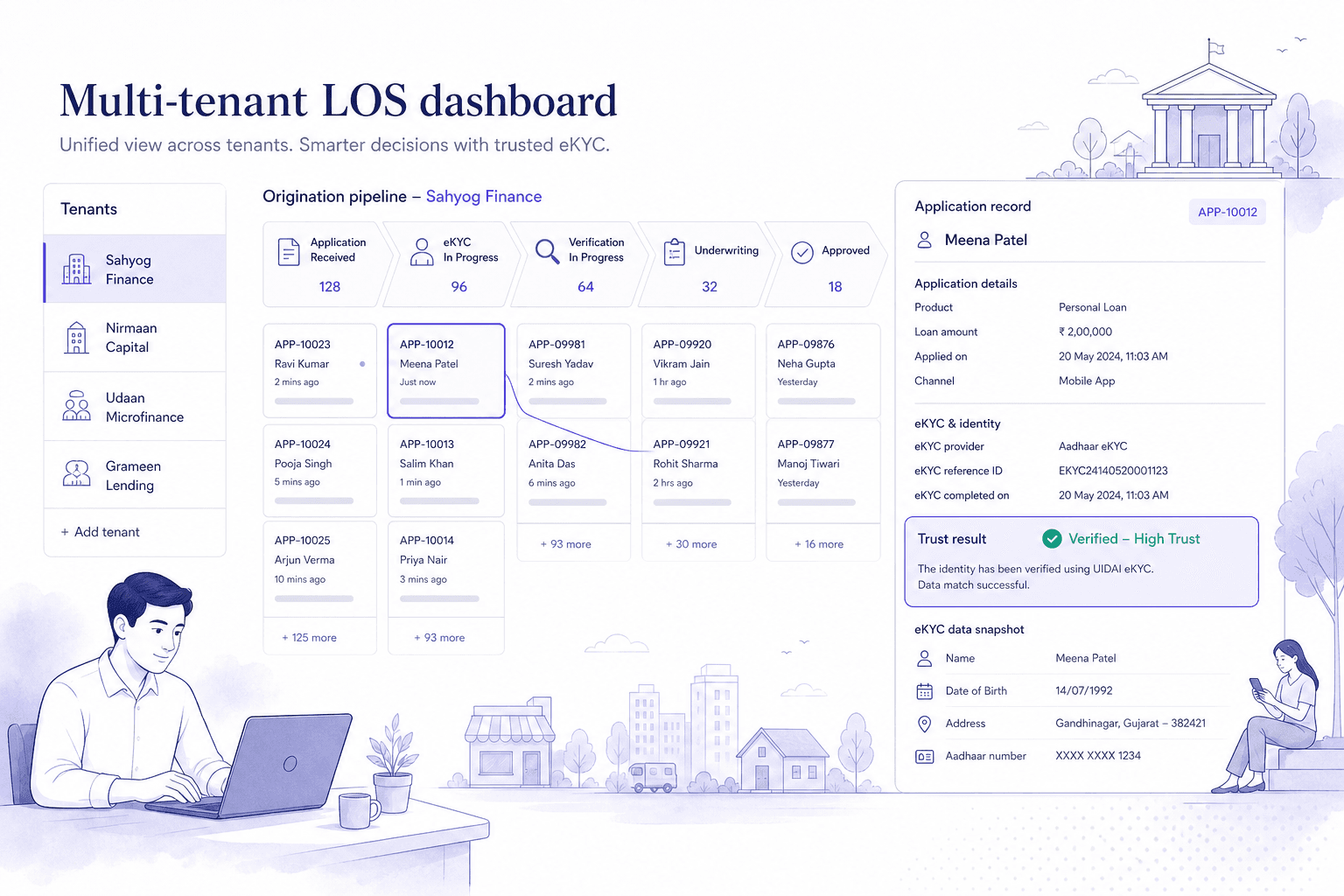
Illustration of a multi-lender digital lending platform with a shared selfie verification step.
AI-generated conceptual editorial illustration; not product UI or forensic evidence.
Powered byNeuroVerifyExplore the product
  • #1 of 36on the public VendorBench-100
  • <200 msp95 on eligible image requests
  • 6 → 1six checks, one unified score
  • 0new steps for your customer

The gap

Your pipeline can pass every check while the media is synthetic.

Lending platforms stitch together vendors for identity, documents, bureau data, liveness and fraud. The platform returns one outcome to each lender, and lenders trust that the pipeline filtered out bad actors.

The gap is upstream of all those vendors. If the selfie or video is generated, swapped or injected, every vendor processes clean-looking input and returns a pass. The platform cannot tell its lender customers that the media itself was checked, because nothing in the stack checked it.

Where a platform pipeline is exposed

Borrower app or partner site → Identity and document vendors → Selfie or video session → Face match → Fraud and credit rules → Lender decision

The selfie or video is the only step carrying a live human. Manipulation there passes silently to every lender on the platform.

Why this matters more for platforms

One weakness is shared across many lenders and many borrowers. Attackers that find a way through can reuse it at scale, and a single incident reaches every lender who depends on the platform. Embedding an authenticity check once, in the shared step, protects the whole book.

Face match and liveness remain useful, but they were not built to flag generated faces or injected streams. See Deepfake Detection vs Liveness Detection.

Threats

How attackers exploit a shared lending pipeline.

These are attack techniques, not claims about any specific platform or lender.

01

Generated selfie at scale

Automated scripts submit AI-generated faces to many lender journeys. Format checks and face match built from the identity photo pass them.

02

Injected video through a virtual camera

The attacker replaces the camera feed in a mobile or web SDK. The platform receives a well-formed stream that never came from a lens.

03

Real-time face swap in video KYC

A live swap runs through a regulated video session offered by the platform. Prompts are answered by a real person behind another face.

04

Synthetic borrower reused across lenders

The same fabricated persona applies to several lenders on the platform. Each lender sees one clean application.

05

Partner and agent channel abuse

A distributor or partner site submits manipulated selfies to hit volume targets, and the platform cannot tell it from genuine traffic.

Where NeuroVerify fits

One shared authenticity step for every lender on your platform.

NeuroVerify sits behind the selfie or video capture in your platform, before face match and fraud rules. You call it once per borrower and expose the result to each lender in the shape their policy needs.

The same journey with NeuroVerify

Borrower app or partner site → Identity and document vendors → Selfie or video capture → NeuroVerify → Face match → Risk score and per-lender rules

One call is added to the shared pipeline. Lenders keep their own thresholds and decisions.

What runs in one request

NeuroVerify checks the face image, video or audio for deepfakes and manipulation beyond liveness. All six signals run together and resolve into one risk score:

- Visual Safety Screening - Live Presence Verification - Face Manipulation Detection - AI Generative Model Analysis - AI Pixel-Level Manipulation - AI Content Compliance

The response carries the unified score plus signal-level evidence. Your own policy makes the final decision.

What stays with you

Your vendor stack, your multi-tenant configuration, each lender’s credit and fraud policy, your consent and retention rules, and the final decision for every borrower.

NeuroVerify Unified Trust LayerSix parallel analysis layers
  • Visual Safety Screening
  • Live Presence Verification
  • Face Manipulation Detection
  • AI Generative Model Analysis
  • AI Pixel-Level Manipulation
  • AI Content Compliance
01

Send the borrower selfie or video

Pass the media your SDK or backend already receives from the borrower journey.

02

Call one API

Use the REST API, a mobile SDK or a backend SDK inside your orchestration layer.

03

Read the unified risk score

Store the score and signal evidence per application, and show it in your lender console.

04

Let each lender set policy

Map score bands to approve, review or decline per lender, under their own rules.

What you get

What platform teams get.

A defensible answer for lender customers

You can show that borrower media was checked for deepfakes, not only for liveness.

One integration, many tenants

Add the call once and offer it to every lender on the platform.

Configurable per lender

Score bands map to different actions for different risk appetites.

Faster time to market

Two lines to integrate and live in under 24 hours, as a Neural Defend claim.

Flexible deployment

Run in managed cloud, a customer VPC, secure container, on-premises or air-gapped to meet lender requirements.

Questions

What teams ask before they integrate.

We already run liveness. Do we still need NeuroVerify?

Liveness answers whether a live person appears to be in front of the camera. It was built for presentation attacks such as a printed photo, a mask or a screen held to the lens. It was not built to tell whether the stream reaching your server came from a camera at all, or whether the face inside it was generated or swapped.

NeuroVerify runs inside the selfie or video step you already have. Live Presence Verification is one of its six signals, and the other five look for face manipulation, generative-model traces, pixel-level edits and unsafe content in the same request. For a platform, that avoids adding a second vendor next to the liveness provider you already offer. You can keep your current liveness vendor during an evaluation and compare outcomes on your own media. See deepfake detection vs liveness detection.

Can we offer this to each lender with different thresholds?

Yes. NeuroVerify returns a unified risk score and signal evidence. You map score bands to actions per lender, so each one applies its own policy.

Where does it fit in a multi-vendor pipeline?

After selfie or video capture and before face match and fraud rules, so every later vendor and rule can use the result.

How hard is it to integrate?

NeuroVerify offers native mobile SDKs (Android/Kotlin, iOS/Swift, Flutter), backend SDKs (Python, TypeScript/Node.js, Go, Java) and a REST API. Integration is two lines of code, and teams can be live in under 24 hours.

Mobile SDKs cover Android/Kotlin, iOS/Swift and Flutter, and backend SDKs cover Python, TypeScript/Node.js, Go and Java. An MCP server is available for AI agents.

How is our data handled, and where can it run?

NeuroVerify analyses the face images, video or audio you send and returns a risk score with evidence. Platforms often need tenant-level residency, so ask about private cloud and on-premises options early. Consent, retention and residency stay under your policy. See product data handling for how media is treated.

Deployment options include the managed cloud API, private cloud or customer VPC, a secure container, on-premises and air-gapped environments. Neural Defend holds ISO/IEC 27001, ISO/IEC 27701, ISO/IEC 42001 and SOC 2 Type II certifications, shown on the trust page.

How fast is it, and will it slow the journey?

NeuroVerify targets under 200 ms at p95 on eligible image requests under defined test conditions. The test methodology is available on request, so you can check it against your own media sizes and network path.

It is one API call on media you already capture, so it adds a single request rather than a new user step. Platform latency budgets are tight, so test end to end inside your own pipeline.

How do we handle false positives and set thresholds?

NeuroVerify returns one unified risk score and signal-level evidence. It does not approve or reject anyone. Your policy sets the thresholds and decides what each band does.

Because you expose scores to lenders, you can offer different step-up paths per tenant.

Can we test it on our own media first?

Yes, and that is the test that matters. Public results help: NeuroVerify ranked first of 36 systems on VendorBench-100, with a detection score of MCC 0.876 against 0.646 for the next-best vendor. But your capture devices, compression and attack mix decide real performance.

Run authorized samples from several lenders and channels through NeuroVerify next to your current checks. Compare scores and evidence against your current decisions. For a vendor shortlist, see the top 5 deepfake detection APIs.

Evaluate NeuroVerify

Test NeuroVerify in your lending platform.

Bring authorized media from your own journey. NeuroVerify returns a risk score with signal-level evidence, so you can compare it with your current checks before changing anything.