
Sign-up → Document upload → Selfie and liveness → Face match → Approved to work → Periodic selfie re-check
Each selfie moment can be passed with synthetic or swapped media. NeuroVerify adds an authenticity read at those moments.
Gig economy / NeuroVerify
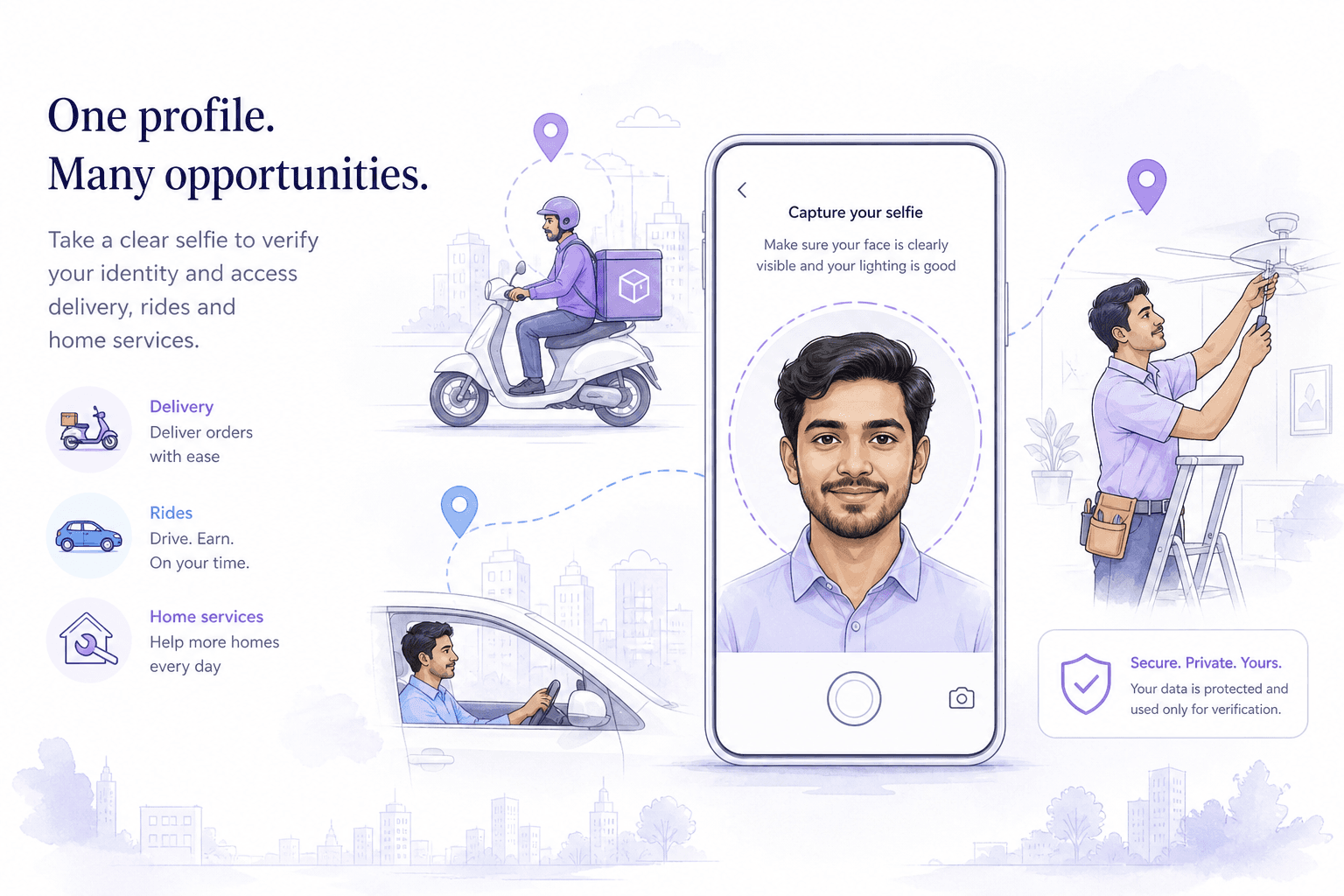
For ride-hailing, delivery, freelance and home-services platforms that onboard thousands of workers. NeuroVerify checks the onboarding and re-verification selfie for deepfakes and manipulation beyond liveness, so the verified worker is the one doing the job.
It fits the selfie step your onboarding already runs: one API call, no new step for the worker, one unified risk score with signal-level evidence.
NeuroVerify does not run background checks or verify licences and documents. It adds authenticity evidence for the face, video and audio; your trust and safety policy decides.
The gap
Gig platforms grow by making onboarding quick. A worker uploads details and a selfie, passes a check and starts earning. Trust and safety then depends on the idea that the person on the job is the person who was verified.
That assumption is attacked from two sides. Banned or unqualified workers want back in under a new identity. Others rent or sell verified accounts to someone else. Both need to pass a selfie step that was designed to prove presence, not authenticity.
Many platforms re-verify at login or before a job. That helps, but liveness and face match can be fooled by a face swap, a replay or injected video. The cost lands on customers and on workers who followed the rules. See identity review for gig worker onboarding.
Sign-up → Document upload → Selfie and liveness → Face match → Approved to work → Periodic selfie re-check
Each selfie moment can be passed with synthetic or swapped media. NeuroVerify adds an authenticity read at those moments.
Threats
These are attack techniques, not claims about any platform.
A previously removed worker re-registers using a generated or swapped face on a fresh identity.
A verified worker lets another person work the account, and a swap at re-check hides the change.
Rings register batches of accounts with generated faces to harvest sign-up incentives or receive payouts.
Emulators and virtual cameras feed prepared video so no real face is ever captured.
A swapped face is used to appear as a legitimate driver or courier to a customer or support agent.
A deepfake of the real worker passes a selfie re-check, letting an attacker change payout details.
Gig platforms operate in many markets with different worker rules. The authenticity risk is the same: the selfie is trusted because it was captured live.
See also seller identity controls for marketplace onboarding and deepfake detection for online marketplaces.
Where NeuroVerify fits
NeuroVerify sits at each selfie moment: onboarding, periodic re-check and payout change. Your app sends the selfie or video it already captures. NeuroVerify runs six signals in one request and returns a unified risk score with signal-level evidence.
Your trust and safety policy decides next steps. Your background-check and document vendors stay in place.
Post the onboarding or re-check selfie from your worker app to NeuroVerify with the native SDK.
Get one score with evidence from the six signals.
Approve, ask for a supervised re-check, route to review or deactivate.
Run the same check on payout change, account recovery and long inactivity.
What you get
Catch swapped or generated faces at re-registration.
Stronger re-checks make handing over a verified account harder.
Workers take the same selfie. Genuine workers are unaffected.
Customers see a worker who matches the verified identity.
Image checks return in under 200 ms p95 under defined test conditions.
Questions
No. NeuroVerify fits the selfie or video step your journey already runs. You send the media you already capture in one API call. There is no new step for the end user.
Integration uses native mobile SDKs (Android/Kotlin, iOS/Swift, Flutter), backend SDKs (Python, TypeScript/Node.js, Go, Java) or REST. Two lines of code is the product claim; live in under 24 hours is the target. Native Android, iOS and Flutter SDKs keep capture inside your app.
Not as a replacement. Liveness asks whether a live person was in front of the camera. NeuroVerify asks whether the media itself is authentic, and it includes a Live Presence Verification signal alongside five others, so it checks beyond liveness. See deepfake detection vs liveness detection.
You can keep your current liveness vendor and send the same selfie or video to NeuroVerify as well.
No. NeuroVerify checks face images, video and audio only. Background checks, licence and document verification stay with your current vendors.
NeuroVerify scores the authenticity of each piece of media. Matching faces across accounts is a separate analytic that your own systems or vendors may run. The authenticity evidence can feed those rules.
NeuroVerify returns in under 200 ms p95 on eligible image requests under defined test conditions. The test methodology is available on request, so you can compare it with your own traffic and network path.
Image checks run inside the capture step, so the end user does not see a separate wait. Video and audio take longer because they carry more media; ask us for numbers that match your clip lengths.
NeuroVerify runs as a managed cloud API, in a private cloud or your own VPC, as a secure container, on-premises, or air-gapped. The right option depends on your data-residency and security rules.
The same six signals and the same unified risk score are available in each model. Neural Defend holds ISO/IEC 27001, ISO/IEC 27701, ISO/IEC 42001 and SOC 2 Type II; see the Trust Center for details.
NeuroVerify returns one unified risk score plus signal-level evidence, so a reviewer can see which of the six signals raised concern. It does not make the final decision. Your own policy decides whether to approve, step up, route to manual review or decline.
Because thresholds are yours, you can tune them to your own tolerance for false positives and false negatives. See deepfake detection errors.
Yes. We recommend evaluating on your own media: your real capture conditions, devices and attack samples. Start with a small test set, compare the unified score and signal evidence against your current checks, then set thresholds with your own policy team.
NeuroVerify ranked #1 of 36 systems on VendorBench-100 (detection score MCC 0.876 versus 0.646 for the next-best vendor), but a public benchmark is a starting point. Your own media is the real test. Contact us to set one up.
Evaluate NeuroVerify
Send selfies from real onboarding and from known fraud cases. We will show how the unified score separates them before you change a flow.