
Sign-up → Licence and vehicle documents → Selfie and liveness → Face match → Background and compliance checks → Activated partner
Every step can pass while someone else does the work behind the approved account.
Logistics and transportation / NeuroVerify
Freight, delivery, ride and fleet platforms onboard drivers and partners remotely, often at high volume. NeuroVerify checks the onboarding selfie and re-verification video for deepfakes, swaps and replays, and returns one risk score with evidence.
It fits the selfie or liveness step your partner app already runs: no new step for the driver, one API call on the media you collect.
NeuroVerify does not verify licences or vehicle papers and does not decide who may work on your platform. It adds authenticity evidence; your safety and compliance policy decides.
The gap
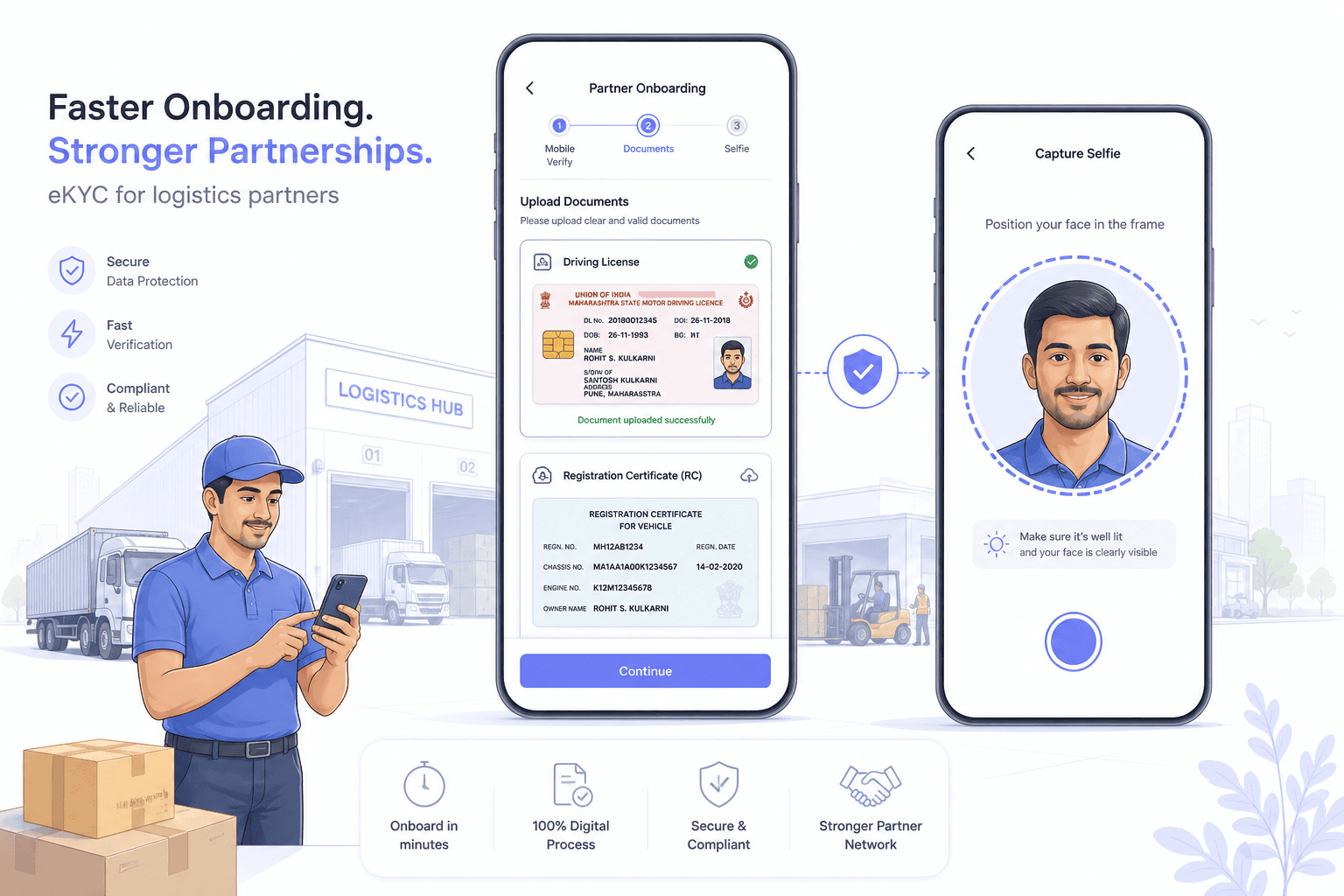
Logistics and mobility platforms verify driver licences, vehicle registrations and background records, then confirm the person with a selfie. The selfie is the link between a clean paper file and the human who will carry goods or passengers.
That link is weak. A genuine licence with a manipulated or substituted selfie produces a fully consistent file for the wrong person. Basic liveness may catch a printed photo, but it may not catch a generated face or a swapped video stream.
Sign-up → Licence and vehicle documents → Selfie and liveness → Face match → Background and compliance checks → Activated partner
Every step can pass while someone else does the work behind the approved account.
Accounts get shared, sold or handed to unverified drivers. Platforms that re-verify with a selfie at shift start or on a trigger face the same issue: a replayed photo or video can stand in for the live driver. Authenticity checks at each of those points protect delivery safety, insurance cover and customer trust.
Threats
These are attack techniques seen in remote workforce and partner verification, not claims about any specific company.
A verified partner lets someone else drive under their identity. A recorded or replayed selfie passes shift-start checks while the real driver is elsewhere.
The applicant submits a generated or face-swapped selfie built from the face on a borrowed licence, so the face match looks perfect.
A photo or video shown on a second screen is captured in the app. Simple checks may accept it as a live face.
Entire driver or vehicle entries are created with synthetic faces so payouts and incentives flow to accounts that do not exist.
A recruiter completes selfie steps for many applicants, or feeds manipulated media, to hit onboarding targets.
A banned or rejected person returns on another platform or region with a swapped face. See synthetic identity fraud.
Background: replay attacks in identity proofing and virtual camera injection attacks.
Related workforce guidance: Deepfake Controls for Remote Hiring.
Where NeuroVerify fits
NeuroVerify sits behind the selfie or video capture in your partner app. Use it at sign-up and at any re-verification point, such as shift start, payout change or account reactivation.
Sign-up → Licence and vehicle documents → Selfie or video capture → NeuroVerify → Face match → Risk score and platform policy
The same call works at re-verification. Your background and compliance vendors stay as they are.
NeuroVerify checks the face image, video or audio for deepfakes and manipulation beyond liveness. All six signals run together and resolve into one risk score:
- Visual Safety Screening - Live Presence Verification - Face Manipulation Detection - AI Generative Model Analysis - AI Pixel-Level Manipulation - AI Content Compliance
The response carries the unified score plus signal-level evidence. Your own policy makes the final decision.
Your licence and background-check vendors, your safety and insurance rules, your payout controls, your recruiter and agency oversight, your consent and retention rules, and the decision on every partner.
Pass the image or frames the driver app already captures at sign-up or re-verification.
Use the REST API or a mobile or backend SDK from your partner platform.
Get one score with signal-level evidence for the partner record.
Activate, ask for a retry in person or at a hub, or block, under your own rules.
What you get
Impersonators and shared accounts are harder to slip through onboarding and shift checks.
Ghost partners and recycled identities are flagged before payouts begin.
One API call per check fits high-throughput onboarding without a new user step.
The same call covers every market and channel, including agent-led onboarding.
Signal-level output supports safety, insurance and compliance reviews.
Questions
Liveness answers whether a live person appears to be in front of the camera. It was built for presentation attacks such as a printed photo, a mask or a screen held to the lens. It was not built to tell whether the stream reaching your server came from a camera at all, or whether the face inside it was generated or swapped.
NeuroVerify runs inside the selfie or video step you already have. Live Presence Verification is one of its six signals, and the other five look for face manipulation, generative-model traces, pixel-level edits and unsafe content in the same request. At scale, that means one check for drivers on low-end phones and mixed networks. You can keep your current liveness vendor during an evaluation and compare outcomes on your own media. See deepfake detection vs liveness detection.
No. NeuroVerify analyses face images, video and audio only. Licence and vehicle checks stay with your document and background vendors.
Yes. The same call can run on a selfie at shift start, account reactivation or a payout change, so a recorded or swapped face is not enough to take over an approved account.
NeuroVerify offers native mobile SDKs (Android/Kotlin, iOS/Swift, Flutter), backend SDKs (Python, TypeScript/Node.js, Go, Java) and a REST API. Integration is two lines of code, and teams can be live in under 24 hours.
Native Android and iOS SDKs and a Flutter SDK suit driver apps, and backend SDKs support partner portals.
NeuroVerify analyses the face images, video or audio you send and returns a risk score with evidence. Consent, retention and residency stay under your policy, which matters when drivers sit in many jurisdictions. See GDPR, biometrics and authenticity analysis for one framework. Consent, retention and residency stay under your policy. See product data handling for how media is treated.
Deployment options include the managed cloud API, private cloud or customer VPC, a secure container, on-premises and air-gapped environments. Neural Defend holds ISO/IEC 27001, ISO/IEC 27701, ISO/IEC 42001 and SOC 2 Type II certifications, shown on the trust page.
NeuroVerify targets under 200 ms at p95 on eligible image requests under defined test conditions. The test methodology is available on request, so you can check it against your own media sizes and network path.
It is one API call on media you already capture, so it adds a single request rather than a new user step. Driver apps often run on weak networks, so test on realistic connections.
NeuroVerify returns one unified risk score and signal-level evidence. It does not approve or reject anyone. Your policy sets the thresholds and decides what each band does.
A common pattern is to send mid-band results to a retry or an in-person check rather than rejecting a driver outright.
Yes, and that is the test that matters. Public results help: NeuroVerify ranked first of 36 systems on VendorBench-100, with a detection score of MCC 0.876 against 0.646 for the next-best vendor. But your capture devices, compression and attack mix decide real performance.
Use authorized onboarding and shift-start samples from low-end devices and poor lighting. Compare scores and evidence against your current decisions. For a vendor shortlist, see the top 5 deepfake detection APIs.
Evaluate NeuroVerify
Bring authorized media from your own journey. NeuroVerify returns a risk score with signal-level evidence, so you can compare it with your current checks before changing anything.