
Sign-up → Licence and vehicle documents → Selfie and liveness → Face match → Background check → Activation → Periodic selfie re-checks
The selfie recurs, so an attacker gets more than one chance.
Ride-hailing and mobility / NeuroVerify
Ride-hailing and bike-taxi platforms depend on a selfie to prove the person driving is the person who was vetted. NeuroVerify checks driver selfies for deepfakes and manipulation beyond liveness and returns one unified risk score with signal-level evidence.
It runs behind the selfie step you already use at onboarding and at periodic or per-shift checks: no new step for the driver, one API call.
NeuroVerify does not verify licences, vehicle documents or background checks and does not decide who may drive; it adds authenticity evidence for your own policy.
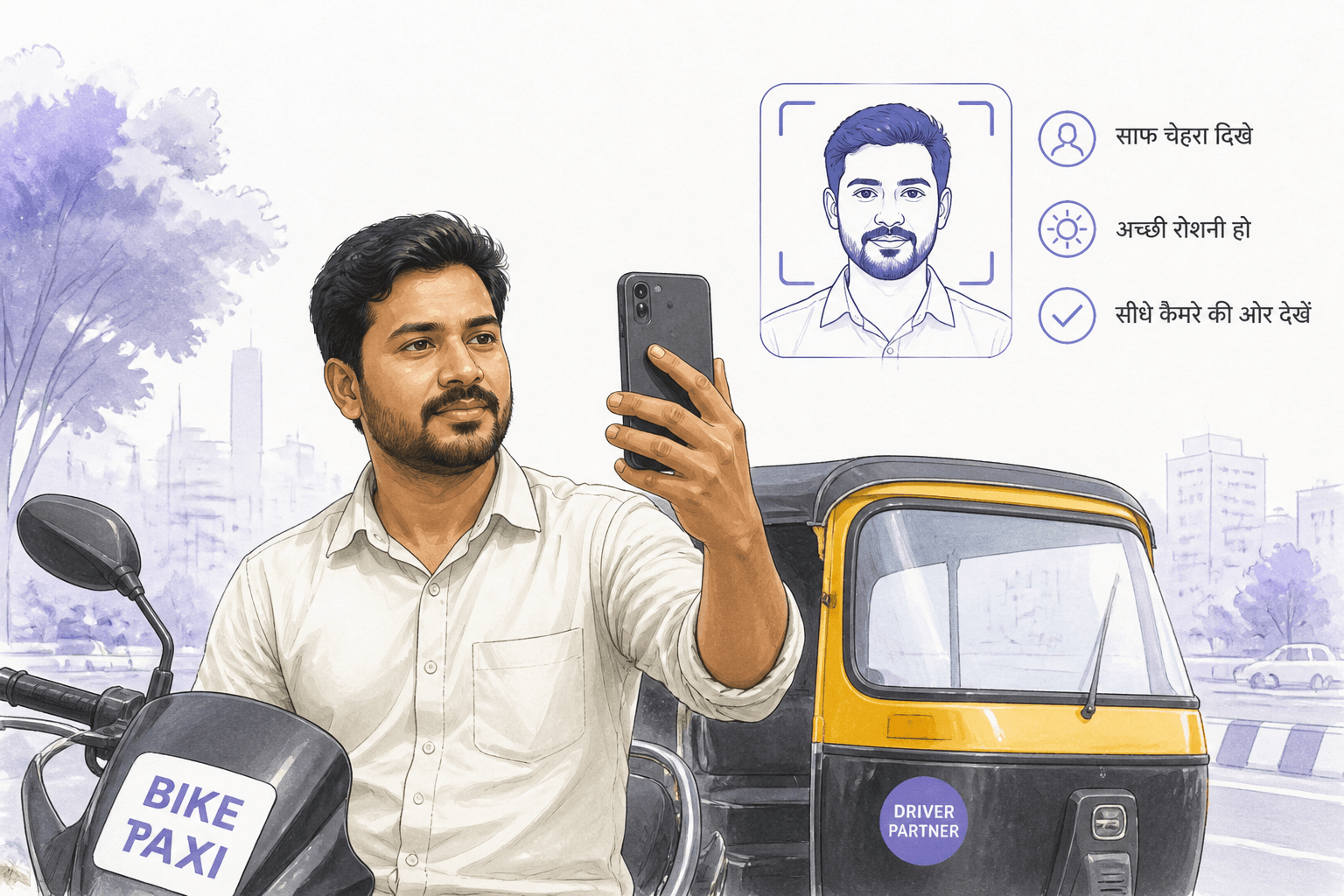
The gap
Mobility platforms vet drivers with documents: a licence, vehicle registration, insurance and often a background check. Those documents prove a person and a vehicle exist. The selfie is meant to tie the driver to the file, both at onboarding and again before or during shifts.
Sign-up → Licence and vehicle documents → Selfie and liveness → Face match → Background check → Activation → Periodic selfie re-checks
The selfie recurs, so an attacker gets more than one chance.
A rider gets into a car on the strength of a name, a photo and a rating. If the driver is not the vetted person, the safety promise of the platform fails. Account sharing, rented accounts and fleet-operator models all stress that link.
Existing checks do not test authenticity. A face match shows two images look alike. Liveness shows a prompt was satisfied. Neither shows that the face is a live, unaltered capture from the device camera.
Background checks and police verification take days. The selfie takes seconds, so the quick tier tends to carry most of the identity risk until the slower checks finish.
Threats
These are techniques, not claims about any platform. Each separates the vetted identity from the person driving.
One verified driver account is used by several people, with prepared or swapped faces used at periodic selfie checks.
Someone else holds a genuine licence and vehicle file and uses a synthetic or swapped face to pass the check.
A face is generated or swapped from the licence photo so face match passes without a live person.
A printed photo or second screen is held to the camera to pass basic liveness.
An agent submits many drivers in a session, reusing or lightly editing media.
A banned driver returns with a new account, a new name and a different face for the same person.
Recurring checks help only if each one tests whether the face is authentic.
Where NeuroVerify fits
NeuroVerify sits behind the selfie capture in your driver onboarding and periodic verification. You send the image or video you already collect. It returns one unified risk score with evidence from six signals, and your policy decides whether to activate, ask for a fresh capture or review.
Using the same API at both onboarding and re-check lets you compare evidence over time. It checks face and video evidence, not licences or vehicles.
Pass the image or video from your existing capture step to the API.
Get one score with signal-level evidence in a single response.
Activate, request a new capture, route to a human reviewer or decline, by city and vehicle type.
Send re-check selfies to the same API and keep the evidence with the driver record.
What you get
Reduce the chance that a vetted account is used by someone else.
Catch substituted faces at onboarding and at re-checks.
Keep the authenticity record with the driver file for investigations.
They complete the selfie step they already know.
Android, iOS and Flutter SDKs plus REST and backend SDKs.
Questions
It sits behind the selfie or face-capture step you already run. You send the image, video or audio you already collect to one API call, and the response comes back with a unified risk score and signal-level evidence. The end user sees no new step.
Integration uses native mobile SDKs (Android/Kotlin, iOS/Swift, Flutter), backend SDKs (Python, TypeScript/Node.js, Go, Java) or the REST API. Two lines to integrate and live in under 24 hours are product claims; your own environment and review process set the real timeline.
Liveness asks whether a live person appears to be in front of the camera. It was designed around printed photos, screen replays and masks. It does not ask how the media was produced, so a face swap, a fully synthetic face or an injected stream can satisfy it.
NeuroVerify checks for deepfakes and manipulation beyond liveness. Keep your liveness vendor and add the authenticity evidence next to it. See deepfake detection vs liveness detection.
One unified risk score, plus evidence from six signals: Visual Safety Screening, Live Presence Verification, Face Manipulation Detection, AI Generative Model Analysis, AI Pixel-Level Manipulation and AI Content Compliance.
Your policy decides what happens next: approve, step up, route to manual review or decline. NeuroVerify does not approve or reject the driver or the account.
Latency is under 200 ms p95 on eligible image requests under defined test conditions. The methodology is available on request, so you can compare it with your own traffic.
On the public VendorBench-100 benchmark, NeuroVerify ranked first of 36 systems, with a detection score (MCC) of 0.876 against 0.646 for the next-best vendor.
Deployment options are a managed cloud API, private cloud or customer VPC, a secure container, on-premises, and air-gapped. Pick the one that matches your data residency and security requirements.
The platform holds ISO/IEC 27001, ISO/IEC 27701, ISO/IEC 42001 and SOC 2 Type II certifications. For handling details, see product data handling and the trust centre.
Yes. Send a representative sample of driver selfies from onboarding and from periodic checks, across cities and device types and compare the scores with your own labels. Include genuine captures from low-end handsets and poor lighting so you can see how thresholds behave on real users, not just on attacks.
Contact the team to set up an evaluation. See also how to evaluate a detection API.
Yes. Any face image or video you send gets the same checks. Teams typically compare the new capture with earlier evidence and run a face-match step separately. Frequency and triggers are your policy decision.
Evaluate NeuroVerify
Send NeuroVerify a sample of driver selfies from onboarding and re-verification and compare the scores with your existing checks.