
What Does NIST SP 800-63A-4 Require for Deepfakes in Remote Proofing?
NIST published SP 800-63A-4, Digital Identity Guidelines: Identity Proofing and Enrollment, on 31 July 2025. Section 3.14, Digital Injection Prevention and Forged Media Detection, says attackers now pair injection attacks with generative AI tools that create or modify images and videos of applicants and their evidence, and that every type of remote proofing is exposed in some way.
The section turns that warning into controls. Credential service providers (CSPs) SHALL use technical controls that raise confidence the media came from a genuine sensor, such as detecting a virtual camera, device emulator or jailbroken device. They SHALL analyze all digital media submitted during proofing for signs of modification, manipulation, tampering or forgery. They SHALL test automated analysis against forged and genuine media, document which attack artifacts were tested with the matching false negative rates, and give that record to relying parties on request.
Several further controls are SHOULD statements: passive forged-media detection for all capture scenarios, sensor authentication or device attestation, and analysis for signatures of known generative AI and deepfake tools. For remote attended sessions, proofing agents SHALL be trained to spot signs such as high latency, synchronization issues and inconsistent skin tone, and CSPs SHALL add random human-in-the-loop cues, for example asking the applicant to move an object between the camera and their face.
| Control | Strength | What an agency or its CSP has to show |
|---|---|---|
| Genuine-sensor checks (virtual camera, emulator, jailbreak) | SHALL (Sec. 3.14) | Capture integrity signals logged per session |
| Analyze all submitted media for manipulation or forgery | SHALL (Sec. 3.14) | Every selfie, video and evidence image passes through analysis |
| Test against attack artifacts and document false negative rates | SHALL (Sec. 3.14) | Test report listing attack types and miss rates, shareable with relying parties |
| Remote biometric PAD tested to ISO/IEC 30107-3:2023, IAPAR below 0.07 | SHALL (Sec. 3.11) | Conformant PAD test evidence |
| Passive forged-media detection in all capture scenarios | SHOULD (Sec. 3.14) | Detection that runs without extra applicant steps |
| Analyze for signatures of known generative AI and deepfake tools | SHOULD (Sec. 3.14) | Coverage of current generators, refreshed as new ones appear |
How Deepfakes and Injected Media Reach a Government Enrollment Flow
An injection attack inserts forged or modified media between the capture point, usually the applicant's phone or webcam, and the system doing the comparison. The camera may never see a real face. A virtual camera driver, an emulator or a modified app feeds the proofing session a face swap, a generated video of someone who matches a stolen document, or a replay of an earlier genuine session. Readers new to the mechanics can start with our explainer on virtual camera injection attacks.
NIST is direct that a biometric comparison on its own does not stop this. A generated face built to match the portrait on a stolen licence will match it. Live document capture and presentation attack detection make the job harder, because the forged media must also defeat those checks, but the guideline says even these mechanisms are not enough for every case. That is why it asks for manipulation analysis on the media itself and for signals about the capture device.
Government services attract these attacks because one approved enrollment can open access to benefits, tax records or licences. The same synthetic identity can be tried many times against a public, always-open portal, and each failed attempt teaches the attacker which step stopped them.
Where Deepfake Detection Sits in the Enrollment Pipeline
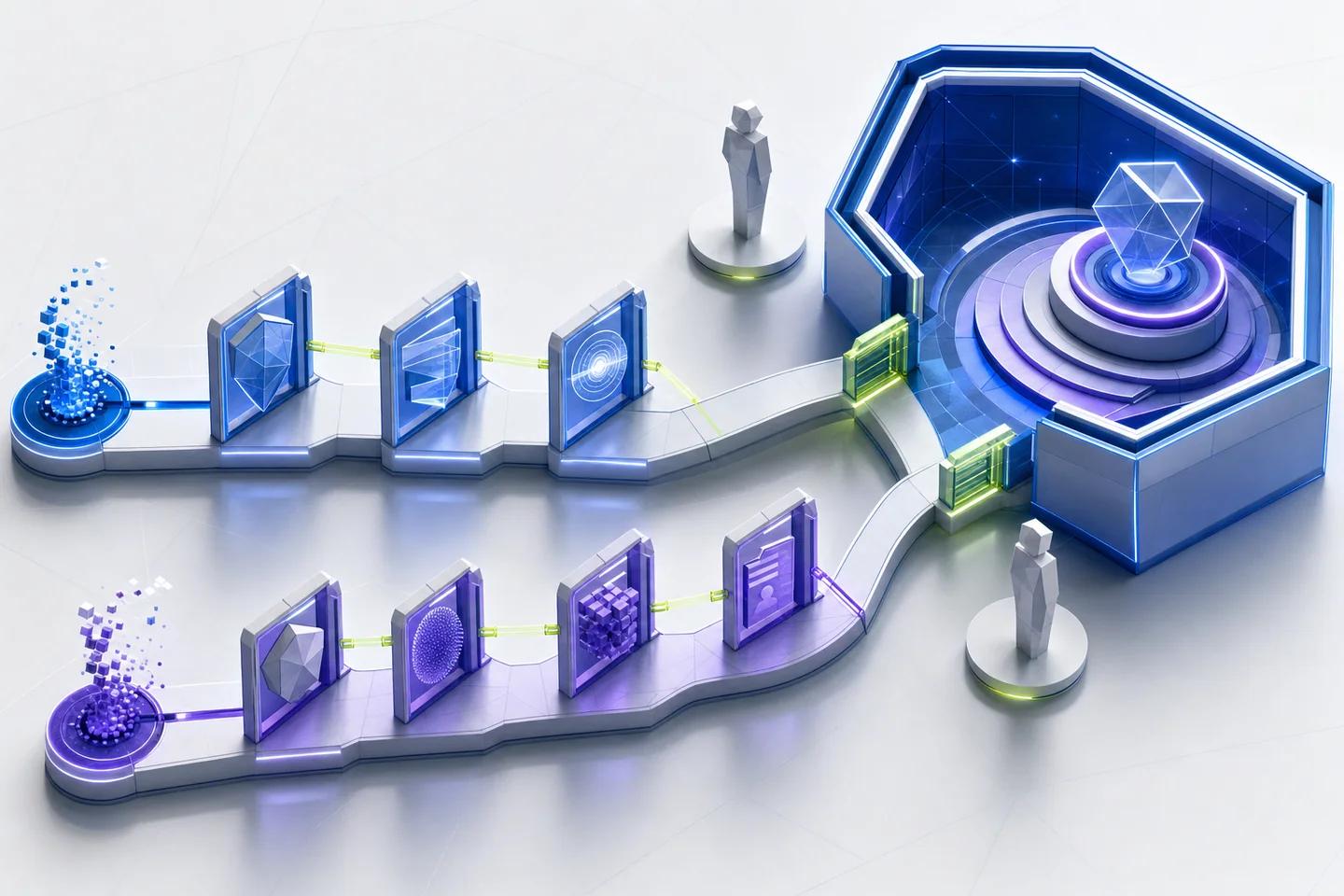
Order matters. Media analysis is most useful after the session is bound and the capture preserved, and before any comparison result is trusted. A practical sequence for remote unattended proofing at IAL2 looks like this:
- Bind the session: tie each capture to one transaction, one device and a short time window, over an authenticated protected channel as Section 3.14 requires.
- Check capture integrity: record virtual camera, emulator and jailbreak signals and keep them with the case.
- Validate the evidence: live document capture, document presence checks and comparison of MRZ or barcode data with the printed fields, handled by the document verification component.
- Analyze the face media: run the selfie or video through deepfake and manipulation analysis, including presentation attack detection.
- Compare and resolve: match the face to the evidence portrait and resolve the claimed identity against authoritative records and duplicate-enrollment checks.
- Route on policy: send clean cases forward, and send manipulation flags, capture-integrity failures or conflicts to a trained reviewer with the signals attached.
Keeping a Fallback Path for Applicants Who Fail Automated Checks
A false alert in a government service can block someone from benefits they are owed, so the exception path is part of the control, not an afterthought. Section 3.15 of SP 800-63A-4 says CSPs SHALL document how they handle errors and exceptions and SHOULD provide trusted referees for applicants who cannot meet IAL1 or IAL2 requirements. Section 3.15.1 lists people who may need that help, including persons with disabilities, older individuals, people experiencing homelessness, victims of identity theft and people without access to computing devices.
The guideline also says CSPs SHOULD offer trusted referee services to applicants who fail fraud checks in unattended remote processes, and that when they do, the referee SHALL receive a summary of the fraud failures. In practice the reviewer should see which signal fired, the capture conditions and the evidence, but not a raw score presented as a verdict. CSPs SHALL also publish how to reach trusted referee services and SHALL run a redress process for applicants who dispute fraud check outcomes.
Track abandonment, retries and referee outcomes by channel and by applicant group. If one group fails the face step far more often, the cause may be device quality, lighting or a model weakness, and the fix belongs in testing, not in a higher manual workload for that group.
What Deepfake Detection for Government Identity Proofing Can and Cannot Settle
Face and media analysis answers a narrow question: does this capture show signs of being generated, swapped, replayed or edited? It is good at catching AI-generated selfies, face swaps and composited video that would otherwise pass a face match. It does not tell an agency whether the document is genuine, whether the person is eligible, or whether a real applicant is being coached or coerced by someone off camera.
Detection also has error rates that depend on the population and devices. Older phones, heavy compression, low light and assistive technology all change what the model sees. NIST's requirement to test against attack artifacts and genuine media in conditions close to operations exists for this reason. Ask for results on media that resembles your applicants, not only on a vendor's showcase set, and decide in policy what score bands send a case to review.
How NeuroVerify Fits a Government Proofing Stack
NeuroVerify is Neural Defend's API for checking face images, video and audio for deepfakes and manipulation beyond liveness. One request returns six signals: Visual Safety Screening, Live Presence Verification, Face Manipulation Detection, AI Generative Model Analysis, AI Pixel-Level Manipulation and AI Content Compliance. The response is a unified risk score with signal-level evidence, which maps well to NIST's request for analysis of all submitted media and gives a trusted referee something concrete to read. The agency's own policy decides what happens next.
Speed matters in a citizen-facing flow. NeuroVerify returns results in under 200 ms at p95 on eligible image requests under defined test conditions, so the check can run inline without adding a visible wait. Agencies with data residency or classification rules can deploy it as a managed cloud API, in a private cloud or VPC, as a secure container, on premises or air-gapped. Neural Defend holds ISO/IEC 27001, ISO/IEC 27701, ISO/IEC 42001 and SOC 2 Type II certifications.
On detection quality, Neural Defend ranked first of 36 systems on the public VendorBench-100 benchmark of adversarial still images, with an MCC of 0.876 against 0.646 for the next-best vendor. One VendorBench author also co-authored Neural Defend's ARCAS 1B model paper, and the corpus and results are public so an agency can rerun them. VendorBench covers still images only, so test video capture and injection resistance separately. NeuroVerify does not analyse ID documents; pair it with your document verification provider.
Evidence boundary
Limitations
- Face and media analysis does not establish legal identity, eligibility or intent, and cannot detect a genuine applicant who is being coerced or coached.
- NeuroVerify does not analyse ID documents; document validation and record resolution need separate components.
- VendorBench-100 measures still-image deepfake detection only. It does not cover video capture, injection attacks, latency in an agency network or subgroup performance.
- Error rates vary with devices, compression, lighting and assistive technology, so results need testing on media representative of the applicant population.
Source record
Sources and references
- National Institute of Standards and TechnologyNIST SP 800-63A-4, Digital Identity Guidelines: Identity Proofing and Enrollment (PDF)Published July 31, 2025. Verified October 19, 2026.
- National Institute of Standards and TechnologySP 800-63A-4, Digital Identity Guidelines: Identity Proofing and EnrollmentPublished July 31, 2025. Verified October 19, 2026.
- International Organization for StandardizationISO/IEC 30107-3:2023 Biometric presentation attack detection, Part 3: Testing and reportingPublished January 1, 2023. Verified October 19, 2026.
- arXivVendorBench-100: A Unified Cross-Paradigm Benchmark for Deepfake Image Detection (v2)Published July 29, 2026. Verified October 19, 2026.
- National Institute of Standards and TechnologySP 800-63A-4 Customer Experience ConsiderationsVerified August 7, 2026.