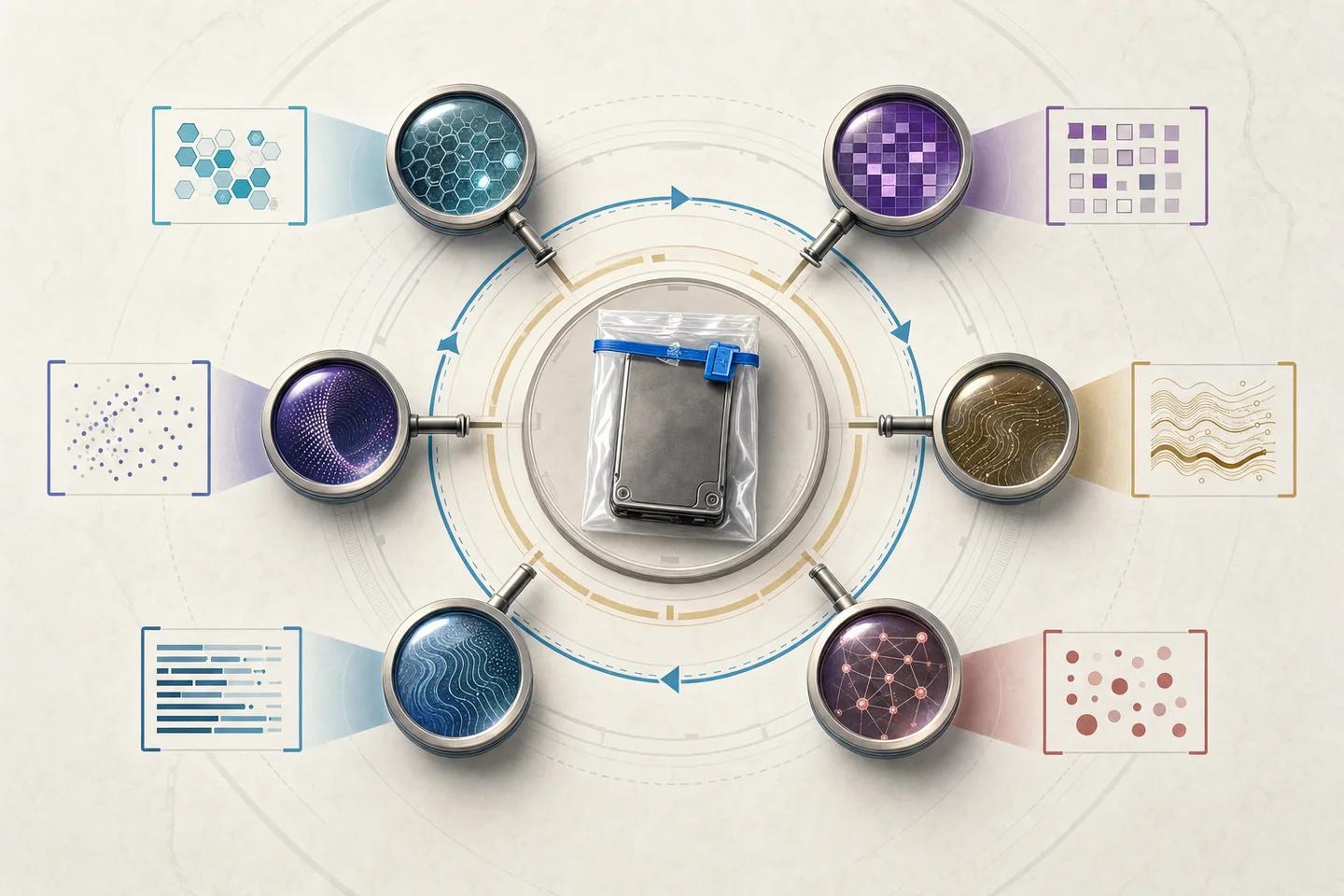

Where deepfake detection fits in an investigation
Deepfake detection sits in the analysis stage of an investigation, after the evidence has been collected and preserved and before anyone writes a conclusion. Fraud teams, insurance special investigation units, corporate security, journalists and law enforcement all follow roughly the same sequence, even if they name the steps differently.
Placing detection there has practical consequences. Run it on a copy, never the only original. Run it after you have recorded where the file came from, because the model cannot recover that context. Run it before the finding is drafted, so a manipulation flag can change the line of inquiry rather than decorate a decision already made.
The table shows the stages and what detection contributes to each. Most investigations use it at stage three, but triage teams also run it at intake to decide which cases need a specialist.
| Stage | What happens | Role of detection |
|---|---|---|
| 1. Intake | Receive the file, record source, sender and time | Optional triage to prioritise cases |
| 2. Preservation | Hash the original, store it read-only, work on copies | None; detection must not alter the original |
| 3. Analysis | Provenance check, metadata review, manipulation analysis | Core: flags generated or edited regions, frames and audio segments |
| 4. Corroboration | Compare against other evidence, witnesses, records | Result is weighed with everything else |
| 5. Finding and report | Write conclusion, uncertainty and method | Report records tool, model version and flagged evidence |


How can investigators review suspected synthetic media?
Investigators review suspected synthetic media in a fixed order, so that later steps cannot contaminate earlier ones. The steps below suit a single suspect file; for a batch, apply them per file and record which ones were skipped.
Context comes first because it is often decisive. A video said to show a meeting last Tuesday that carries a creation date from two years ago, or that matches an older clip found by reverse image search, may be a reused genuine recording rather than a deepfake. FinCEN's November 2024 alert notes that reverse image searches have matched identity photos to online galleries of AI-generated faces.
Manipulation analysis then looks for traces the human eye misses: blending boundaries around a swapped face, frequency patterns left by image generators, lip and audio misalignment, and voice artifacts from synthesis. A good tool shows where it found them, so the analyst can check whether a flagged region makes sense.
- Preserve: compute a hash of the original, store it read-only and log who handled it.
- Contextualise: record the claimed source, date and location; run reverse image or video search.
- Inspect provenance: read metadata and any Content Credentials, noting that both can be stripped or forged.
- Analyse: run manipulation detection on a working copy and examine the flagged regions, frames or segments.
- Corroborate: compare with independent evidence such as other recordings, logs or witness accounts.
- Report: state the conclusion, the confidence, the method and the model version used.
What a detection result can and cannot support in a case
A detection result is evidence about a file, produced by a process. In US courts, Federal Rule of Evidence 901 requires evidence sufficient to support a finding that an item is what its proponent claims, and Rule 901(b)(9) allows evidence describing a process or system and showing that it produces an accurate result. That is the frame a forensic report has to fit: it must explain the method and its reliability, not only give a score.
Detector reliability depends on what the model has seen. The FaceForensics++ study (Rössler et al., 2019) built a dataset of over 1.8 million manipulated images across four methods and found that trained detectors beat human observers even under strong compression. Detectors tend to lose accuracy on generation methods absent from their training data; the ARCAS 1B paper argues for this reason that a single benchmark score gives an incomplete picture of generalisation. An investigator should treat a clean result on a novel technique with care.
Public evaluations help calibrate expectations. NIST's Open Media Forensics Challenge ran image and video manipulation detection and deepfake detection tasks through 2023, giving teams a common way to compare systems.
Documenting detection so the finding survives review
Investigations are reviewed by supervisors, opposing counsel, regulators or editors months after the analysis. The record has to let someone else understand and, ideally, repeat what was done.
At minimum, keep the original file hash, the working copy hash, the tool name and model version, the date of analysis, the regions or time segments flagged, any scores with their scale, and the analyst's reasoning in plain language. Note anything that limits the result, such as heavy compression, low resolution or a format the tool handles poorly. The guide to evidence preservation for synthetic media covers chain of custody in more depth.
Version context matters because models are updated. A result from a newer model may differ on the same file, and a reviewer must be able to tell which version produced the finding.

How NeuroDetect supports investigators
NeuroDetect is Neural Defend's forensic media workspace, built for the analysis and reporting stages above. An investigator uploads an authorised image, audio file, video or document into a case. Each analysis keeps its model and version context, and the detailed views show the original alongside explainability heatmaps and attention views, down to specific regions, frames and audio segments.
An LLM-assisted summary describes the findings in plain language and links each statement back to the evidence, and the analyst makes the final call. The downloadable forensic report records observations, uncertainty, provenance, model context and analyst notes, and structured results can be exported for case management or eDiscovery systems.
The detection models build on ARCAS 1B, Neural Defend's own deepfake detection model. The ARCAS paper reports pooled accuracy of 99.99% on GenImage and 97.65% on OpenFake, and it cautions that results describe only the records tested. On the public VendorBench-100 still-image benchmark, Neural Defend ranked first of 36 systems with an MCC of 0.876 against 0.646 for the next vendor; one benchmark author also co-authored the ARCAS paper, and the corpus is public.
For cases involving sensitive evidence, Neural Defend deploys in private cloud, on premises or air-gapped, and holds ISO/IEC 27001, ISO/IEC 27701, ISO/IEC 42001 and SOC 2 Type II certifications. Teams that need automated screening of high volumes, such as intake triage, can add the NeuroVerify API for face images, video and audio.
Evidence boundary
Limitations
- No detection tool can establish who created a file or why; attribution and intent remain investigative questions.
- Accuracy on generation methods released after a model's training is uncertain, so negative results on novel media should be treated as inconclusive.
- Heavy recompression, cropping and screen recording degrade the traces detectors rely on and should be noted in any report.
- Admissibility rules differ by jurisdiction; the Federal Rules of Evidence discussion applies to US federal courts only.
Source record
Sources and references
- Legal Information Institute, Cornell Law SchoolFederal Rules of Evidence, Rule 901: Authenticating or Identifying EvidenceVerified October 19, 2026.
- arXivFaceForensics++: Learning to Detect Manipulated Facial ImagesPublished January 25, 2019. Verified October 19, 2026.
- National Institute of Standards and TechnologyOpen Media Forensics Challenge (OpenMFC)Verified October 19, 2026.
- Financial Crimes Enforcement Network (FinCEN)FIN-2024-Alert004: FinCEN Alert on Fraud Schemes Involving Deepfake Media Targeting Financial InstitutionsPublished November 13, 2024. Verified October 19, 2026.
- National Institute of Standards and TechnologyNIST AI 100-4: Reducing Risks Posed by Synthetic ContentPublished November 1, 2024. Verified October 19, 2026.
- arXivBenchmarking Neural Defend ARCAS 1B: A Foundational Multimodal Deepfake Detection ModelPublished September 21, 2026. Verified October 19, 2026.
- arXivVendorBench-100: A Unified Cross-Paradigm Benchmark for Deepfake Image DetectionPublished July 29, 2026. Verified October 19, 2026.