
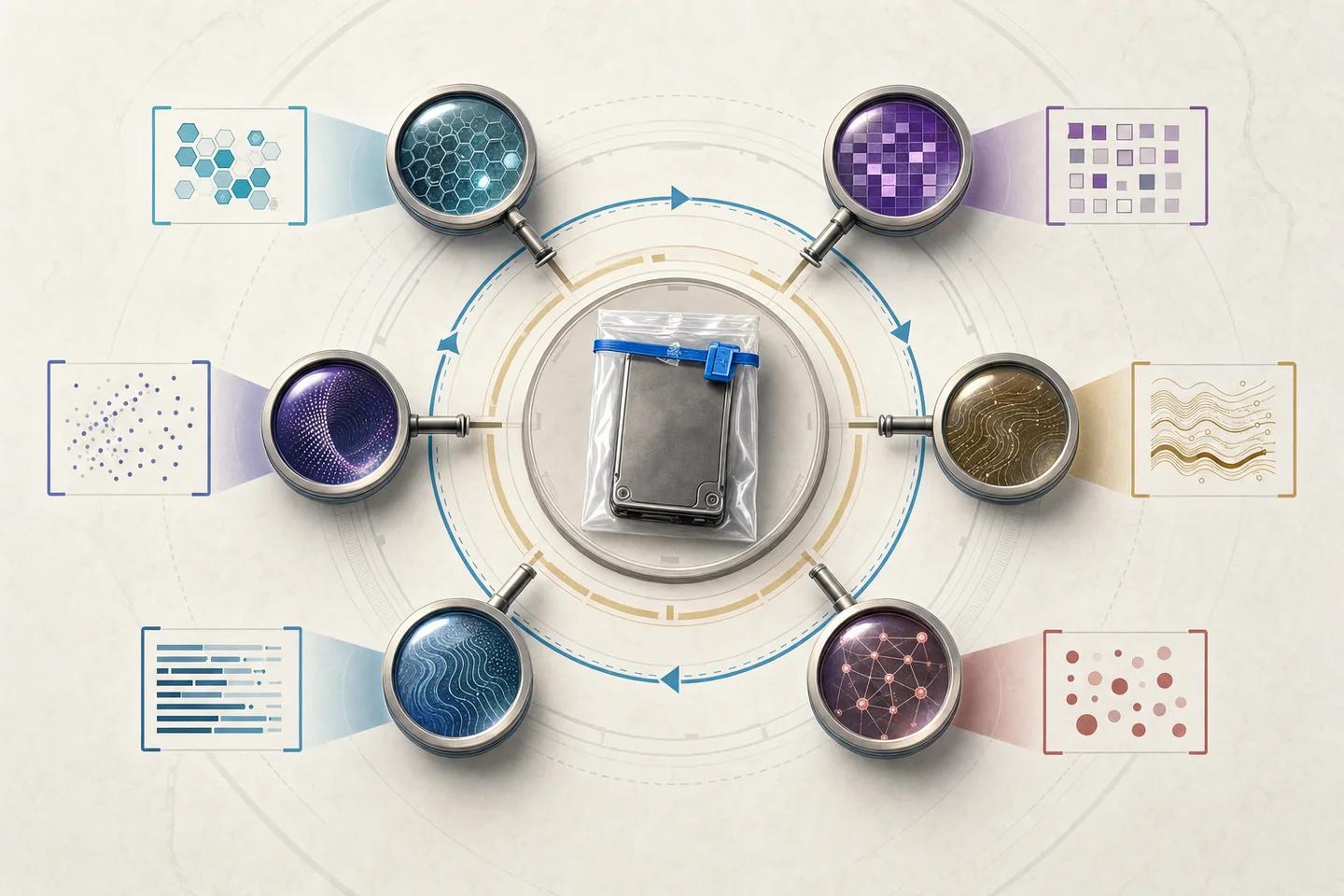
How to assess fabricated digital evidence: five separate questions
Assessing fabricated digital evidence starts by refusing to ask a single question. "Is it fake?" mixes several issues that need different evidence. A genuine photo can carry a false caption, a real recording can be edited, and an authentic file can come from a different source than claimed. Write down which question each finding answers.
The five questions below cover most cases. Integrity and manipulation can be tested on the file; source, identity and event usually need records from outside it, such as device logs, platform data, witnesses, or documents from the organization involved.
| Question | What it asks | Typical evidence |
|---|---|---|
| Integrity | Has the file changed since it was collected? | Hash values, chain-of-custody log |
| Manipulation | Was the content generated, edited or spliced? | Forensic analysis of pixels, frames, audio and file structure |
| Source | Did it come from the claimed device, account or sender? | Device data, platform records, email headers, provenance manifests |
| Identity | Does it show or record the person claimed? | Comparison with known samples, witnesses, other records |
| Event | Did the depicted event happen as described? | Independent records, location and time checks, witnesses |
Where fabricated evidence is turning up
Fabricated media now reaches routine decisions. Insurers see edited photos of vehicle damage and generated receipts. Employers receive recordings of a manager supposedly saying something offensive. Family courts and civil disputes see messages and voice notes whose origin is contested. Fraud teams receive forged bank statements and identity documents.
The Pikesville High School case in Baltimore County shows the stakes. In early 2024 an audio clip appearing to capture principal Eric Eiswert making racist and antisemitic remarks spread online. Police later said the audio was AI-generated and charged the school's former athletic director, Dazhon Darien. In April 2025, CBS News reported, Darien entered an Alford plea to disturbing school operations and was sentenced to four months.
What courts expect: authentication and machine-generated evidence
In US federal courts, Rule 901 of the Federal Rules of Evidence sets the basic test: the proponent must produce evidence sufficient to support a finding that the item is what the proponent claims it is. Testimony from a witness with knowledge, distinctive characteristics and evidence about a process or system are among the listed ways to meet it. Many state rules follow the same structure.
Rules are also being written for AI output itself. Proposed Federal Rule of Evidence 707 would require machine-generated evidence offered without an expert witness to meet the reliability requirements of Rule 702, which covers expert testimony. According to a Barnes and Thornburg alert, the revised proposal was open for public comment until 16 February 2026. That standard would also apply to deepfake detection output offered on its own, which is a reason to document methods, model versions and error rates.
The opposite risk is just as real. Robert Chesney and Danielle Citron described the liar's dividend in their 2019 California Law Review article: as deepfakes become familiar, people caught on genuine recordings can claim the evidence is fake. Assessment has to be able to support authenticity as well as reject it.
A repeatable assessment method
Good assessments are repeatable: another examiner with the same file and tools should reach the same findings. Start from a preserved original with a recorded hash, use documented methods such as the Scientific Working Group on Digital Evidence's guidelines for image analysis and video authentication, and record every tool, version and setting.
Examine the file structure and metadata, then the content, then the context. Structure can show re-encoding, editing software or inconsistent container data. Content analysis looks for generation artifacts, splices and lighting or audio inconsistencies. Context checks compare the claim with independent records. Each step should report what it found and what it could not determine.
- Confirm the hash of the file you are examining matches the preserved original.
- State the exact claim being tested before analysis starts.
- Record tools, versions, settings and results for each step.
- Report findings per question, with uncertainty, rather than one overall verdict.
- Have a second examiner review significant conclusions.
Reporting what the evidence supports
Findings should be bounded. "The audio contains splice points at 0:42 and 1:15" or "the image shows signs consistent with generation in the face region" can be checked and challenged. "The evidence is fake" usually cannot. Say what was not tested, and distinguish an inconclusive result from a negative one: a detector that finds nothing on a heavily compressed copy has not shown the file is authentic.
Keep interpretation separate from observation. The forensic report states what the file shows; the investigator, tribunal or court decides what that means for the case, together with the other evidence.
Write for a reader who was not in the room. A judge, claims manager or HR panel should be able to follow from the file, through each test, to the conclusion without needing the examiner to explain it. Include images of the relevant regions or frames, timestamps for audio findings, and a plain statement of what each finding does and does not mean for the claim.
Using NeuroDetect for evidence assessment
Neural Defend's NeuroDetect addresses the manipulation question in a form designed for review. Authorized analysts upload an image, audio, video or document into a case. Each analysis keeps its model and version context, and explainability heatmaps and attention views show the regions, frames and audio segments behind a finding. An LLM-assisted summary describes the results in plain language with links to the evidence, and the analyst makes the final call.
The downloadable forensic report records observations, uncertainty, provenance, model context and analyst notes, and structured results can be exported. Those are the details a Rule 702-style reliability review asks about. The underlying model, ARCAS 1B, has published results: the ARCAS paper reports pooled accuracy of 99.99% on GenImage, 99.09% on AIGIBench and 97.74% on Community Forensics. On the public VendorBench-100 benchmark of difficult still images, Neural Defend ranked first of 36 systems with an MCC of 0.876; one VendorBench author also co-authored the ARCAS paper, and the corpus is public for anyone to rerun.
Evidence boundary
Limitations
- Analysis of re-encoded or low-resolution copies may be inconclusive; that is not evidence of authenticity.
- Proposed Rule 707 was not final at the time of writing, and state courts may apply different standards.
- ARCAS and VendorBench figures cover benchmark datasets of images; performance on a specific case file must be judged from its own evidence views.
Source record
Sources and references
- Legal Information Institute, Cornell Law SchoolFederal Rules of Evidence, Rule 901: Authenticating or Identifying EvidenceVerified October 19, 2026.
- Barnes & ThornburgNew Evidence Rule 707 Would Set Standards for AI-Generated Courtroom EvidenceVerified October 19, 2026.
- Boston University School of Law (California Law Review)Deep Fakes: A Looming Challenge for Privacy, Democracy, and National SecurityVerified October 19, 2026.
- CBS News BaltimoreBaltimore man accused of framing school principal with an AI-generated rant takes a plea dealVerified October 19, 2026.
- Scientific Working Group on Digital EvidenceBest Practices for Digital Video AuthenticationVerified August 7, 2026.
- arXivBenchmarking Neural Defend ARCAS 1B: A Foundational Multimodal Deepfake Detection ModelVerified October 19, 2026.