
Detecting AI callers in contact centres: what you are looking for
Contact centres now receive three kinds of AI caller, and each needs a different response. The first is a cloned human voice: a fraudster, or software driven by one, imitating a specific customer to take over an account. The second is an autonomous AI voice agent that runs a script at scale, testing account numbers, harvesting information or social-engineering agents without a human on the line. The third is legitimate: a customer's own AI assistant calling to cancel a subscription or check an order.
Detecting AI callers means answering two questions on every call: is this voice synthetic, and if so, is it acting for the account holder? The first question is technical and can be scored automatically. The second is a policy question that the contact centre has to answer in advance, because an assistant authorised by a real customer should not be treated like an impersonator.


Do AI voice agents pose a fraud risk to contact centres?
Yes. AI voice agents remove the main limit on phone fraud, which was the number of people a criminal group could put on calls. A single operator can run many simultaneous conversations, each adapting to the agent's answers, and hand only the promising ones to a human or a cloned voice for the final step.
The FBI's December 2024 public service announcement lists cloned audio used to gain access to bank accounts among current criminal uses of generative AI, and its May 2025 alert describes AI-generated voice messages used at scale against officials and their contacts. Contact centres are attractive because they combine high call volume, staff trained to be helpful, and the power to reset credentials and change contact details.
Cost is the other risk. Automated callers that probe, abandon and redial consume agent time and queue capacity even when they fail, which pushes wait times up for genuine customers.

How do fraudsters use synthetic voices to probe IVR systems?
Fraudsters use synthetic voices and automated dialling to treat the interactive voice response (IVR) system as a free reconnaissance tool. Bots call repeatedly, step through menu options and speak or key in account numbers, card numbers or dates of birth drawn from breached data. The IVR's responses tell them which accounts exist, which ones accept partial authentication, and sometimes balances or recent activity.
That information is then used in a second phase: a targeted call to a live agent, often with a cloned or converted voice, armed with confirmed details and knowledge of which verification path is weakest. Because each probing call looks routine and short, it rarely triggers fraud rules designed for live-agent conversations.
Signals that expose probing include many short calls against different accounts from related numbers, identical menu paths repeated at machine speed, synthetic speech at the IVR's voice prompts, and failed authentication attempts spread across accounts rather than concentrated on one.

Signals that identify an AI caller
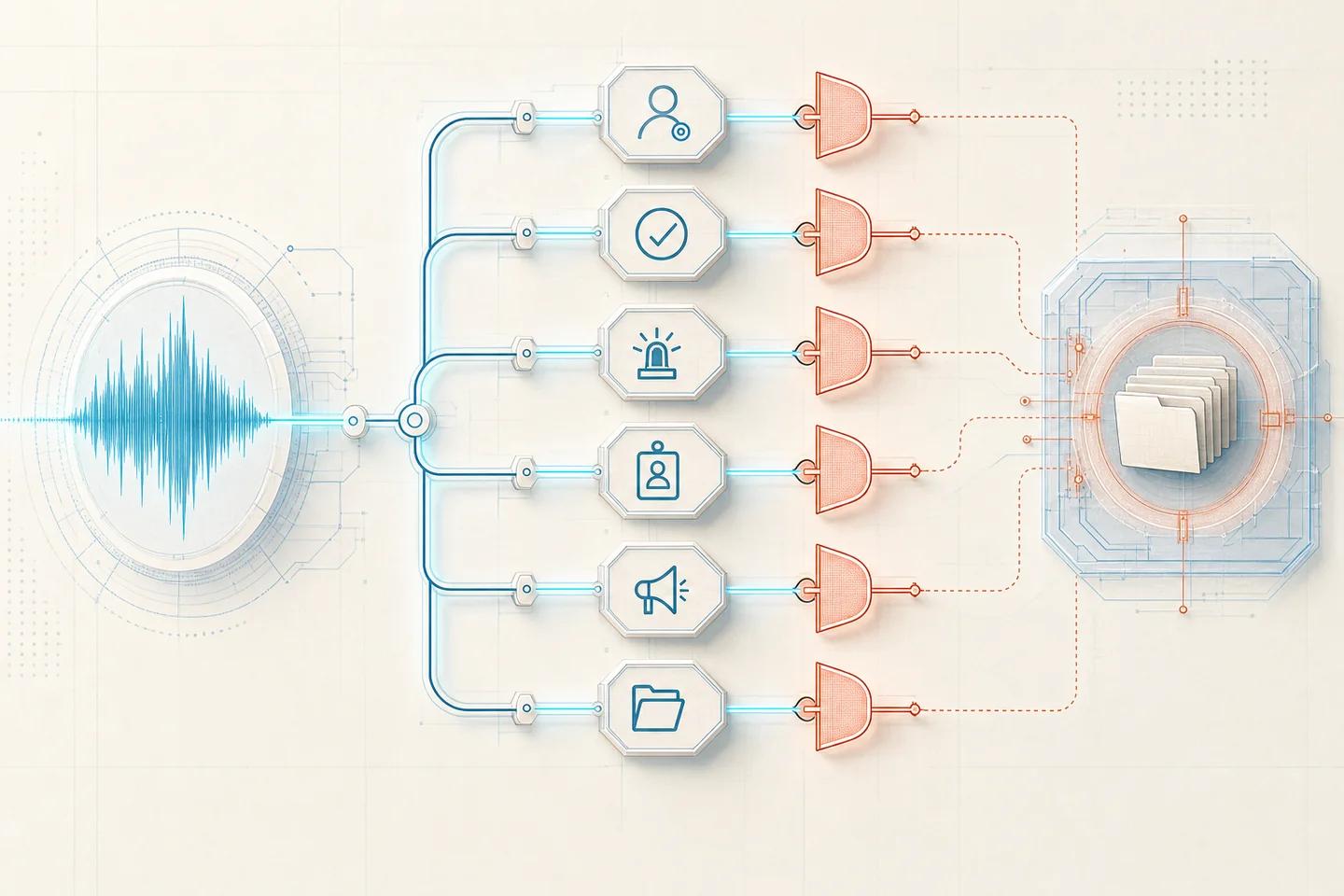
No single signal is reliable, so effective programmes combine several and score them together.
- Audio signals: synthetic-speech detection that scores the caller's voice for artefacts of cloning, text-to-speech or voice conversion.
- Conversation signals: unusually uniform response latency, unnatural handling of interruptions, and answers that ignore what the agent just said.
- Telephony signals: spoofed or recently issued numbers, VoIP routing inconsistent with the claimed customer, and call bursts across many accounts.
- Account signals: requests that target the riskiest actions first, such as contact detail changes, new devices or password resets.
- Cross-call signals: the same voice characteristics appearing on calls for different customers.

A response strategy for AI callers
Write a policy for each caller type. Legitimate customer assistants can be allowed for low-risk servicing if they identify themselves, with any sensitive change confirmed by the customer through the app or a callback. In the EU, Article 50 of the AI Act, applying from 2 August 2026, requires AI systems that interact with people to make that clear unless it is obvious, which supports asking automated callers to declare themselves.
Undeclared synthetic voices on sensitive requests should be stepped up: end self-service, move the call to a trained agent and confirm through a registered channel. Repeated probing patterns should feed fraud rules that rate-limit or block the source and flag the targeted accounts for monitoring. For outbound calls, the FCC confirmed on 8 February 2024 that AI-generated voices count as artificial voices under the TCPA, so the same consent rules apply to your own AI agents.
Measure the effect. Track stepped-up calls, abandonment after step-up, confirmed fraud originating from phone channels and the agent minutes consumed by automated calls. These numbers justify the programme and show where to tune thresholds.

How Neural Defend helps contact centres detect AI callers
Neural Defend's NeuroCall, currently in Beta, analyses call audio for synthetic speech and returns a risk signal that your routing, IVR and fraud rules can act on, for example by sending a high-risk call to a specialist queue or requiring a callback before a sensitive change. It addresses the audio question; your policy and your telephony and account signals answer whether the caller is authorised.
For calls that become fraud cases, NeuroDetect lets investigators review recordings with audio-segment evidence and export a forensic report. Deployment can be managed cloud, private cloud or VPC, on-premises or air-gapped, which matters when call recordings must stay inside the contact centre's environment.

Evidence boundary
Limitations
- Conversation and telephony signals described here are general patterns; their reliability depends on your call volumes and platform data.
- Public data on the scale of AI-driven IVR probing is limited, so this page describes the method rather than its frequency.
- NeuroCall is in Beta and addresses synthetic speech only; deciding whether an AI caller is authorised remains a policy decision.
Source record
Sources and references
- FBI Internet Crime Complaint CenterCriminals Use Generative Artificial Intelligence to Facilitate Financial Fraud (I-120324-PSA)Published December 3, 2024. Verified October 19, 2026.
- FBI Internet Crime Complaint CenterSenior US Officials Impersonated in Malicious Messaging Campaign (I-051525-PSA)Published May 15, 2025. Verified October 19, 2026.
- European CommissionTransparency obligations under Article 50 of the AI ActVerified October 19, 2026.
- Federal Communications CommissionDeclaratory Ruling FCC 24-17 on AI technologies and the TCPAPublished February 8, 2024. Verified October 19, 2026.
- Federal Trade CommissionFighting back against harmful voice cloningPublished April 8, 2024. Verified October 19, 2026.
- NISTSP 800-63B-4 Digital Identity Guidelines: Authentication and Authenticator ManagementPublished July 31, 2025. Verified October 19, 2026.