
How contact centres detect voice deepfakes
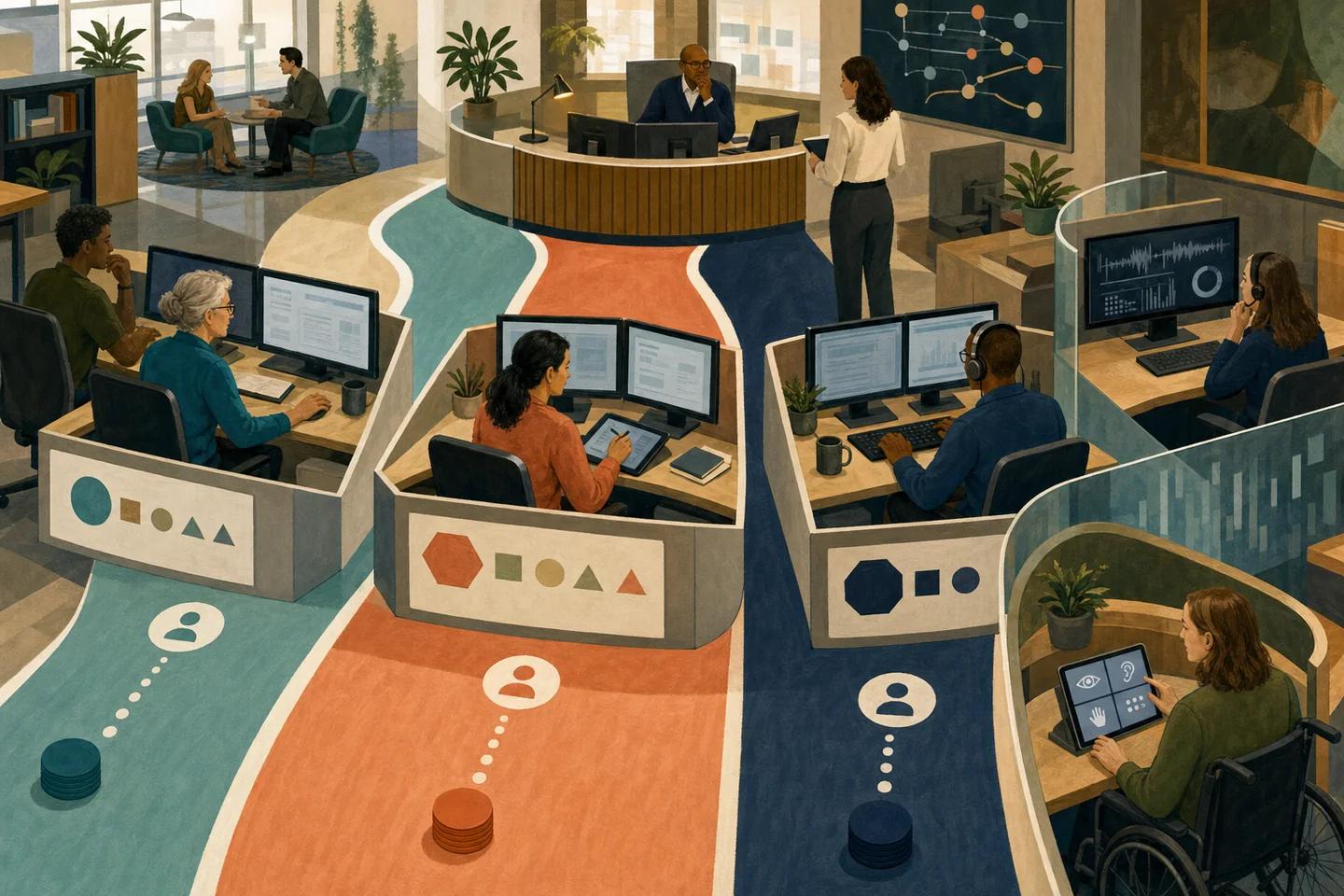
Contact centres detect voice deepfakes by sending a copy of each call's audio to a synthetic-speech detector, which scores short windows of the caller's voice while the conversation continues. The score goes to the routing and fraud rules the centre already runs, so a high-risk call can be moved to a specialist, held for a callback or blocked from sensitive changes before an agent acts. The same detector can also score recorded calls after the fact for fraud review and disputes.
Real-time detection works on rolling windows of a few seconds. An early score is available soon after the caller starts speaking and firms up as more speech arrives. The FTC's 2024 Voice Cloning Challenge recognised an approach that scored incoming call audio in two-second chunks, which shows the pattern. Recorded analysis can use the whole call and heavier models, and suits investigations where evidence matters more than speed.


How can contact centres detect voice impersonation?
Contact centres detect voice impersonation by checking three things together: whether the voice is synthetic, whether the caller can pass an out-of-band check, and whether the request fits the account's normal behaviour. Synthetic-speech detection catches cloned and converted voices that a voiceprint would accept. Out-of-band checks, such as an in-app approval or a callback to the number on file, catch impersonators whatever voice they use. Behavioural rules catch the request pattern: new device, new payee, changed phone number, all in one call.
Voice biometrics alone is no longer enough. NIST's SP 800-63B-4, finalised in July 2025, states that biometric comparison based on voice shall not be used in its authentication guidelines. Centres that keep voiceprints should treat a match as a low-risk convenience signal and connect detection results to the same step-up logic used for multi-factor authentication, so a high synthetic-speech score triggers the second factor automatically.

How do contact centres justify voice deepfake controls?
Contact centres justify voice deepfake controls by tying them to the losses and costs a cloned voice can cause in their own operation, not to industry headlines. Build the case from four numbers you can measure: confirmed fraud losses that started with a phone call, the share of those calls that passed authentication, agent minutes spent on calls later found to be fraudulent, and customer complaints and churn after account takeovers.
External evidence supports the risk side. The FBI's December 2024 public service announcement lists cloned audio used to gain access to bank accounts among current criminal techniques, and Starling Bank's September 2024 survey found 28% of UK adults said they had been targeted by an AI voice cloning scam in the past year. FinCEN's November 2024 alert warned financial institutions about fraud schemes using deepfake media.
Run a parallel test before buying. Score a few weeks of recorded calls, including known fraud cases and consented synthetic samples, and count how many risky calls would have been flagged and how many genuine customers would have been stepped up. That gives a measured benefit and a measured friction cost for the decision.
How should contact-centre leaders manage voice deepfake risk?
Contact-centre leaders should manage voice deepfake risk as an operational process with owners, thresholds and reviews, not as a tool purchase. Assign a single owner for synthetic-voice risk across fraud, operations and security. Decide which actions a phone call may never complete without an out-of-band check. Set detection thresholds against a false-positive budget agents can live with, and review them monthly as score distributions and attack patterns change.
Agents need simple rules. Tell them what a high-risk flag means, what to say to the caller and that following the step-up script is never a mistake. Give supervisors a way to escalate suspected cloned calls and preserve recordings. Report to leadership on flagged calls, step-up outcomes and fraud prevented, so the programme is judged on results.
Detection is never a standalone answer. It is one signal among authentication, behavioural fraud rules and agent judgement, and it should feed your existing fraud platform through an API rather than run as a separate console agents must watch.

Incident response when a deepfake call gets through
Plan the response before the first incident. When a cloned-voice call succeeds, lock the affected account and reverse the change it made, contact the real customer through a registered channel, stop or recall any payment, and preserve the call recording in its original form with timestamps and detector output.
Then look for the campaign. Search for other calls with the same number ranges, voice characteristics or request pattern, and check IVR logs for probing in the days before. Feed what you learn back into thresholds and agent guidance. Where suspicious activity reporting applies, include the detection evidence and call details.

How Neural Defend supports contact centres
Neural Defend's NeuroCall, currently in Beta, analyses live and recorded call audio for synthetic speech and returns a risk signal for your routing, authentication and fraud rules. Results arrive as structured data your systems can act on, so detection becomes one more input to existing workflows. For incidents, NeuroDetect lets investigators examine recordings at audio-segment level and export a forensic report with model and version context.
Deployment is scoped during evaluation and can be managed cloud, private cloud or VPC, secure container, on-premises or air-gapped, so recordings can stay inside your environment. Neural Defend holds ISO/IEC 27001, ISO/IEC 27701, ISO/IEC 42001 and SOC 2 Type II certification. Because NeuroCall is in Beta, measure detection quality and latency on your own telephony audio before relying on it.

Evidence boundary
Limitations
- Business case guidance describes what to measure; it does not provide loss or return figures, which vary widely by organisation.
- Real-time detection on narrowband or noisy calls and very short utterances is less reliable than on clean recordings.
- NeuroCall is in Beta, and Neural Defend does not publish latency or accuracy figures for it; evaluate on your own call audio.
Source record
Sources and references
- Federal Trade CommissionFighting back against harmful voice cloningPublished April 8, 2024. Verified October 19, 2026.
- NISTSP 800-63B-4 Digital Identity Guidelines: Authentication and Authenticator ManagementPublished July 31, 2025. Verified October 19, 2026.
- FBI Internet Crime Complaint CenterCriminals Use Generative Artificial Intelligence to Facilitate Financial Fraud (I-120324-PSA)Published December 3, 2024. Verified October 19, 2026.
- Starling BankStarling Bank launches Safe Phrases campaignPublished September 18, 2024. Verified October 19, 2026.
- FinCENFinCEN Issues Alert on Fraud Schemes Involving Deepfake Media Targeting Financial Institutions (FIN-2024-Alert004)Published November 13, 2024. Verified October 19, 2026.
- Federal Communications CommissionDeclaratory Ruling FCC 24-17 on AI technologies and the TCPAPublished February 8, 2024. Verified October 19, 2026.
- European CommissionTransparency obligations under Article 50 of the AI ActVerified October 19, 2026.