
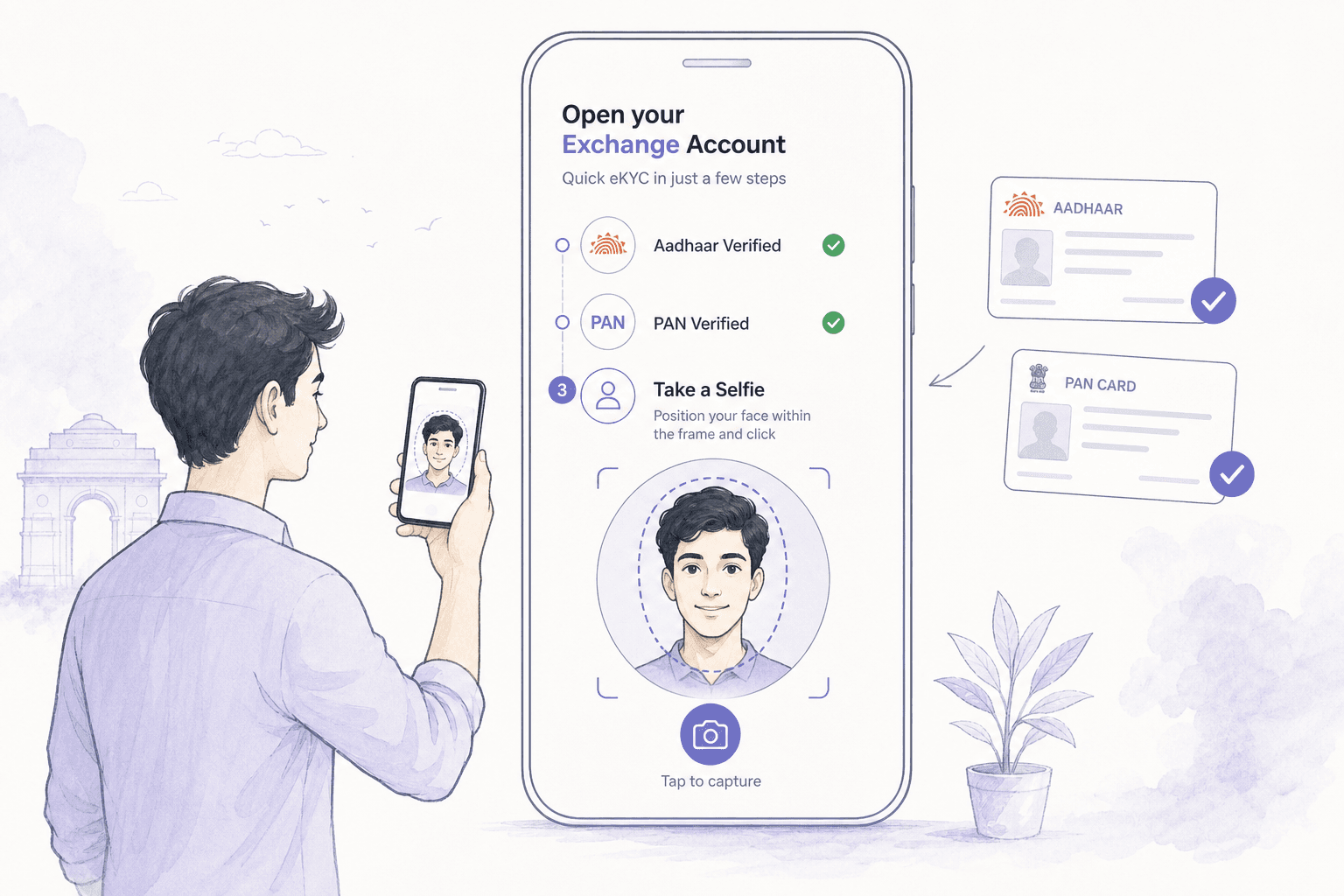
Create account → Upload document → Selfie and liveness → Face match → Deposit access
Each check passes on a convincing synthetic face. Nothing in the flow asks whether the face is real.
Crypto exchanges / NeuroVerify
Exchanges onboard users in minutes from anywhere, so the selfie step is the front line against fake and stolen identities. NeuroVerify checks that selfie for deepfakes and face manipulation beyond liveness, and returns one risk score with signal-level evidence before deposits open.
It runs on the selfie your KYC flow already captures: no new step for the user, one API call for you.
NeuroVerify does not verify identity documents, screen sanctions or monitor transactions. Your KYC vendor and your AML programme keep those jobs.
The gap
Crypto exchanges serve users across many countries, often with instant sign-up and fast access to deposits. Identity assurance usually rests on a document scan, a selfie, and a liveness check, run by one or more KYC vendors. There is no branch, no meeting, and little time for manual review.
That makes the exchange an attractive place to open accounts under someone else's face. A generated or face-swapped selfie can match a stolen document and respond to a liveness prompt. Once the account is verified, it can receive funds, move assets quickly and cash out across borders.
Create account → Upload document → Selfie and liveness → Face match → Deposit access
Each check passes on a convincing synthetic face. Nothing in the flow asks whether the face is real.
Verified accounts under false identities hide the real owner of funds. Financial-crime guidance on digital identity, such as FATF Digital Identity Guidance, stresses that identity assurance depends on the reliability of the technology used. Media authenticity is part of that reliability. See also crypto exchange customer onboarding.
Threats
These are attack patterns, not claims about any specific exchange.
The attacker maps the document holder's face onto their own movements to pass match and liveness.
A prepared or generated video replaces the camera feed, so nothing live was ever captured.
Fraudsters pass KYC with fake faces, then sell the verified account to others who want anonymity.
Fabricated people with generated faces open many accounts to split and move proceeds.
After credentials are stolen, a manipulated face passes the step-up check before withdrawal.
One operator scales across hundreds of accounts by re-rendering a handful of faces.
Where NeuroVerify fits
NeuroVerify runs between selfie capture and the point where your policy grants trading, deposit or withdrawal rights. Your KYC vendor, sanctions screening and transaction monitoring stay where they are.
Upload document → Selfie → NeuroVerify risk score → Face match → Your decision on access
One added call. Everything else in the flow is unchanged.
Six signals run in one request: Visual Safety Screening, Live Presence Verification, Face Manipulation Detection, AI Generative Model Analysis, AI Pixel-Level Manipulation and AI Content Compliance. NeuroVerify analyses face images, video and audio, not documents.
Native mobile SDKs and backend SDKs fit exchange apps and web flows. Compare approaches in Best Deepfake Detection API for KYC.
Pass the image or video your app or web flow already captures to the API or SDK.
Receive one score with signal-level evidence in the same call.
Grant, limit deposits and withdrawals pending review, or decline.
Keep the evidence against the user ID for AML and investigation work.
What you get
Synthetic and swapped faces are flagged before access opens.
Manipulated selfies are caught at the step fraudsters rely on.
Signal-level results show why an account was scored as risky.
Under 200 ms p95 on eligible images keeps sign-up smooth.
The same call covers users in every country you serve.
Questions
NeuroVerify analyses the face media, not the document, so it works the same way regardless of which country or ID type the user presents. Your KYC vendor still handles document checks and local rules.
Yes. The risk score is an input to your policy, so you can apply different thresholds by tier, geography or product. NeuroVerify does not set those rules for you.
Not for this purpose. Live Presence Verification is one of the six signals NeuroVerify runs in a single request, alongside Face Manipulation Detection, AI Generative Model Analysis, AI Pixel-Level Manipulation, Visual Safety Screening and AI Content Compliance. It checks selfie images and video from exchange KYC for deepfakes and manipulation beyond liveness.
If you already run a liveness vendor, keep it during evaluation and compare outcomes on your own media before deciding what to retire. The difference is explained in Deepfake Detection vs Liveness Detection.
It fits the capture step you already run, so the end user sees nothing new. You send the media you already collect to one API call. Native mobile SDKs (Android/Kotlin, iOS/Swift, Flutter), backend SDKs (Python, TypeScript/Node.js, Go, Java) and a REST API are available, and an MCP server covers AI agents.
Two lines to integrate and live in under 24 hours are product claims. Your own timeline depends on how your KYC stack is wired.
NeuroVerify returns in under 200 ms at p95 on eligible image requests under defined test conditions. The methodology is available on request. Video and audio take longer than a single image, so decide with your team which step runs inline and which runs in the background.
You choose the deployment model: managed cloud API, private cloud or customer VPC, secure container, on-premises, or air-gapped. Neural Defend holds ISO/IEC 27001, ISO/IEC 27701, ISO/IEC 42001 and SOC 2 Type II certifications. Your legal team decides consent, retention and residency for the media you send.
Details are on the deployment and product data handling pages. For the privacy angle, see GDPR, Biometrics, and Authenticity Analysis.
Yes, and that is the test that matters. On the public VendorBench-100 benchmark, NeuroVerify ranked first of 36 systems with a detection score (MCC) of 0.876 against 0.646 for the next-best vendor. A benchmark does not reflect your devices, lighting, compression or attack mix, so bring representative samples from your own journey.
Contact us to set up an evaluation.
NeuroVerify returns one unified risk score with signal-level evidence. It does not approve or reject anyone. Your policy sets the thresholds and decides what happens at each level: continue, step up to a manual review, or decline.
The signal-level evidence tells a reviewer why a case scored high, which makes review queues faster and decisions easier to explain later.
Evaluate NeuroVerify
Send selfies from your own sign-up flow and compare NeuroVerify results with your current liveness decisions. Contact us to set up an evaluation.