
Identity and tax records pulled → Bank verification → Selfie or video verification → Account approved
The face check proves presence and similarity. It does not prove authenticity.
Brokerage and trading / NeuroVerify
Brokers and trading apps open accounts remotely with a document pull, a selfie and, in many markets, a video verification. NeuroVerify checks that face media for deepfakes and manipulation beyond liveness and returns one risk score with signal-level evidence.
It runs on the selfie or video frames your journey already captures, so the investor takes no new step and you make one API call.
NeuroVerify does not verify tax or identity records, run suitability or risk-profiling checks, or approve accounts. Your intermediary process and compliance policy keep those decisions.
The gap
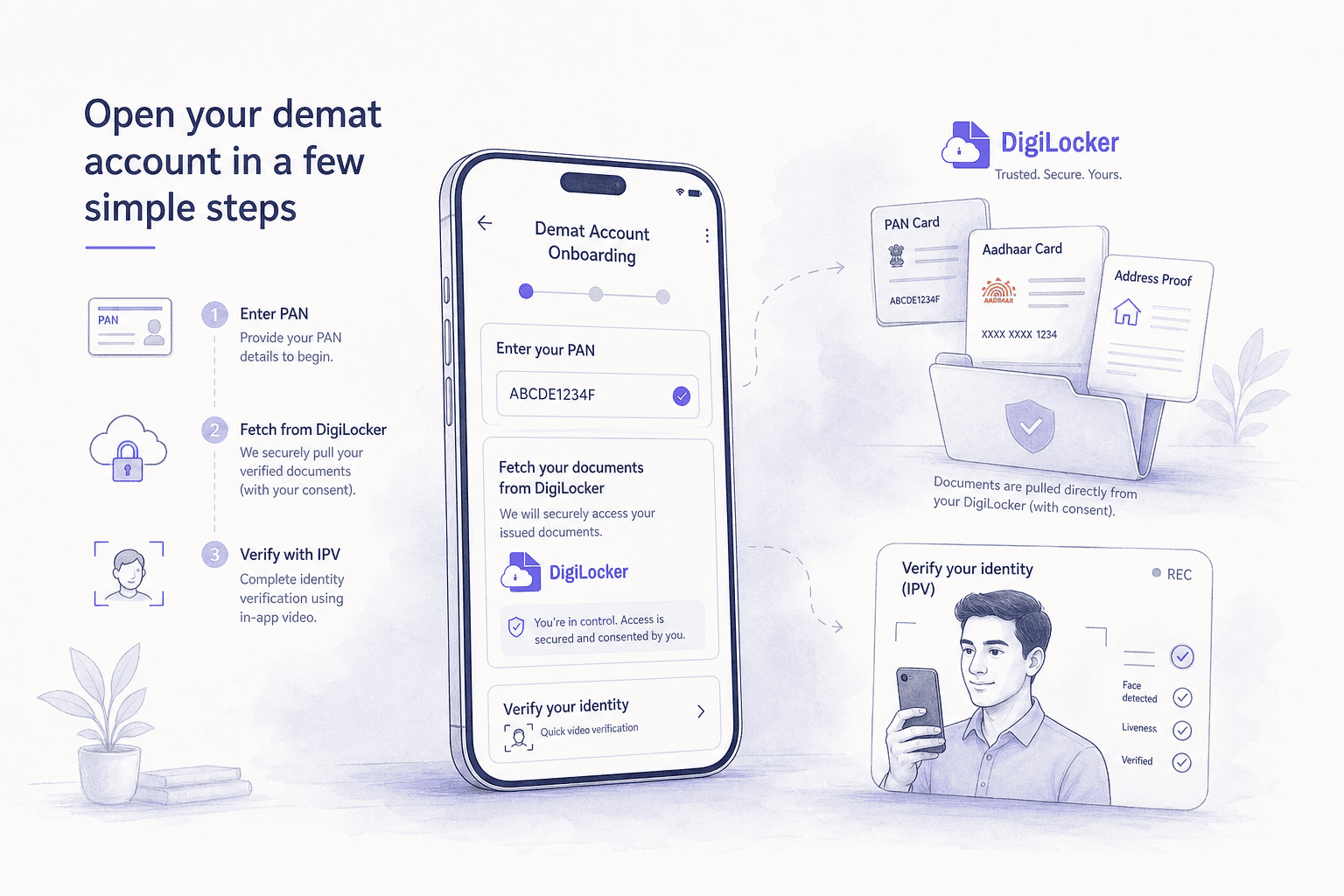
Opening a brokerage or trading account involves identity and tax records, bank verification and a face check. In India the securities account is called a demat account and the face check is often a video in-person verification (IPV). In other markets the same step is a selfie or a video call with an agent. The principle is global: confirm that a real, present person owns the identity.
That step can be beaten with synthetic media. A real-time face-swap lets an operator pass a video session as the document owner. A generated clip can respond to scripted prompts. The record is stored as evidence of verification, though the person verified may not exist.
Identity and tax records pulled → Bank verification → Selfie or video verification → Account approved
The face check proves presence and similarity. It does not prove authenticity.
A trading account can be a mule account for moving funds, a vehicle for market manipulation, or a base for account takeover and investment-scam payouts. Fast onboarding means the face check is often the last control before the account is usable. See brokerage new account opening review and the FinCEN Deepfake Fraud Alert.
Threats
These are attack patterns, not claims about any specific broker.
An operator appears as the record owner on a live session while a real person is off-screen.
The attacker builds a face from the photo returned by the identity pull so face match passes.
Fake faces open multiple accounts to coordinate trades or conceal beneficial ownership.
Accounts opened with synthetic faces move funds through deposits and withdrawals.
After stealing credentials, the attacker passes a face re-check with manipulated media.
A pre-made video replaces the live camera during capture.
Where NeuroVerify fits
NeuroVerify sits right after the selfie or video capture in your onboarding journey and before approval. Your records pulls, bank verification and compliance review stay as they are.
Records pulled → Bank verified → Selfie or video → NeuroVerify risk score → Account approved, reviewed or held
One added call. Everything else is unchanged.
Six signals run in one request: Visual Safety Screening, Live Presence Verification, Face Manipulation Detection, AI Generative Model Analysis, AI Pixel-Level Manipulation and AI Content Compliance. NeuroVerify analyses face images, video and audio. It does not analyse documents.
Mobile and backend SDKs plus a REST API fit trading apps and broker back offices. See NeuroVerify and financial services.
Pass the media your broker app already records to the API or SDK.
Receive one score and signal-level evidence.
Route risky cases to a compliance analyst before the account is usable.
Keep the result with onboarding records for audits and investigations.
What you get
Face-swap and generated media are flagged that a human agent can miss.
Manipulated faces are caught before funds or trades move.
Signal-level results show why an account was approved or held.
Under 200 ms p95 on eligible images keeps the app experience quick.
Cloud, VPC, on-premises or air-gapped to match broker data rules.
Questions
No. Your verification step stays. NeuroVerify analyses the video and frames it produces and adds an authenticity score to what the reviewer sees. Whether a given process meets a regulator's requirement is for your compliance team to judge.
No. The same call applies to any market where brokerage account opening uses a selfie or video check. Terms like demat or IPV are regional examples of the same step.
Not for this purpose. Live Presence Verification is one of the six signals NeuroVerify runs in a single request, alongside Face Manipulation Detection, AI Generative Model Analysis, AI Pixel-Level Manipulation, Visual Safety Screening and AI Content Compliance. It checks selfie images, video and audio from account opening for deepfakes and manipulation beyond liveness.
If you already run a liveness vendor, keep it during evaluation and compare outcomes on your own media before deciding what to retire. The difference is explained in Deepfake Detection vs Liveness Detection.
It fits the capture step you already run, so the end user sees nothing new. You send the media you already collect to one API call. Native mobile SDKs (Android/Kotlin, iOS/Swift, Flutter), backend SDKs (Python, TypeScript/Node.js, Go, Java) and a REST API are available, and an MCP server covers AI agents.
Two lines to integrate and live in under 24 hours are product claims. Your own timeline depends on how your broker onboarding stack is wired.
NeuroVerify returns in under 200 ms at p95 on eligible image requests under defined test conditions. The methodology is available on request. Video and audio take longer than a single image, so decide with your team which step runs inline and which runs in the background.
You choose the deployment model: managed cloud API, private cloud or customer VPC, secure container, on-premises, or air-gapped. Neural Defend holds ISO/IEC 27001, ISO/IEC 27701, ISO/IEC 42001 and SOC 2 Type II certifications. Your legal team decides consent, retention and residency for the media you send.
Details are on the deployment and product data handling pages. For the privacy angle, see GDPR, Biometrics, and Authenticity Analysis.
Yes, and that is the test that matters. On the public VendorBench-100 benchmark, NeuroVerify ranked first of 36 systems with a detection score (MCC) of 0.876 against 0.646 for the next-best vendor. A benchmark does not reflect your devices, lighting, compression or attack mix, so bring representative samples from your own journey.
Contact us to set up an evaluation.
NeuroVerify returns one unified risk score with signal-level evidence. It does not approve or reject anyone. Your policy sets the thresholds and decides what happens at each level: continue, step up to a manual review, or decline.
The signal-level evidence tells a reviewer why a case scored high, which makes review queues faster and decisions easier to explain later.
Evaluate NeuroVerify
Run NeuroVerify on selfies and verification videos from your own onboarding and compare the evidence with your current checks. Contact us to plan an evaluation.