
Sign up → Business and ID details → Selfie and liveness → Marketplace review → Listing and payouts enabled
A deepfake that clears liveness enters the same review queue as a legitimate seller, and gains the trust that comes with an approved account.
E-commerce marketplaces / NeuroVerify
Marketplaces verify sellers, delivery partners and returning customers with a selfie. Fraud rings now answer those checks with face swaps, generated faces and injected video to open fake storefronts and take over genuine ones. NeuroVerify checks that selfie for deepfakes beyond liveness in one API call.
It fits the selfie step your onboarding and recovery flows already run: send the media you already capture, with no new step for sellers or customers.
NeuroVerify does not verify business registrations, tax records or documents, and it does not replace your trust and safety policy. It adds authenticity evidence for face, video and audio.
The gap
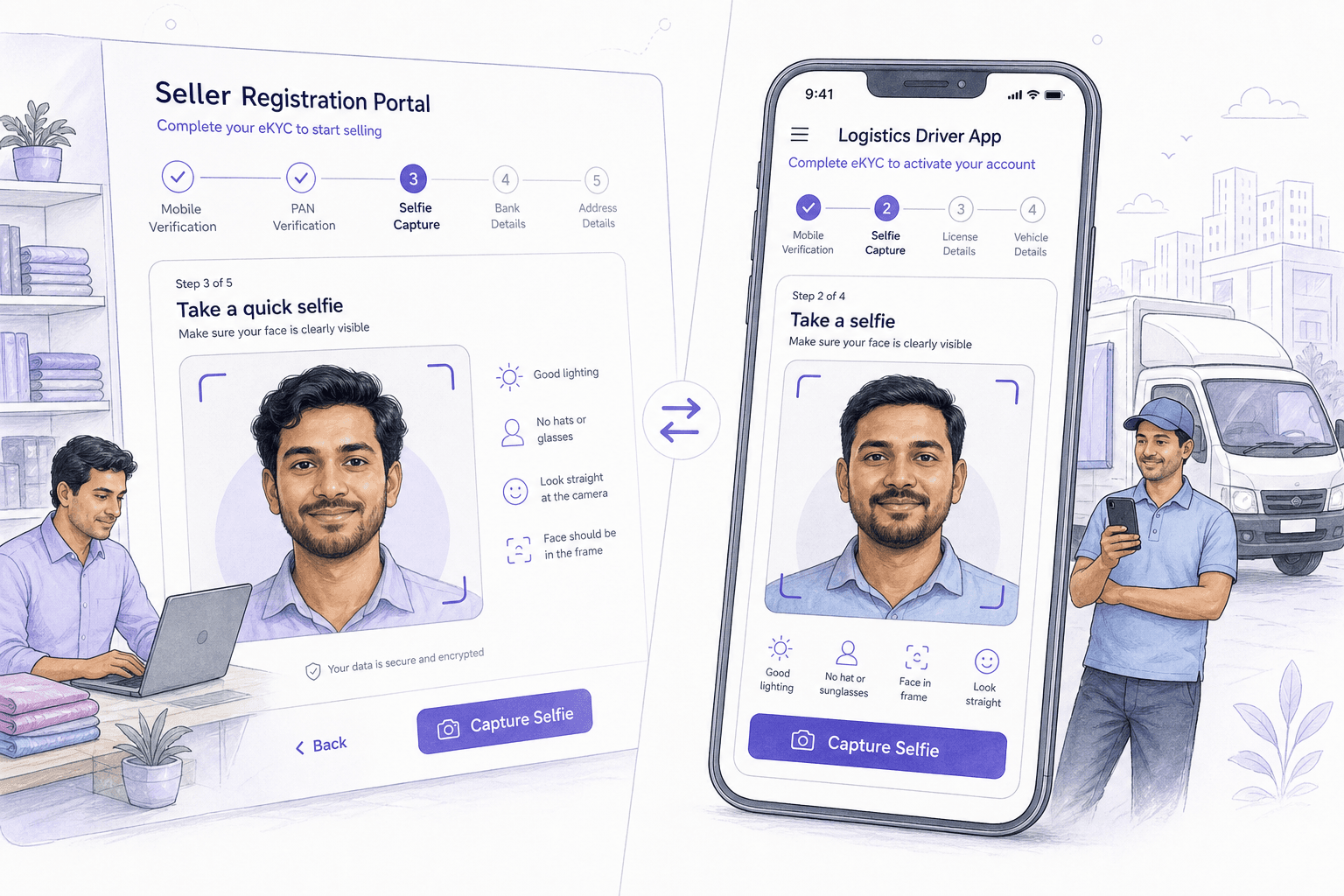
Marketplaces onboard large numbers of sellers, couriers and service providers, often across many countries. To keep that fast, identity checks are automated: a document, a selfie and a liveness prompt. Account recovery and high-value actions often reuse the same selfie step.
That makes the selfie a high-value target. A fake seller who passes it can list products, collect payments and disappear. A fraudster who passes it during account recovery can take over a trusted seller's reputation and payout details.
Sign up → Business and ID details → Selfie and liveness → Marketplace review → Listing and payouts enabled
A deepfake that clears liveness enters the same review queue as a legitimate seller, and gains the trust that comes with an approved account.
Liveness shows a live person may be present. It does not say whether the face is generated or manipulated. See Deepfake Detection for Online Marketplaces and Seller Identity Controls for Marketplace Onboarding.
Threats
These are attack techniques, not claims about any specific marketplace. Each targets the selfie or video evidence behind an approved account.
An attacker maps another person's face onto their own during the selfie check to register a storefront under a false identity.
Rings use synthetic faces with fabricated business details to create many sellers quickly. Each account looks clean on its own.
A virtual camera feeds prepared footage to the app, so the capture step never sees a physical camera. See Virtual Camera Injection Attacks.
An attacker passes a selfie-based recovery flow with a deepfake of the account owner, then changes payout details. See Account Recovery Impersonation.
A banned or unqualified person uses a manipulated selfie to operate under someone else's approved delivery account.
Attackers use synthetic video or face images to impersonate customers in refund or dispute claims. See Impersonation Controls for Marketplace Refunds.
Marketplaces face varied rules by region, including AML and consumer protection obligations. Authenticity evidence supports your trust and safety controls but does not decide compliance. See FATF Digital Identity Guidance.
Where NeuroVerify fits
NeuroVerify sits after the selfie or video is captured and before your trust and safety policy acts. The same call can protect seller onboarding, courier onboarding, account recovery and payout changes.
Sign up → ID and selfie → Liveness → Review → Account approved
A deepfake that passes liveness is approved and starts selling.
Sign up → ID and selfie → NeuroVerify risk score → Review → Account approved or escalated
One call is added to the selfie you already collect.
Six signals run in one request: Visual Safety Screening, Live Presence Verification, Face Manipulation Detection, AI Generative Model Analysis, AI Pixel-Level Manipulation and AI Content Compliance. They return one unified risk score with signal-level evidence. See NeuroVerify and Digital onboarding.
Your identity provider, business verification, risk engine and decisions stay with you. NeuroVerify supplies authenticity evidence. Your policy decides.
Pass the seller or partner selfie or video you already capture through a mobile SDK, a backend SDK or the REST API.
Get one risk score with signal-level evidence, typically under 200 ms p95 for eligible image requests.
Approve, send to trust and safety review, or require a step-up check, using thresholds you set.
Call the same API at account recovery, payout detail changes and other high-value actions.
What you get
Face swaps and generated faces are checked beyond liveness, before a seller gains listing and payout rights.
The same call covers seller, courier, recovery and dispute flows without separate vendors.
You send the selfie you already capture. There is no extra step for legitimate sellers.
Signal-level evidence helps reviewers explain and document why an account was held.
Under 200 ms p95 on eligible image requests under defined test conditions.
Managed cloud, private cloud or customer VPC, secure container, on-premises or air-gapped.
Questions
Any flow that captures a face image, video or audio: seller and courier onboarding, selfie-based account recovery, payout changes, and dispute or refund verification.
It does not check business documents or tax records. Those stay with your existing providers.
Liveness answers whether a live person appears to be present. It was not built to answer whether the face, video or audio was generated or manipulated. A face swap, a virtual camera feed or a synthetic video can still pass a liveness prompt.
NeuroVerify includes Live Presence Verification as one of six signals, then adds face manipulation, generative-model and pixel-level analysis in the same request. You keep your existing liveness step and add authenticity evidence to it. See Deepfake Detection vs Liveness Detection.
Most teams send the media they already capture. There is no new step for the end user. NeuroVerify offers native mobile SDKs (Android/Kotlin, iOS/Swift, Flutter), backend SDKs (Python, TypeScript/Node.js, Go, Java), a REST API and an MCP server for AI agents.
Integration is two lines of code, and teams can be live in under 24 hours. That is a product claim; your timeline depends on your own change process.
NeuroVerify targets under 200 ms p95 on eligible image requests, measured under defined test conditions. The test methodology is available on request, so you can compare it with your own latency budget.
Video and audio checks take longer than image checks. Share your media types during evaluation and we will confirm the expected timings.
NeuroVerify can run as a managed cloud API, in a private cloud or customer VPC, as a secure container, on-premises, or air-gapped. Pick the option that fits your security review and data-residency rules. See Deployment and Product data handling.
Neural Defend holds ISO/IEC 27001, ISO/IEC 27701, ISO/IEC 42001 and SOC 2 Type II certifications, shown on the Trust page.
Yes. We recommend evaluating on your own captures, including real customer media and the attack types you worry about most. Use your own acceptance criteria rather than a vendor demo set.
For context, NeuroVerify ranked first of 36 systems on VendorBench-100, with a detection score (MCC) of 0.876 against 0.646 for the next-best vendor. Read How to Evaluate Deepfake Detection Vendors for a checklist.
You do. NeuroVerify returns one unified risk score with signal-level evidence. Your own policy decides what to approve, send to review or block. No detector is perfect, so set thresholds against your own risk appetite and review volume.
Because the evidence is signal-level, reviewers can see why a case was flagged instead of facing an unexplained score.
Evaluate NeuroVerify
Send us selfie and video media from your marketplace flows and see the unified risk score and signal-level evidence on your own captures.