
Submit identity and tax details → Document and bank checks → Selfie or video session → Compliance approval
The video step proves presence, but nothing in the file proves the face was genuine.
Capital markets / NeuroVerify
Brokers, wealth platforms and asset managers onboard investors remotely with a selfie or video check. NeuroVerify analyses that face media for deepfakes and manipulation beyond liveness and returns one risk score with signal-level evidence before the account is approved.
It runs on the selfie or in-person-verification video your flow already records, with no new step for the investor.
NeuroVerify does not verify tax or identity documents, run suitability checks or approve investors. Your onboarding process and compliance policy keep those decisions.
The gap
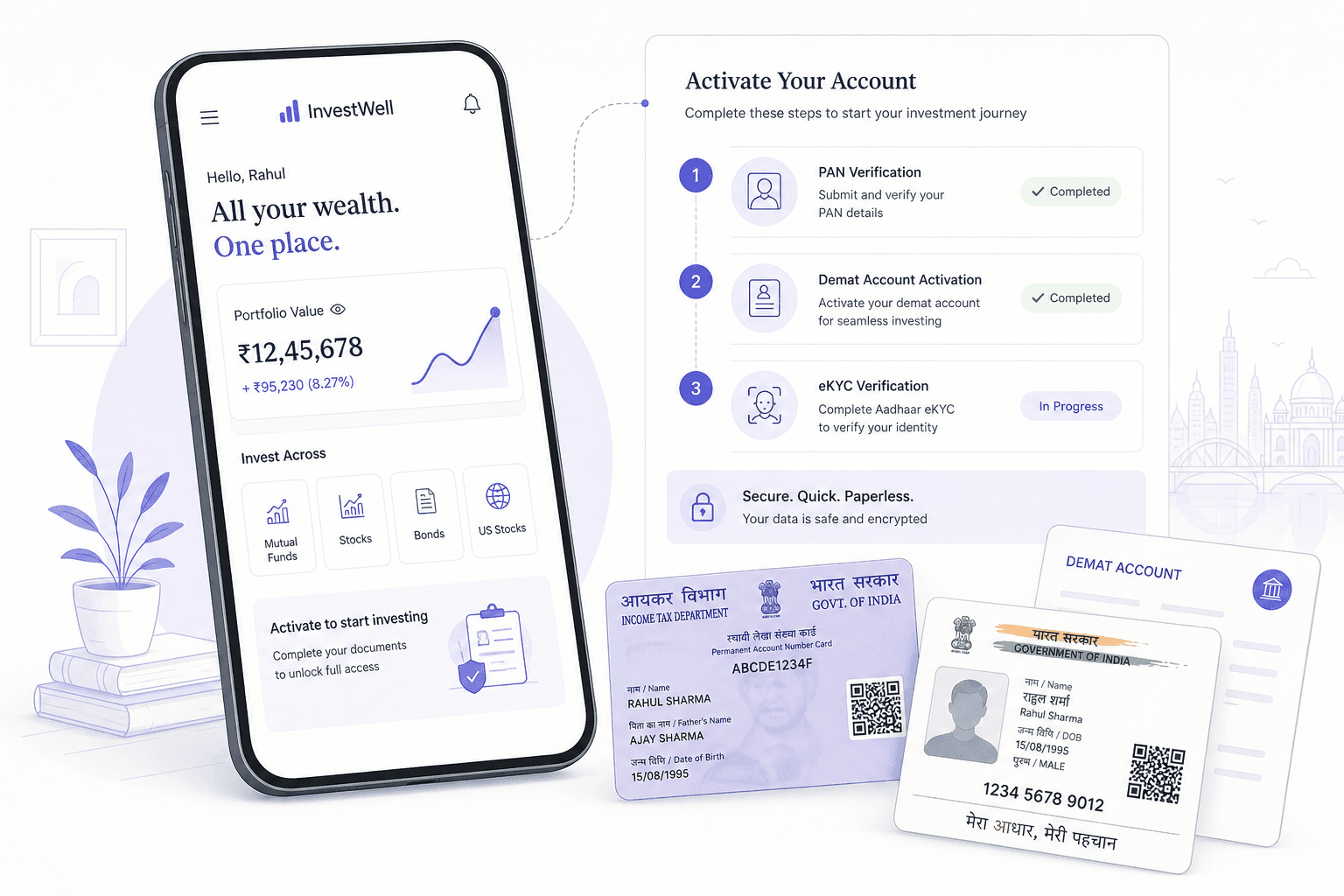
Investor onboarding collects identity documents, tax details, bank links and a face check. In many markets the face check is a selfie or a short video session with a staff member, sometimes called in-person verification. Its purpose is to confirm that the applicant is a live, real person and the same one who owns the documents.
A deepfake can defeat that purpose. A real-time face-swap lets an operator sit in front of the camera while the screen shows the document owner. A pre-generated clip can answer a scripted prompt. The agent on the call sees a plausible person, and the recording is filed as proof.
Submit identity and tax details → Document and bank checks → Selfie or video session → Compliance approval
The video step proves presence, but nothing in the file proves the face was genuine.
A brokerage account gives access to funds movement, margin and, for fraudsters, a place to launder or manipulate. Account takeover and mule use are also common. Deepfake-enabled impersonation is a topic of rising regulatory attention; see the FinCEN Deepfake Fraud Alert.
Threats
These are attack patterns, not claims about any specific firm.
An operator masks their face with the document owner's in real time while answering the agent's questions.
A synthetic video played through a virtual camera satisfies the capture prompt.
Accounts are opened with fake faces to route funds or hide the true beneficial owner.
After taking over credentials, the attacker passes a face re-check with manipulated media.
A fabricated person with a generated face opens accounts to build history or layer funds.
A deepfake of a known wealth client is used to authorise changes or large transfers.
See brokerage new account opening review and brokerage account takeover response for the operational side.
Where NeuroVerify fits
NeuroVerify takes the selfie or video your onboarding already captures and returns an authenticity result before your compliance team or automated policy approves the account.
Document and bank checks → Selfie or video session → NeuroVerify risk score → Compliance approval
The reviewer sees the score and evidence alongside the usual file.
Six signals run in one request: Visual Safety Screening, Live Presence Verification, Face Manipulation Detection, AI Generative Model Analysis, AI Pixel-Level Manipulation and AI Content Compliance. NeuroVerify handles faces in images, video and audio. It does not inspect documents.
Firms with strict data rules can deploy in a private cloud, secure container or on premises. See deployment and financial services.
Pass the media your investor-verification step already records to the API or SDK.
Get one score and signal-level evidence for the face in the media.
Approve, escalate to a compliance analyst, or decline, under your rules.
Retain the result with the onboarding record for later review.
What you get
Detects face-swap and generated media that a human agent may not catch.
Flags manipulated faces before funds can move.
Signal-level results show why an account was approved or held.
Use it on a selfie in seconds, or on recorded session media in a review queue.
Private cloud, on-premises and air-gapped options.
Questions
Yes. NeuroVerify accepts video and audio as well as images, so you can analyse recordings from sessions you already store, either as part of onboarding or later in a review.
Yes, wherever a face or voice check is used to re-verify a customer, such as a password reset or a high-value change. Call it at those points the same way. The account recovery use case covers this pattern.
Not for this purpose. Live Presence Verification is one of the six signals NeuroVerify runs in a single request, alongside Face Manipulation Detection, AI Generative Model Analysis, AI Pixel-Level Manipulation, Visual Safety Screening and AI Content Compliance. It checks selfie, video and audio from investor onboarding for deepfakes and manipulation beyond liveness.
If you already run a liveness vendor, keep it during evaluation and compare outcomes on your own media before deciding what to retire. The difference is explained in Deepfake Detection vs Liveness Detection.
It fits the capture step you already run, so the end user sees nothing new. You send the media you already collect to one API call. Native mobile SDKs (Android/Kotlin, iOS/Swift, Flutter), backend SDKs (Python, TypeScript/Node.js, Go, Java) and a REST API are available, and an MCP server covers AI agents.
Two lines to integrate and live in under 24 hours are product claims. Your own timeline depends on how your investor onboarding stack is wired.
NeuroVerify returns in under 200 ms at p95 on eligible image requests under defined test conditions. The methodology is available on request. Video and audio take longer than a single image, so decide with your team which step runs inline and which runs in the background.
You choose the deployment model: managed cloud API, private cloud or customer VPC, secure container, on-premises, or air-gapped. Neural Defend holds ISO/IEC 27001, ISO/IEC 27701, ISO/IEC 42001 and SOC 2 Type II certifications. Your legal team decides consent, retention and residency for the media you send.
Details are on the deployment and product data handling pages. For the privacy angle, see GDPR, Biometrics, and Authenticity Analysis.
Yes, and that is the test that matters. On the public VendorBench-100 benchmark, NeuroVerify ranked first of 36 systems with a detection score (MCC) of 0.876 against 0.646 for the next-best vendor. A benchmark does not reflect your devices, lighting, compression or attack mix, so bring representative samples from your own journey.
Contact us to set up an evaluation.
NeuroVerify returns one unified risk score with signal-level evidence. It does not approve or reject anyone. Your policy sets the thresholds and decides what happens at each level: continue, step up to a manual review, or decline.
The signal-level evidence tells a reviewer why a case scored high, which makes review queues faster and decisions easier to explain later.
Evaluate NeuroVerify
Send samples of your own onboarding selfies and session videos and review the risk scores and evidence. Contact us to plan an evaluation.